

Introduction
Why Real Diamonds Are Worth Getting Right
When shopping for jewelry real diamonds, the difference between a genuine stone and a convincing fake can be thousands of dollars — and a lifetime of regret.
Here's what makes a diamond "real" and worth buying:
| Feature | What to Look For |
|---|---|
| Stone type | Natural mined diamond or lab-grown diamond (both are real) |
| Certification | GIA or IGI grading report |
| Metal hallmark | 14K, 18K, PT (platinum), or 10K stamps on the setting |
| Clarity grade | VS2 or SI1 for eye-clean stones at a fair price |
| Color grade | D–J range; G–H is the sweet spot for value |
| What to avoid | Cubic zirconia, moissanite, or unstamped mystery metals |
Real diamonds are made of pure carbon and are the hardest natural substance on earth. Lab-grown diamonds share that same chemical structure. Simulants like cubic zirconia and moissanite look similar but are entirely different materials — and they behave differently over time.
The stakes are high. High-end diamond jewelry products can range in price from $500 to over $25,000. Knowing what you're actually buying matters.
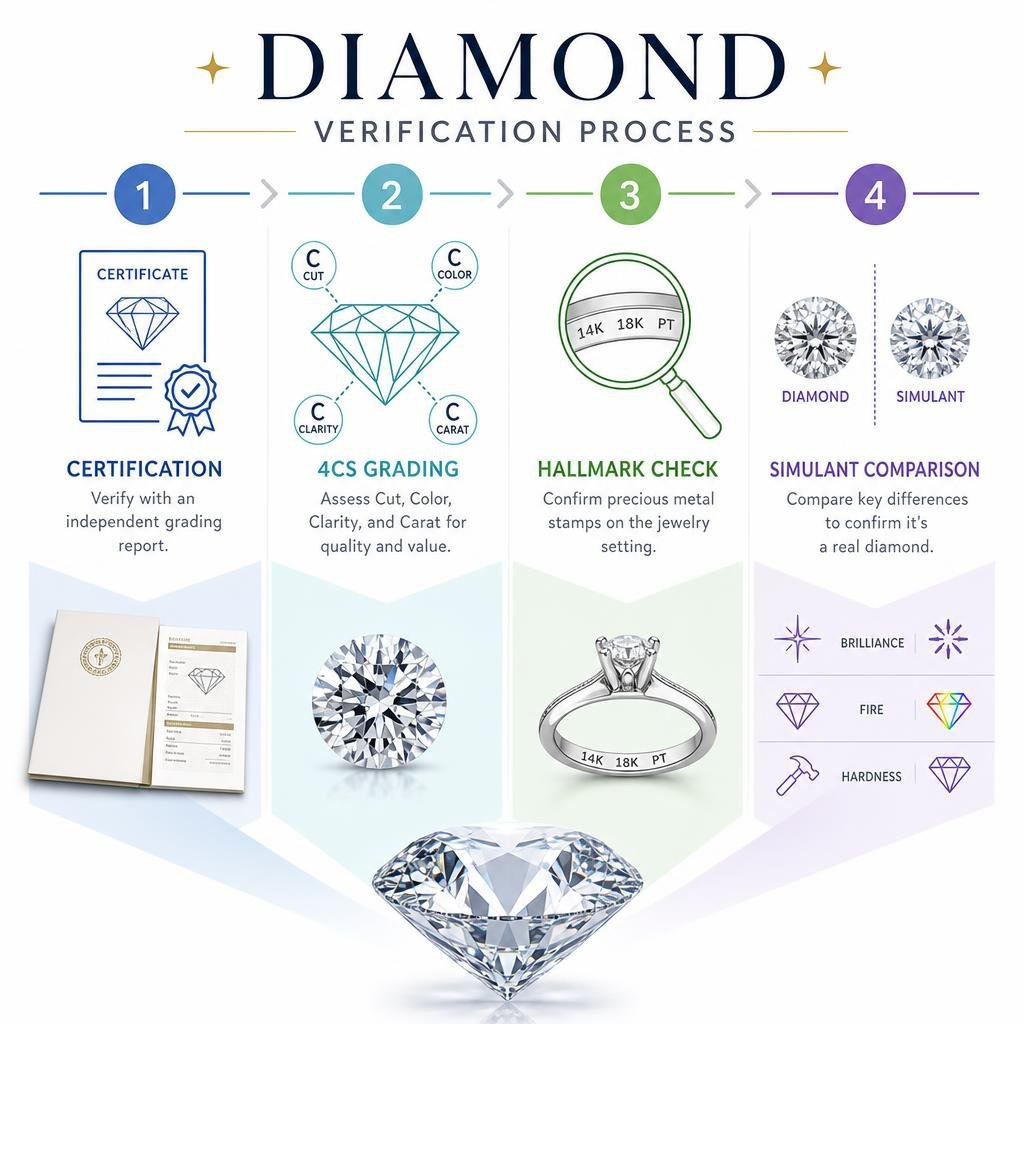
Essential Guide to Buying Jewelry Real Diamonds
Navigating the sparkling world of fine jewelry can feel overwhelming, especially with so many terms thrown around. To make an informed purchase, it helps to understand what actually constitutes a real diamond and how to evaluate its long-term worth. Whether you are looking for a timeless heirloom or a stunning modern piece, having a solid foundational knowledge is key. For a deep dive into everything from history to care, check out our Diamonds Complete Guide 2026.
When we talk about real diamonds today, we are referring to two distinct categories: natural diamonds and lab-grown diamonds. Both are chemically, physically, and optically identical. They are both made of crystallized carbon, score a perfect 10 on the Mohs hardness scale, and exhibit the signature brilliance that has captivated humanity for centuries.
However, they differ significantly in their origin, pricing, and long-term value retention:
- Natural Diamonds: Created deep within the Earth over billions of years under immense heat and pressure, natural diamonds are rare geological treasures. Because of their finite supply, they retain a higher percentage of their resale value over time. For those who value natural rarity and a connection to ancient Earth history, natural diamonds represent the ultimate traditional luxury.
- Lab-Grown Diamonds: Grown in highly controlled laboratory environments using advanced technological processes, such as Chemical Vapor Deposition or High Pressure High Temperature, lab-grown diamonds offer the exact same sparkle and durability at a fraction of the cost - often up to 80% less than natural stones. If you want to maximize your budget and get a larger stone for your money, exploring lab-grown diamond jewelry is an excellent, modern path.
Beyond the physical properties, ethical sourcing is a major consideration for modern buyers. Responsible jewelers ensure their natural diamonds are conflict-free by adhering to the Kimberley Process, sourcing from ethical mining regions like Canada, or utilizing blockchain ledgers to track a stone's journey from the mine to the finger. Additionally, many brands have completely excluded Russian-sourced diamonds from their supply chains since early 2022 to maintain strict ethical standards.
Understanding the 4Cs of Jewelry Real Diamonds
Every real diamond is evaluated and priced based on four globally accepted standards: Cut, Color, Clarity, and Carat Weight. Known collectively as the 4Cs, these factors dictate how much a diamond sparkles and how much it will cost. To master these concepts before you buy, read our dedicated breakdown on the Four Cs Of Diamonds.
Here is what the 4Cs mean for the average buyer looking to maximize both beauty and budget:
- Cut: This is the most crucial "C" because it directly impacts how light reflects through the stone. A diamond with an "Excellent" or "Ideal" cut will dance with light, masking minor imperfections in color or clarity. If you must compromise on any of the Cs, never let it be the cut!
- Color: Graded on a scale from D, completely colorless, to Z, light yellow or brown. While D-F grades command a heavy premium, the "near-colorless" range of G or H is the ultimate sweet spot. To the naked eye, a G or H color diamond set in white gold or platinum looks completely white, but costs significantly less than a colorless stone.
- Clarity: This measures the internal "inclusions" or external "blemishes" in a diamond. The scale ranges from Flawless, or FL, to Included, or I3. For the best value, look for VS2 or SI1 clarity. These grades contain microscopic inclusions that are invisible to the naked eye - often referred to as "eye-clean" - allowing you to avoid paying for flawless grades that look identical without magnification.
- Carat Weight: This measures the physical weight of the diamond, not its physical size. Because larger diamonds are rarer, the price climbs exponentially as carat weight increases. A single 1.0-carat diamond will cost significantly more than two 0.50-carat diamonds of equal quality.
How Professional Certifications Verify Jewelry Real Diamonds
How do you know that the diamond you are purchasing actually matches the quality claimed by the seller? The answer lies in independent, third-party gemological certifications.
The most respected grading authority in the world is the Gemological Institute of America (GIA). A GIA grading report provides an unbiased, scientific analysis of a diamond's 4Cs, polish, symmetry, and fluorescence. Because GIA standards are incredibly strict, a GIA certificate is considered the gold standard of authenticity.
Another reputable laboratory, particularly popular in the lab-grown market, is the International Gemological Institute (IGI). IGI certifies lab-grown and natural stones using the same rigorous criteria, offering peace of mind to buyers looking at modern options.
To guarantee that your certificate matches your physical stone, certified diamonds feature a microscopic laser inscription on the outer edge, known as the girdle. This unique serial number can only be seen under 10x magnification and acts as a permanent, unalterable digital passport for your jewelry. Always ask your jeweler to show you this inscription under a loupe to verify your purchase.
How to Spot a Fake: At-Home and Visual Tests
Before taking your jewelry to a professional appraiser, there are several reliable at-home visual tests you can perform to rule out obvious glass, cubic zirconia, or basic simulants.
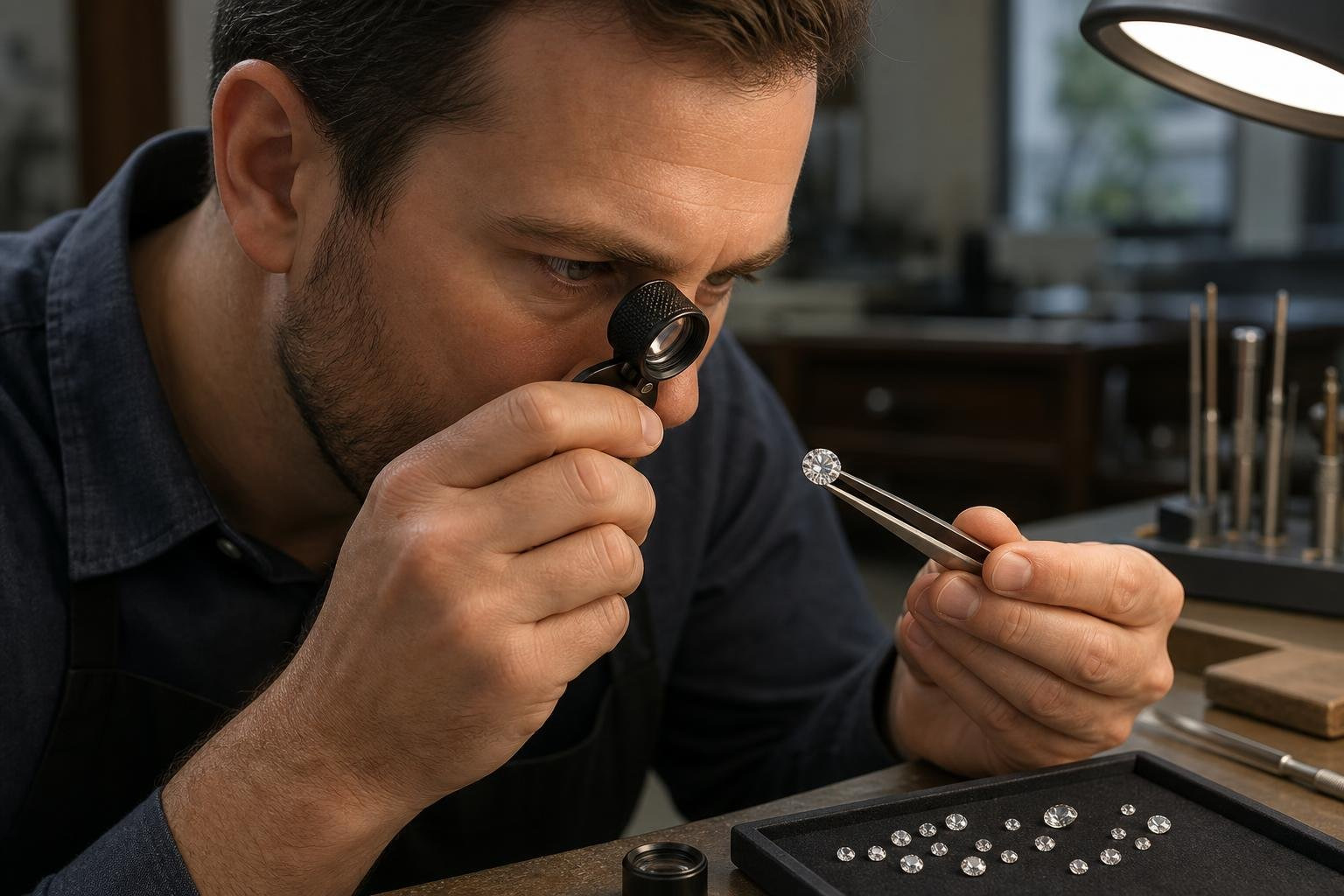
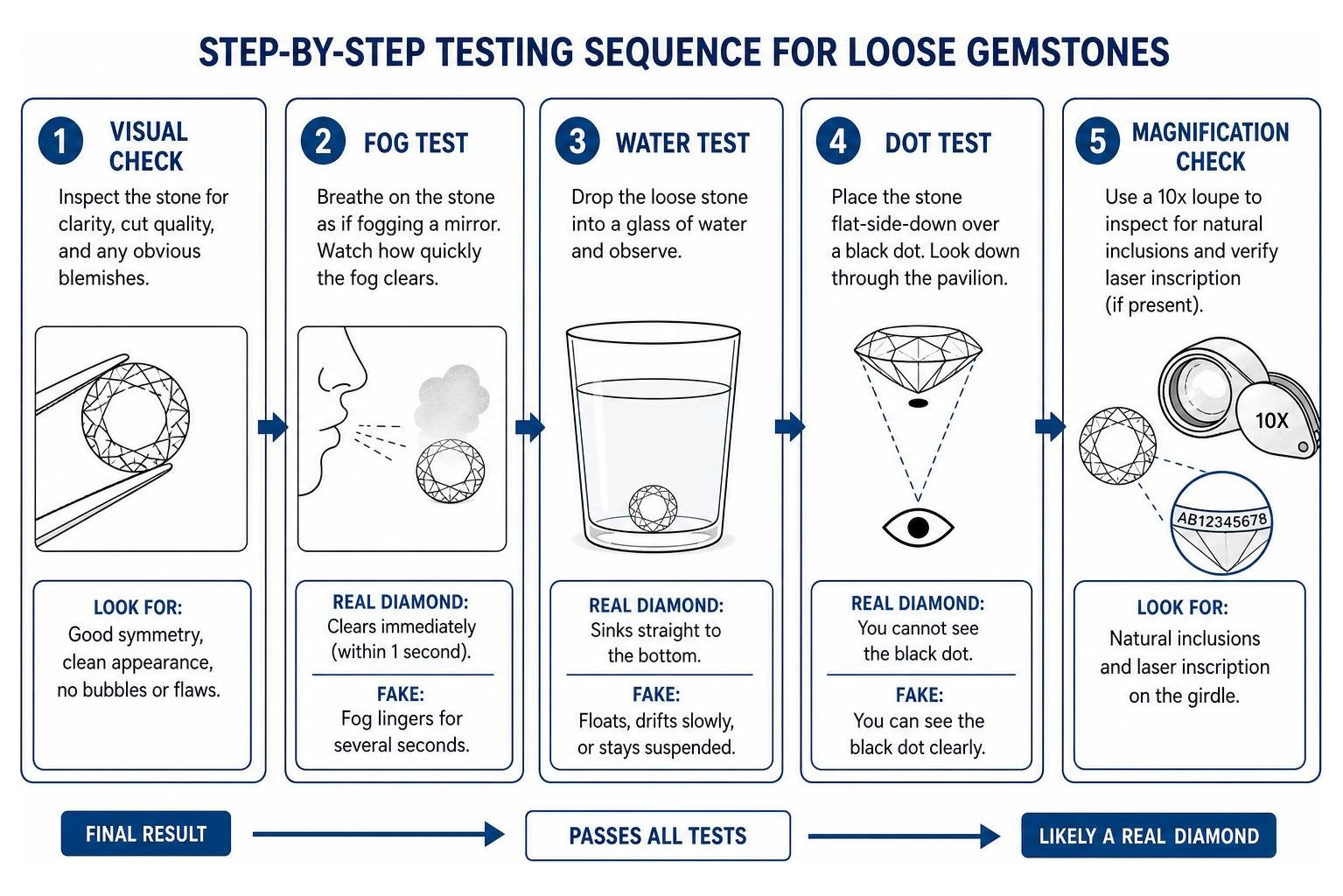
- The Fog Test: Because diamonds are highly efficient thermal conductors, they disperse heat almost instantly. Breathe on the stone as if you were fogging up a mirror. If the condensation clears immediately (within one second), it is likely a real diamond. If the fog lingers for several seconds, you are likely looking at a simulant like glass or cubic zirconia.
- The Water Test: Diamonds are incredibly dense. Drop a loose, unmounted stone into a glass of water. A real diamond will sink straight to the bottom immediately. If the stone floats, drifts slowly, or stays suspended in the middle of the glass, it is a fake.
- The Dot Test: Draw a small black dot on a piece of white paper. Place your loose stone flat-side-down directly over the dot. Look straight down through the pointed end (the pavilion). Because of a diamond's high refractive index, the light will bend so that you will not be able to see the dot. If you can see the black dot clearly through the stone, it is a fake.
To help visualize how these tests work step-by-step, refer to this diagnostic sequence:
Here is a quick reference table comparing the physical properties of real diamonds to their most common lookalikes:
| Material | Sparkle Style | Thermal Conductivity | Water Reaction | Mohs Hardness |
|---|---|---|---|---|
| Real Diamond | Balanced white brilliance & subtle fire | Extremely High (passes fog test) | Sinks instantly | 10 |
| Moissanite | Intense, colorful "rainbow" flashes | High (may pass thermal testers) | Sinks instantly | 9.25 |
| Cubic Zirconia | Moderate, glassy reflections | Low (fails fog test) | Sinks (but weighs more than diamond) | 8–8.5 |
| Glass | Dull, flat reflections | Extremely Low (fails fog test) | May drift or float | 5.5 |
Visual Differences: Real Diamonds vs. Simulants
If you are examining a mounted stone where water or dot tests are not possible, you can still spot key visual differences by looking closely at the stone’s light performance and physical wear.
Cubic zirconia (CZ) is a synthetic material that is far softer than a diamond. Over time, a CZ stone will accumulate tiny scratches on its facet edges, making them look rounded and dull under a magnifying glass. Real diamonds, being incredibly hard, will maintain razor-sharp, crisp facet edges even after decades of wear. Additionally, cubic zirconia is much denser than diamond; a CZ stone of the exact same physical dimensions will weigh about 1.7 times more than a real diamond.
Moissanite, on the other hand, is a gorgeous gemstone that was originally discovered in a meteor crater. However, it behaves very differently under light. Moissanite has a higher refractive index than diamond, meaning it displays double refraction. When you look through the side of a moissanite stone, the facet lines may appear doubled. It also exhibits an intense, colorful "rainbow fire" under direct sunlight, which can look overly flashy compared to the balanced, white-light brilliance and deep contrast of a real diamond.
Popular Styles of Diamond Jewelry and Settings
When purchasing jewelry real diamonds, the setting and the metal are just as important as the stone itself. The setting secures your investment, while the metal alloy dictates the durability and overall aesthetic of the piece.
Always look for official quality hallmarks stamped inside the jewelry band or on the clasp. Common hallmarks include:
- 10K (or 417): Contains 41.7% pure gold. Highly durable, scratch-resistant, and perfect for active daily wear or men's wedding bands.
- 14K (or 585): Contains 58.5% pure gold. This is the industry standard for fine jewelry, offering a perfect balance of rich gold color and structural strength.
- 18K (or 750): Contains 75% pure gold. It offers a luxurious, warm yellow hue but is softer and more prone to scratching.
- PT (or 950): Indicates 95% pure platinum. Naturally white, hypoallergenic, and exceptionally durable.
To ensure your jewelry lasts for generations, opt for solid-cast designs rather than hollowed-out pieces. Mass-produced jewelry often hollows out the underside of rings and pendants to save on gold weight, which drastically reduces structural integrity. Solid-cast jewelry feels substantial, heavy, and can easily handle the wear and tear of daily life.
If you are looking to explore classic and budget-friendly ring designs, check out our resources on Diamond Rings For Sale Cheap and our detailed guide to Solitaire Diamond Rings.
Selecting Stud Earrings and Solitaire Pendants
Diamond stud earrings and solitaire pendants are the ultimate wardrobe staples. They are versatile, elegant, and layer beautifully with other pieces. For a comprehensive look at vintage and modern earring options, browse our Estate Diamond Earrings Guide 2026.
When shopping for a necklace, pairing a stunning Diamond Pendant With Chain is a classic choice. To get the best visual impact for your budget, keep these tips in mind:
- Setting Style: A classic four-prong setting lifts the diamond up, allowing light to enter from all sides to maximize sparkle. For a modern, secure look, a bezel setting wraps a thin metal collar around the entire diamond, protecting the edges from chipping.
- Visual Trickery: If a large solitaire is out of your budget, consider a micro-pavé cluster or a square-frame halo setting. By grouping smaller, highly brilliant diamonds closely together, the piece reads visually as a single, much larger stone from a normal viewing distance.
- Secure Backings: For daily-wear earrings, always ensure they feature secure screw-backs or heavy friction posts to prevent accidental loss.
For those planning a classic proposal, our 1 Carat Solitaire Guide 2026 offers a step-by-step roadmap to finding the perfect centerpiece stone.
Choosing Wedding Bands and Tennis Bracelets
For milestone celebrations like weddings and anniversaries, continuous-line diamond designs are incredibly popular.
- Eternity Bands: These feature a continuous loop of diamonds wrapping entirely around the band. Because the stones are set side-by-side, shared-prong settings are highly favored to minimize visible metal and maximize the "crushed ice" brilliance of the stones.
- Tennis Bracelets and Necklaces: A classic tennis bracelet features a flexible, symmetrical line of closely set diamonds. When purchasing these high-carat pieces, ensure the clasp features a double-trigger safety lock to prevent it from snagging and falling off during active use.
Frequently Asked Questions about Real Diamonds
Can all diamond rings be resized?
No. While simple solitaire rings can easily be sized up or down by a professional bench jeweler, certain styles have strict limitations. Full eternity bands, fingerprint-engraved bands, and rings with intricate side-stone detailing cannot be resized without disrupting the structural integrity of the continuous channel or risking stone loss. Always verify your exact ring size before purchasing these continuous designs.
What does eye-clean mean for clarity?
"Eye-clean" is an industry term indicating that a diamond's internal inclusions are completely invisible to the naked eye when viewed from a normal distance (about 8 to 10 inches) under standard lighting. Opting for an eye-clean SI1 or VS2 clarity diamond allows you to avoid the steep premium of flawless grades while securing a stone that looks identical to the naked eye.
How should I clean and care for my diamond jewelry?
To keep your diamonds sparkling like new, clean them gently at home using warm, mild soapy water and a very soft-bristled toothbrush to remove oils and lotion buildup. Avoid harsh chemical cleaners, jewelry dips, or intense ultrasonic cleaners if your jewelry features rhodium-plated white gold, as these can wear down the protective plating over time. Always remove your fine jewelry before swimming, exercising, or performing heavy household chores.
Conclusion
When you are ready to invest in jewelry real diamonds, partnering with a trusted, experienced jeweler makes all the difference. At Creekside Jewelers, we take pride in being the oldest continuously run watch and jewelry store in Colorado, family-owned and operating in our original Golden, CO location since 1902.
We offer personalized custom design services to bring your unique vision to life, alongside expert on-site repairs to keep your cherished heirlooms in pristine condition. Whether you are shopping for a milestone anniversary or looking for professional guidance on certified stones, we are here to help.
For more expert advice and educational resources, visit our Creekside Jewelers Education Blog or stop by our historic storefront in Golden today!