
What Are the Four C's of Diamonds — and Why Do They Matter?
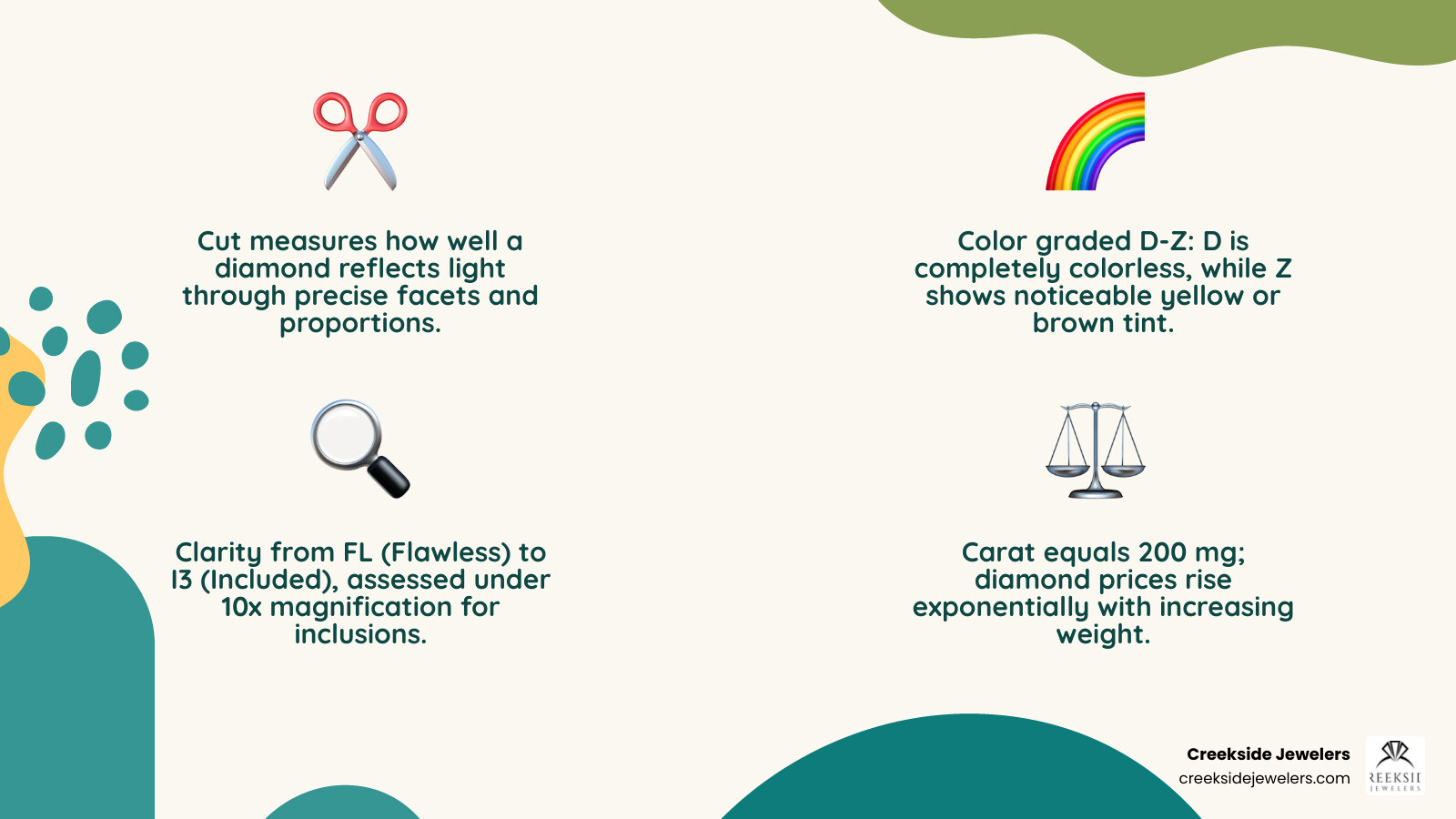
The four c's of diamonds are the four universal standards used to measure a diamond's quality and value. Before you read another word, here's the fast answer:
| C | What It Measures | Quick Tip |
|---|---|---|
| Cut | How well the diamond reflects light | Most important — never compromise here |
| Color | How colorless the diamond is (D–Z scale) | H–J is the sweet spot for value |
| Clarity | Presence of internal or external flaws | VS2–SI1 is usually eye-clean |
| Carat | The diamond's weight (1 ct = 200 mg) | Bigger isn't always better |
These four standards were developed in the 1940s by Robert M. Shipley, the founder of the Gemological Institute of America (GIA). Before that, diamond sellers used vague, inconsistent language — a colorless stone might simply be called "water," and quality was described as "with or without flaws." There was no shared language, and buyers had no reliable way to compare stones.
GIA changed everything. Their grading system gave the industry — and everyday shoppers — a consistent, objective way to evaluate any diamond, anywhere in the world.
But here's the problem: knowing the names of the four C's doesn't mean you know how to use them.
Many buyers walk into a jewelry store (or browse online) thinking a higher grade always means a better diamond. That's not always true. A diamond graded slightly lower in color or clarity can look absolutely stunning — and cost significantly less. Meanwhile, a diamond with impressive grades on paper can look dull if the cut is poor.
This guide will show you exactly how each C works, how they interact, and where the real value lies — so you can make a confident, informed choice.
The Master Key: Why Cut is the Most Important of the Four C's of Diamonds
If you take only one piece of advice from us today, let it be this: Cut is king. While many people focus on how big a diamond is (carat) or how clear it is (clarity), the cut is what actually makes a diamond look like a diamond.
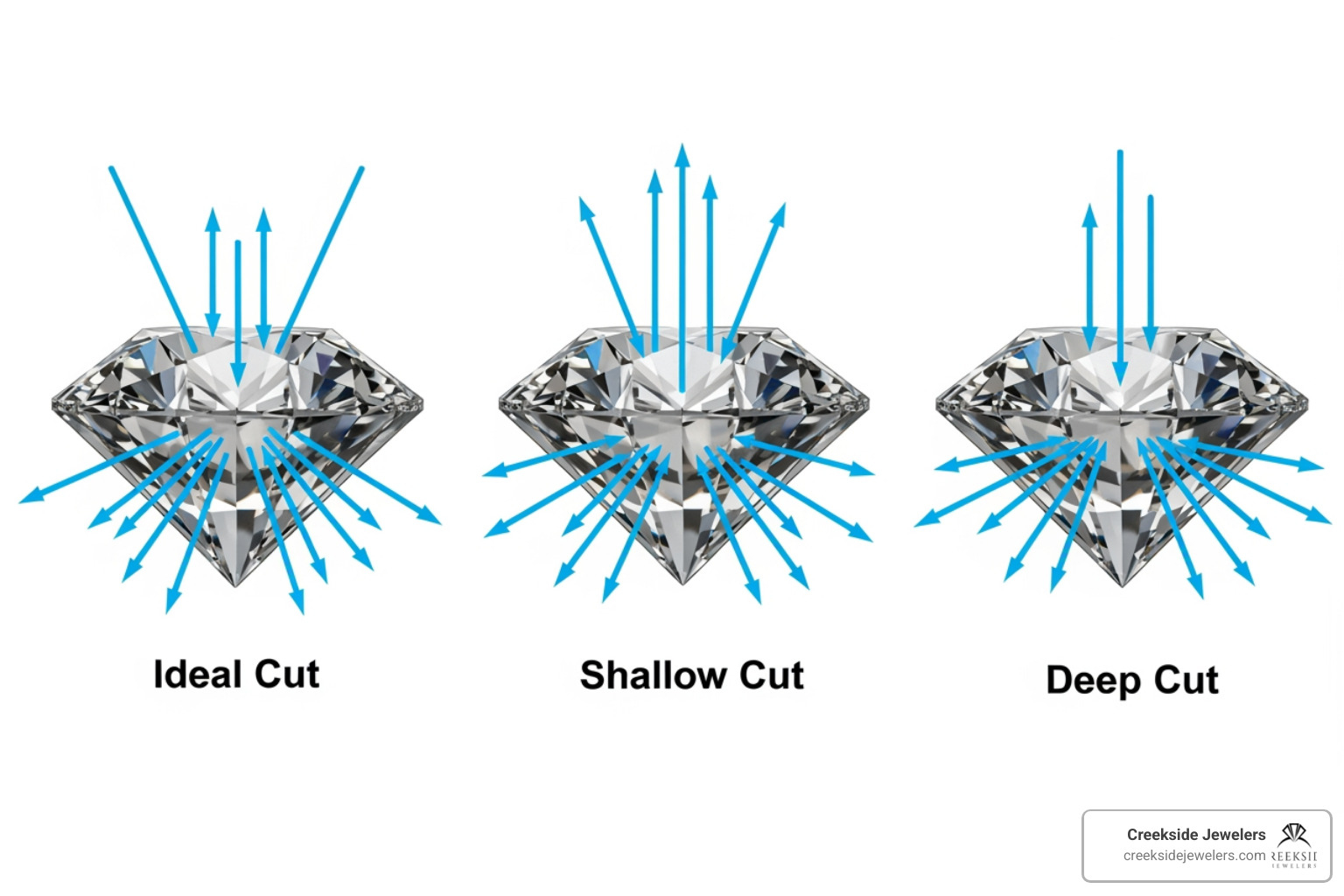
Cut doesn't refer to the shape (like a heart or an oval), but rather to how well a diamond's facets interact with light. When a diamond is cut with the right proportions, light enters through the top, bounces off the internal facets, and reflects back to your eye in a spectacular display of brilliance.
There are three main components to a diamond's "sparkle":
- Brilliance: The total light reflected from a diamond (the white light).
- Fire: The dispersion of light into the colors of the spectrum (the flashes of rainbow color).
- Scintillation: The pattern of light and dark areas and the flashes of light, or sparkle, when a diamond is moved.
If a diamond is cut too shallow, light leaks out the bottom. If it's cut too deep, light escapes through the sides. In both cases, the diamond will look "dead" or dull, regardless of how expensive the other C's were. This is why we always recommend prioritizing an "Excellent" or "Ideal" cut grade. You can learn more about how these techniques have changed over time in our guide on Exploring The 4 Cs And The Evolution Of Diamond Cuts.
Diamond Cut vs. Diamond Shape: Knowing the Difference
It is a common mistake to use the terms "cut" and "shape" interchangeably. In the four c's of diamonds, they mean very different things.
- Shape refers to the outward geometric appearance of the diamond. The most famous is the round brilliant, but you also have "fancy shapes" like the princess, emerald, oval, marquise, and pear.
- Cut refers to the quality of the workmanship. It is the symmetry, polish, and proportions of those shapes.
For instance, you can have two round diamonds that look identical in shape, but one might be an "Excellent" cut while the other is "Fair." The Excellent cut will dance with light, while the Fair cut might look like a piece of glass. If you're wondering which specific shape offers the most light return, check out our breakdown of Which Diamond Cut Sparkles The Most. According to GIA standards, the round brilliant is the only shape with a standard cut grading scale, as its 57 or 58 facets are designed specifically for maximum light return.
The Impact of Cut on the Four C's of Diamonds Value
Cut is the only one of the four c's of diamonds that is directly influenced by human skill rather than nature. A master cutter has to make a difficult choice: do they cut the diamond to be as large as possible (keeping more weight for a higher carat count), or do they cut it for beauty (removing more material to get the proportions perfect)?
Sadly, many diamonds are cut "heavy" to hit certain carat milestones, which results in light leakage and a smaller visual appearance. A well-cut 0.90-carat diamond can actually look larger and more vibrant than a poorly cut 1.00-carat diamond because the light is reflecting off the top surface rather than getting lost in the "dark spots" of a deep cut. While premium cut grades command higher prices, they are the best investment you can make for the diamond's overall beauty.
Decoding Color and Clarity: Finding the Value "Sweet Spot"
Nature isn't perfect, and most diamonds aren't either. Most diamonds contain tiny traces of nitrogen (which creates a yellow tint) or microscopic "birthmarks" called inclusions. The key to being a savvy buyer is finding the "sweet spot" where the diamond looks perfect to the naked eye, even if it isn't technically "flawless" on a lab report.
Navigating the Four C's of Diamonds Color Scale
The GIA color scale for colorless diamonds ranges from D (colorless) to Z (light yellow or brown).
- D-F (Colorless): These are the rarest and most expensive. They are chemically pure and look like a drop of clear water.
- G-J (Near-Colorless): This is where the value lives. To the untrained eye, especially once set in a ring, these diamonds look white.
- K-M (Faint): These have a noticeable warm or yellow tint.
One of our favorite "insider" tips is to match your diamond color to the metal of your setting. If you are choosing a platinum or white gold setting, you'll want a diamond in the D-H range to ensure it looks crisp. However, if you love yellow gold or rose gold, you can easily go down to an I or J (or even a K). The yellow metal actually masks the slight warmth in the diamond, making it look whiter than it would against a silver-colored background.
Understanding Clarity Grades from FL to I3
Clarity measures the "purity" of the diamond. Inclusions are internal (like tiny crystals or clouds), while blemishes are external (like scratches). The scale runs from Flawless (FL) to Included (I3).
| Grade | Description | Recommendation |
|---|---|---|
| FL / IF | Flawless / Internally Flawless | Extremely rare; you're paying for rarity, not a visual difference. |
| VVS1 / VVS2 | Very, Very Slightly Included | Inclusions are difficult for even a pro to see under 10x magnification. |
| VS1 / VS2 | Very Slightly Included | The Sweet Spot. Great balance of beauty and price. |
| SI1 / SI2 | Slightly Included | Inclusions are visible under 10x magnification but usually invisible to the eye. |
| I1 / I2 / I3 | Included | Inclusions are often visible to the naked eye and can affect sparkle or durability. |
As noted by Investopedia, a diamond doesn't have to be Flawless to be beautiful. Most inclusions are invisible without a jeweler's loupe. We recommend looking for "eye-clean" diamonds in the VS2 or SI1 range. This allows you to save significantly on the price without sacrificing the visual appeal of the stone.
Carat Weight vs. Visual Size: Don't Pay for What You Can't See
The most misunderstood of the four c's of diamonds is Carat. Many people assume carat refers to the size of the diamond, but it actually refers to the weight. One metric carat is exactly 200 milligrams, or about the weight of a paperclip. Each carat is divided into 100 "points" (so a 50-point diamond is 0.50 carats).
The Secret of "Under-Size" Diamonds
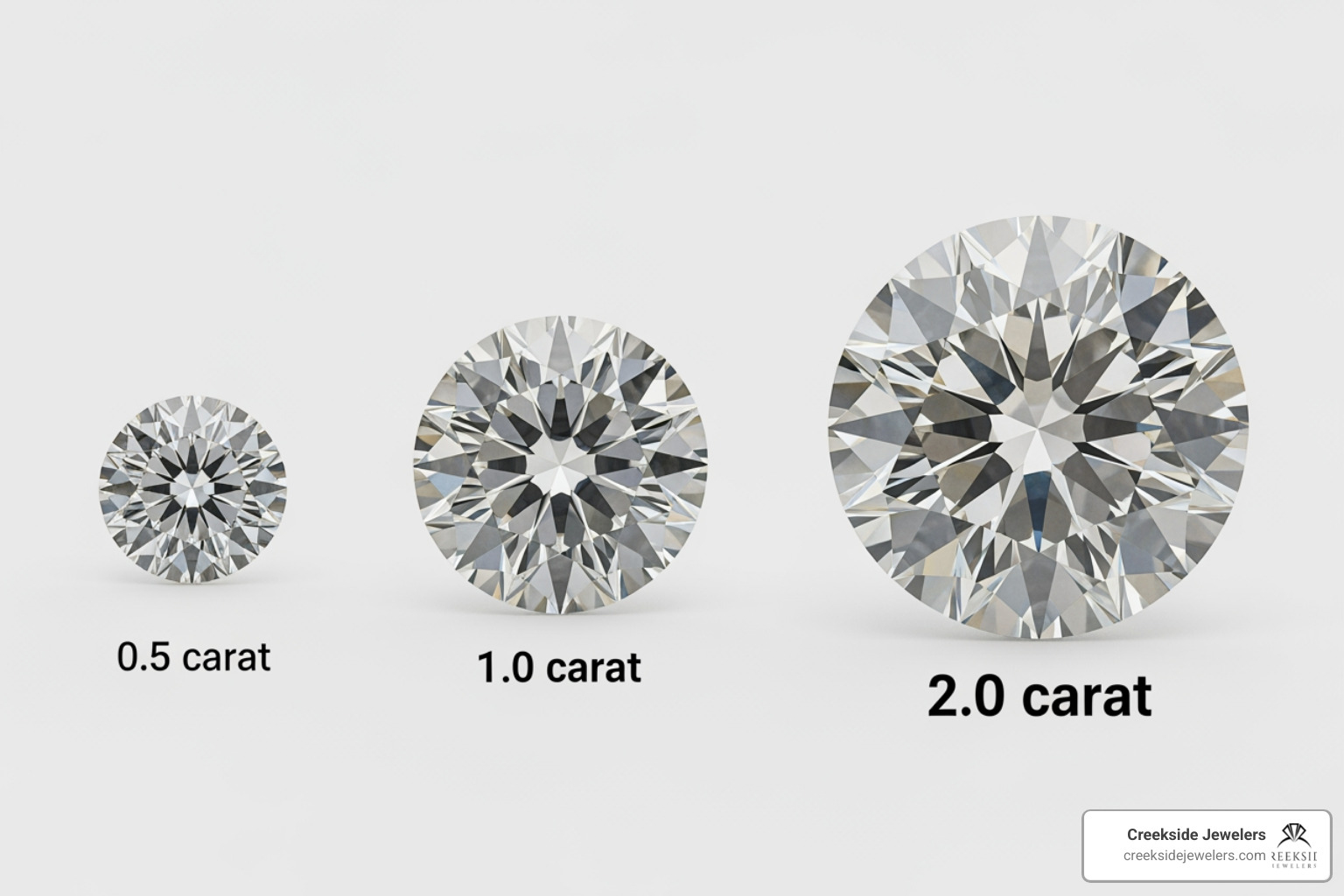
Diamond prices don't increase linearly; they jump at "magic numbers" like 0.50ct, 1.00ct, and 1.50ct. Because a 1.00-carat diamond is highly desirable, its price per carat is much higher than a 0.98-carat stone.
Here is a pro tip: look for "under-size" diamonds. A 0.90-carat diamond and a 1.00-carat diamond are virtually indistinguishable in size when looking at them from the top, but the 0.90-carat stone can be 20-30% cheaper. You are paying a massive premium for that tiny bit of weight that you can't even see! For more on how these factors influence the most expensive stones, see our article on What Is The Most Expensive Diamond Cut.
How Shape Influences Perceived Carat Size
If you want the biggest "bang for your buck," look at the diamond's shape. Because carat is weight, a diamond can hide that weight in its "belly" (the bottom portion).
Elongated shapes like the marquise, oval, and pear often have a larger surface area than a round diamond of the same carat weight. This means an oval diamond will look larger to the eye than a round diamond, even if they weigh exactly the same. This is what jewelers call "spread." By choosing a shape with a larger spread, you can get the look of a 2-carat stone while only paying for 1.7 carats.
Beyond the Basics: Lab-Grown Diamonds and the "Fifth C"
In May 2026, the diamond market is more diverse than ever. One of the biggest shifts has been the rise of lab-grown diamonds. It is important to remember that lab-grown diamonds are not fakes; they are chemically, physically, and optically identical to natural diamonds. They are even graded on the exact same four c's of diamonds scale.
The primary difference is the origin. Natural diamonds were formed billions of years ago deep within the earth, while lab diamonds are grown in a controlled environment over a few weeks. Because they are more abundant, lab-grown diamonds often cost 50-70% less than natural ones, allowing you to get a much higher-quality stone for the same budget.
The Importance of Certification and Confidence
Many experts now refer to a "Fifth C": Certification (or Confidence). A diamond's grades are only as good as the lab that issued them. At Creekside Jewelers, we strongly recommend diamonds certified by the GIA (Gemological Institute of America) or the AGS (American Gem Society).
These labs are non-profit and have the strictest, most consistent grading standards in the world. Some other labs are known for "grade inflation," where they might call a diamond "Color G" when the GIA would have called it an "I." Always ask to see the grading report before you buy. This ensures you are getting exactly what you are paying for, as Diamond Buying School emphasizes.
How Fluorescence and Settings Influence the 4Cs
There are two "hidden" factors that can change how the 4Cs look in real life:
- Fluorescence: Some diamonds glow blue under UV light (like sunlight). While "Strong Blue" fluorescence can sometimes make a diamond look hazy or oily, "Faint" or "Medium" fluorescence can actually make a slightly yellow diamond (like a J or K color) look whiter.
- Settings: As mentioned, the metal color of your ring acts as a backdrop. Furthermore, the number of prongs can affect light. A 4-prong setting allows more light to enter the sides of the diamond, potentially increasing its sparkle, while a 6-prong setting offers more security but covers more of the stone.
Frequently Asked Questions about Diamond Grading
Which of the 4Cs should I prioritize when buying?
Always prioritize Cut. A well-cut diamond will hide inclusions better and look whiter than it actually is because of the intense light return. After Cut, we recommend focusing on Color (making sure it looks white in your chosen setting), then Clarity (ensuring it is eye-clean), and finally Carat.
What is the difference between a natural and lab-grown diamond's 4Cs?
There is no difference in how they are graded. Both are evaluated for Cut, Color, Clarity, and Carat using the same scientific equipment. The only difference is the price and the "story" of the stone's origin.
How can I tell if a diamond is "eye-clean" without a loupe?
The best way is to look at the diamond in natural light (not just the bright spotlights of a jewelry store). Look at the stone from about 6 to 10 inches away. If you can't see any black spots, cracks, or cloudy areas with your naked eye, the diamond is eye-clean.
Conclusion
Understanding the four c's of diamonds is the best way to ensure you don't get fooled during your search for the perfect stone. By prioritizing cut, finding the "sweet spot" for color and clarity, and being smart about carat weight thresholds, you can find a diamond that is both breathtaking and a great value.
At Creekside Jewelers, we’ve been helping Colorado families navigate these choices since 1902. As the oldest continuously run jewelry store in the state, we pride ourselves on our family-owned expertise and our commitment to transparency. Whether you are looking for a natural earth-mined diamond, a modern lab-grown stone, or a completely custom design, our on-site experts are here to help you see beyond the paper grades.
Ready to see these standards in person? Visit us in Golden, CO, or explore more about diamond education on our website to start your journey today.