

What You Need to Know Before Buying Diamonds
Diamonds are the world's most popular gemstone — and one of the most complex purchases you'll ever make.
Before diving in, here's a quick overview of what matters most:
| Factor | What It Means | Why It Matters |
|---|---|---|
| Cut | How well the diamond is shaped and faceted | Determines brilliance and sparkle |
| Color | Graded D (colorless) to Z (light yellow) | Affects how white and bright the stone looks |
| Clarity | Presence of internal flaws or surface blemishes | Impacts visual purity and value |
| Carat | Weight of the diamond (1 carat = 200 mg) | Influences size and price significantly |
| Certification | Report from GIA, IGI, AGS, or similar lab | Verifies quality and protects your investment |
| Origin | Natural (mined) or lab-grown | Affects rarity, price, and ethics |
These six factors shape nearly every diamond buying decision — from a simple solitaire to a multi-stone heirloom piece.
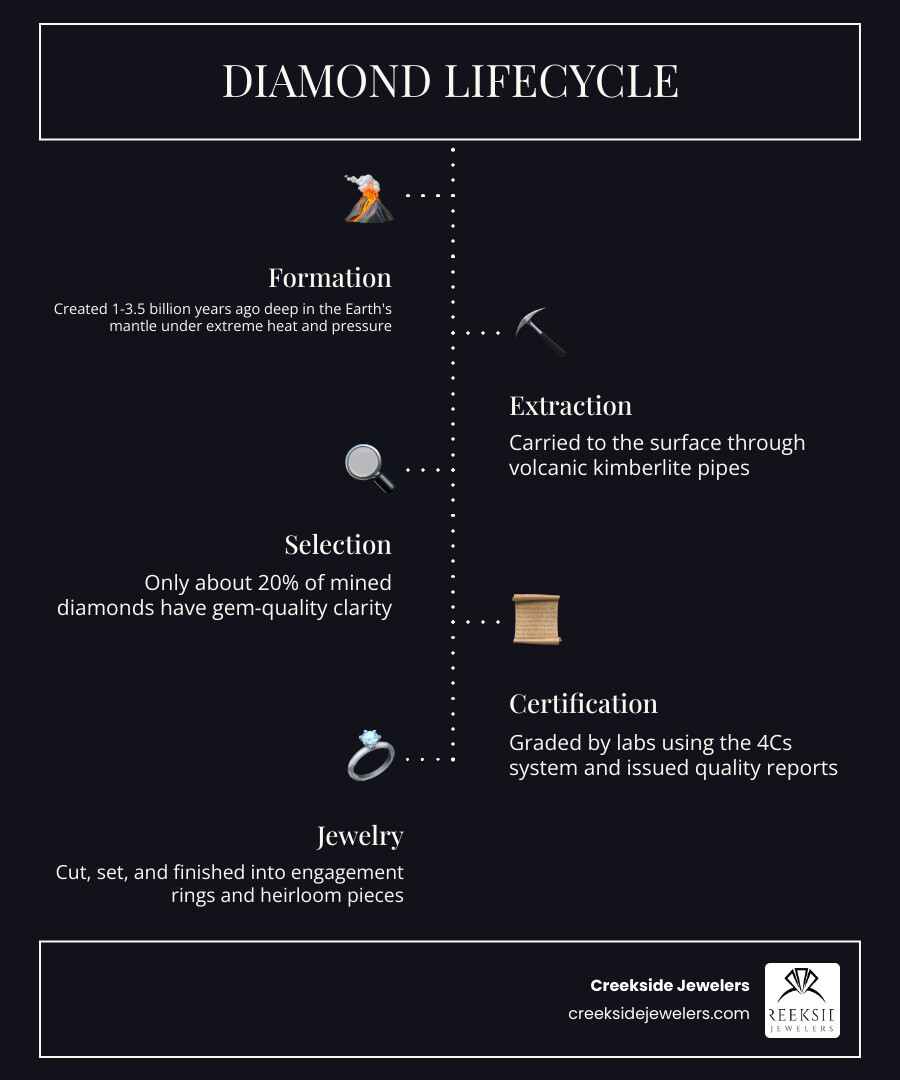
Diamonds are formed deep in the Earth's mantle, under extreme heat and pressure, most of them between 1 billion and 3.5 billion years old. They reach the surface through volcanic activity, carried up in rock formations called kimberlite pipes. Only about 20% of mined diamonds have the clarity needed for use as gemstones.
That rarity — combined with the cost of mining, cutting, and certification — is a big part of why diamonds command the prices they do.
Whether you're choosing an engagement ring, adding to a family collection, or replacing a stone in a cherished heirloom, this guide will walk you through everything you need to make a confident, informed decision.
Understanding the 4Cs of Diamonds
When you begin searching for the perfect gemstone, the first educational milestone you will encounter is the system known as the 4Cs. Developed by the Gemological Institute of America (GIA) in the mid-20th century, this system established a global language for describing and comparing the quality of diamonds.
By understanding the Four Cs of Diamonds, you can easily determine where to compromise and where to invest your budget to get the most beautiful stone possible.

How Cut and Carat Shape Diamonds
Of all the 4Cs, the Cut has the greatest impact on a diamond’s beauty. While people often confuse "cut" with the shape of the stone (such as round, oval, or pear), the technical cut grade actually refers to how effectively its facets interact with light.
A master cutter plans the angles and proportions of each facet to maximize three optical effects:
- Brilliance: The total white light reflected from both the surface and the interior of the diamond.
- Fire: The dispersion of light into flashes of rainbow colors.
- Scintillation: The sparkle produced when the diamond, the light source, or the observer moves.
GIA only assigns an official Cut grade (ranging from Excellent to Poor) to round brilliant diamonds. The classic round brilliant cut features 57 or 58 facets, designed to reflect the maximum amount of light back through the top of the stone. For an ideal light performance, gemologists look for an ideal table percentage of around 53% to 57% and an ideal depth percentage of 59% to 62.5%.
Carat weight measures the mass of the diamond, where one carat equals exactly 200 milligrams. Because larger rough crystals are significantly rarer in nature, diamond prices do not increase linearly with weight. Instead, they jump exponentially at specific weight thresholds, such as 0.50 ct, 0.75 ct, 0.90 ct, and especially the 1.00 ct mark.
Choosing "fancy shapes" (any shape other than round brilliant, such as princess, cushion, emerald, oval, radiant, marquise, or pear) can be an excellent way to maximize visual size. Oval, marquise, and pear cuts have elongated shapes that often make them look larger than a round diamond of the identical carat weight, while also offering a unique and elegant style.
Evaluating Color and Clarity in Diamonds
The remaining two Cs, Color and Clarity, describe the natural purity and structural characteristics of the gemstone.
According to the Natural Diamonds | Diamond Stone – GIA C standard, the color grading scale for white diamonds runs from D (completely colorless) to Z (light yellow or brown). As you move down the scale, the presence of sub-surface nitrogen impurities causes a subtle warm tint.
- D-F (Colorless): Highly rare and premium priced.
- G-J (Near Colorless): Excellent value; these stones appear white to the naked eye when set in jewelry, especially when paired with white gold or platinum settings.
- K-M (Faint): Show a slight warm tint, which can look incredibly charming when paired with yellow or rose gold mounting.
If a diamond has a color intensity stronger than Z, it enters the "fancy color" category. Fancy color diamonds occur in only about 1 in 10,000 stones. These can be yellow, brown, pink, green, or blue. For example, boron impurities substituting for carbon atoms in the crystal lattice create rare blue diamonds. These highly coveted gems can command astronomical prices; the famous 35.56-carat blue Wittelsbach Diamond fetched over US$24 million at auction in 2008, while a rare 5-carat vivid pink diamond sold for US$10.8 million in Hong Kong.
Clarity measures the purity of the stone, evaluating the presence of internal characteristics called "inclusions" and surface flaws called "blemishes." Inclusions might include tiny trapped crystals of other minerals, microscopic clouds, or internal feathers (small fractures). The GIA clarity scale ranges from Flawless (FL) and Internally Flawless (IF) down to Included (I1, I2, I3).
For most buyers, the sweet spot is the "eye-clean" range—typically found in the VS1, VS2, or SI1 grades—where inclusions are invisible to the naked eye and can only be seen under 10x magnification.
Natural vs. Lab-Grown Gemstones
As you explore your options, you will find that the modern jewelry market offers two distinct paths: natural diamonds and lab-grown diamonds. Both share the exact same physical, chemical, and optical properties, but they have very different origins and market dynamics.
A natural diamond is a mineral form of the element carbon with its atoms arranged in a highly rigid tetrahedral crystal structure called diamond cubic. This structure gives it the highest hardness and thermal conductivity of any natural material on Earth.
In contrast, synthetic or lab-grown diamonds are produced in controlled laboratory environments. While early synthetic production was primarily focused on industrial applications, technological advancements have made gem-quality lab-grown diamonds widely available.
Today, lab-grown options represent about 25% of the global diamond market value and around 50% of the U.S. engagement ring market by volume. They are created using two primary scientific methods:
- HPHT (High Pressure High Temperature): This process mimics the intense pressure and heat of the Earth's mantle. A carbon source is placed in a giant press with a metal catalyst and a tiny diamond seed, then subjected to temperatures over 1,400°C and pressures of nearly 60,000 atmospheres to grow the crystal.
- CVD (Chemical Vapor Deposition): In this method, a diamond seed is placed in a vacuum chamber filled with carbon-rich gas (such as methane). A microwave plasma beam breaks down the gas molecules, causing the carbon atoms to rain down and deposit onto the seed layer by layer.
To help you compare, here is a breakdown of the differences between the two:
| Feature | Natural Diamonds | Lab-Grown Diamonds |
|---|---|---|
| Chemical Composition | Pure carbon (crystalline) | Pure carbon (crystalline) |
| Crystal Structure | Cubic | Cubic |
| Mohs Hardness | 10 (hardest natural material) | 10 |
| Refractive Index | 2.418 | 2.418 |
| Age | 1 to 3.5 billion years old | Grown in weeks |
| Rarity | Highly rare; limited global supply | Virtually unlimited production |
| Market Value | High resale/inherent value | Significantly lower cost; minimal resale value |
For a deeper dive into the cultural and historical significance of these stones, you can explore the Diamond (gemstone) ) entry on Wikipedia.
Diamond Grading and Certification Labs
Whether you choose a natural or a lab-grown stone, a third-party grading report is absolutely essential. This certificate is your proof of quality, verifying that the stone is authentic and outlining its precise 4Cs measurements.
Several independent gemological laboratories evaluate diamonds:
- GIA (Gemological Institute of America): The industry's gold standard. GIA is a non-profit research institution known for its strict, consistent grading standards. A typical GIA evaluation involves 3 to 6 gemologists to ensure objectivity.
- IGI (International Gemological Institute): The largest independent grading organization globally, with major laboratories in Antwerp, New York, and across Asia. IGI is highly popular for grading lab-grown diamonds.
- AGS (American Gem Society): Highly respected for its advanced scientific approach to grading light performance and cut quality, particularly for "Ideal-Cut" round diamonds.
- GemEx: Unlike traditional labs that grade physical features, GemEx uses patented spectrophotometer technology to measure a diamond's actual light return (brilliance, fire, and sparkle), comparing it against thousands of other diamonds of the same shape.
During the grading process, most reputable labs will apply a microscopic laser inscription on the diamond's girdle. This microscopic serial number matches the grading report, allowing you to easily verify your stone's identity under 10x magnification.
Geological Origin and Ethical Sourcing
For those who love natural stones, the history of how these gems are formed and mined adds a layer of geological wonder. Natural diamonds are formed at depths of 140 to 190 kilometers in the Earth's mantle, where temperatures exceed 1,000°C. They are transported to the surface by deep-source volcanic eruptions, preserved inside volcanic rock formations known as kimberlites and lamproites.
Interestingly, our home state of Colorado has a fascinating geological connection to these precious gems. To learn more about our local geology, you can read the RockTalk: Diamonds in Colorado publication by the Colorado Geological Survey.
The Colorado-Wyoming state line is home to one of the only documented kimberlite districts in North America, which once hosted the Kelsey Lake Mine. For those interested in local scientific discoveries, the Denver Museum of Nature and Science published an excellent piece on Finding Diamonds - Denver Museum of Nature and Science , detailing the history of these deposits. You can also explore the tectonic history of these formations through the Western US Tectonics: Colorado-Wyoming diamonds - CIRES research portal.
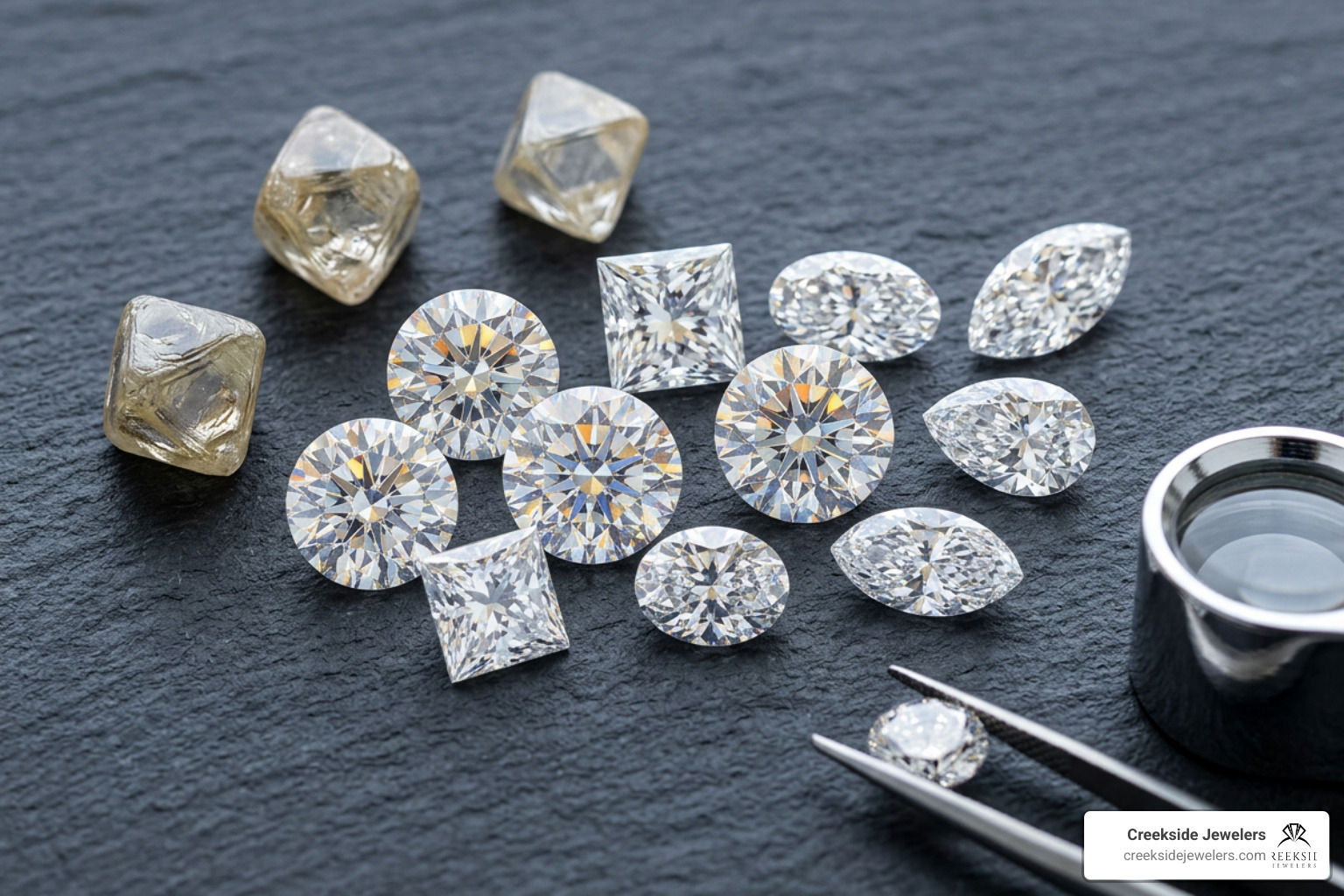
On a global scale, approximately 130 million carats of diamonds are mined annually, with a total value of nearly US$9 billion. Major producing nations include Botswana, Russia, Canada, Angola, and South Africa.
With global mining comes a deep responsibility for ethical sourcing. In the late 1990s, the jewelry industry confronted the issue of conflict diamonds (rough diamonds used by rebel movements to finance wars). This led to the creation of the Kimberley Process Certification Scheme in 2003, an international joint initiative designed to prevent conflict diamonds from entering the mainstream rough diamond market. Today, over 99% of the world's diamonds are sourced from conflict-free areas through this rigorous tracking system.
Industrial and Scientific Applications
While we cherish diamonds for their sparkle in engagement rings and fine jewelry, their unique physical properties make them invaluable to modern science and manufacturing. In fact, about 80% of all mined diamonds—along with billions of carats of industrial-grade synthetic diamonds produced annually (primarily in China)—are used for industrial purposes.
To learn more about these fascinating technical uses, you can read Diamond: A gem mineral with properties for industrial use or explore the Wikipedia article on the industrial diamond.
Because diamond is the hardest known natural substance, it is the ultimate abrasive. Industrial applications include:
- Cutting and Drilling Tools: Diamond-tipped drill bits are essential for oil and gas exploration, mining, and tunneling through solid rock.
- Precision Grinding: Diamond wheels are used to polish optical glass, cut silicon wafers for computer chips, and shape other gemstones.
- Thermal Management: Diamond has the highest thermal conductivity of any solid material. It is used as a "heat sink" in microelectronics to draw damaging heat away from high-power computer processors and lasers.
- Scientific Windows: Because of their extreme durability and optical transparency, thin diamond windows are used in high-power lasers, vacuum chambers, and x-ray machines.
Frequently Asked Questions About Diamonds
How can you tell if a diamond is real?
The absolute safest way to verify if a diamond is real is to check its independent laboratory certification (such as a GIA or IGI report) and match the laser inscription on the stone.
Because of the physical properties of the carbon mineral, professional jewelers use a specialized diamond tester to measure thermal conductivity. Since diamond conducts heat incredibly fast, a thermal tester can instantly distinguish it from common simulants like cubic zirconia or glass.
For more details on the physical properties of the mineral, you can refer to the Wikipedia article on Diamond .
Why do some diamonds exhibit fluorescence?
Between 25% and 35% of natural diamonds exhibit some degree of fluorescence when examined under invisible, long-wave ultraviolet (UV) light. This phenomenon is typically caused by microscopic trace amounts of sub-surface impurities like nitrogen within the crystal structure.
In about 95% of these cases, the diamond emits a soft blue glow. In standard lighting conditions, fluorescence is usually invisible to the naked eye and does not affect the stone's beauty. In fact, a faint or medium blue fluorescence can sometimes make a slightly warm-toned diamond (such as a J or K color grade) appear whiter and brighter by offsetting the yellow tint.
What is the best way to care for diamond jewelry?
While diamonds are exceptionally hard, they can still chip if struck at the correct angle, and their settings can wear down over time. To keep your jewelry—such as a classic Diamond Pendant with Chain—looking its best, we recommend these simple care tips:
- Clean regularly: Soak your jewelry in warm water mixed with a few drops of mild dish soap. Use a soft-bristled toothbrush to gently clean behind the stone where oil and lotion collect.
- Store safely: Store your diamond pieces in individual soft pouches or separate compartments. Because diamonds are so hard, they can easily scratch your gold, platinum, or other gemstones.
- Get professional inspections: Bring your jewelry to a professional jeweler every six months to check the security of the prongs, clean the hard-to-reach areas, and ensure your stones remain safe.
Conclusion
Choosing the perfect diamond is a beautiful journey that blends art, science, and personal history. At Creekside Jewelers, we have been helping families celebrate their most precious moments for over a century. Since 1902, we have proudly served as the oldest continuously run watch and jewelry store in Colorado, operating out of our original historic location in Golden, CO.
As a family-owned business, we specialize in high-quality natural and lab-grown diamonds, custom jewelry design, and expert on-site repairs. Whether you are searching for a brilliant engagement ring, designing a custom heirloom, or looking to restore a vintage piece, we invite you to experience our warm, pressure-free environment.
When you are ready to explore your options, you can consult resources like Jewelers With Prices in Golden, CO - The Knot to see how our heritage of trust and expertise sets us apart.
Stop by our store in historic Golden to chat with our friendly team, or Explore our educational guides to learn more about choosing the perfect jewelry for your story.