

Ring Resizing Cost Starts With the Ring's Design
Most ring resizing jobs cost less than $200, but the real price depends on three things: the metal, the number of sizes changed, and whether stones or detailed settings need extra care.
To get a useful estimate, follow these three steps:
- Identify the band metal and whether the ring must be made larger or smaller.
- Check for diamonds, pavé, channel-set stones, engraving, or other details that add labor.
- Confirm the size change with a professional measurement before approving work.
Making a ring smaller often costs less because the jeweler removes metal rather than adding matching material. A simple gold band may allow a small stretch of about a half size, while larger changes usually require cutting, adding or removing metal, soldering, finishing, and checking the setting.
A good fit should feel secure at the base of your finger, pass the knuckle with slight resistance, and not leave painful marks or spin so much that the center stone turns sideways. Since fingers can change with heat, activity, and time of day, measure more than once before resizing a valuable ring.
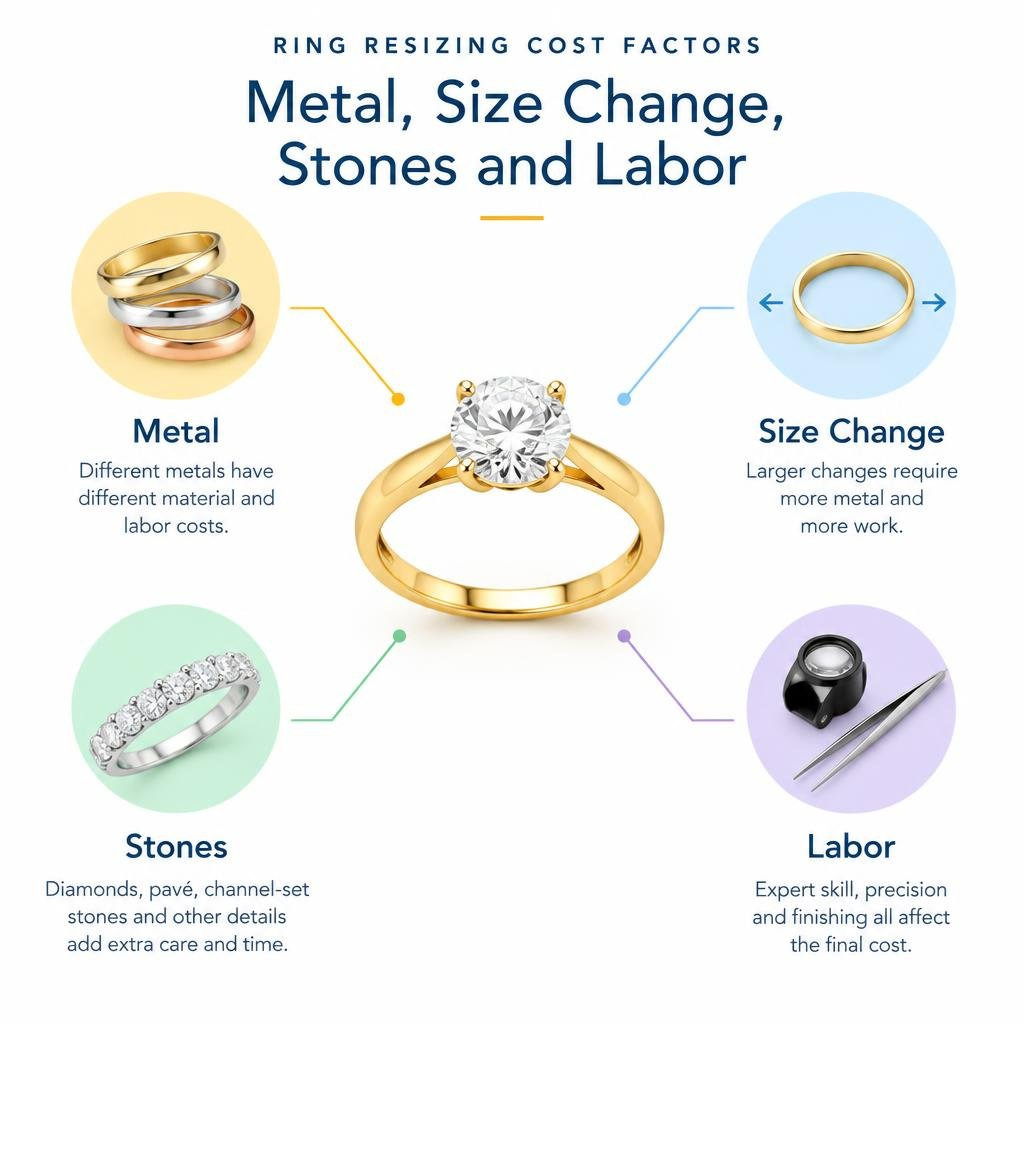
Key Factors That Determine Ring Resizing Cost in 3 Simple Steps
Calculating what you will invest in an adjustment does not have to involve guesswork. While prices vary between fine jewelry studios, professional pricing models rely on standard bench formulas that combine base labor fees, added material weight, and setting complexity surcharges.
Most independent jewelry workshops operate within a standard margin, where base lower-bound estimates run around 85% of standard modeled costs and higher-end custom shops run closer to 125% to account for master hand-finishing and specialized warranties.
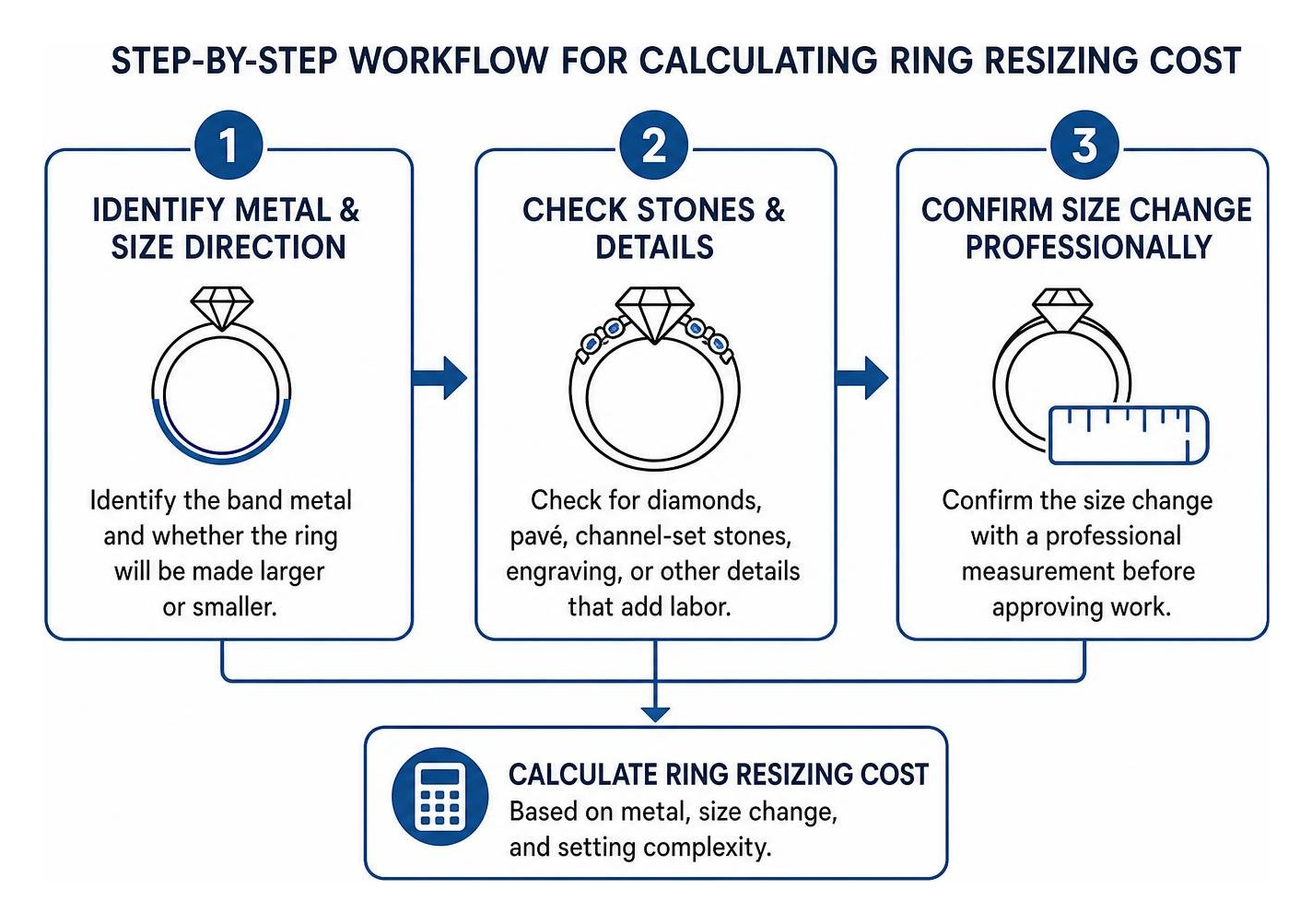
Let us break this down into three easy steps so you know exactly what goes into your quote.
Step 1: Identify Band Metal and Material Added or Removed
The first pricing variable is the precious metal alloy and whether the jeweler is adding or removing material. Making a ring smaller requires cutting out a small segment of the bottom shank and soldering the ends together. Because no new precious metal is added, downsizing costs are primarily driven by bench labor.
Making a ring larger involves adding a matching bridge of precious metal into the cut opening. The cost of that additional piece depends on:
- Metal purity and type: Sterling silver is the most accessible, standard yellow gold carries moderate material costs, while platinum demands premium pricing due to its high density and specialized working temperature.
- Band width and thickness: A wide 6mm men's wedding band requires substantially more grams of gold than a delicate 1.8mm solitaire shank.
When you need professional gold jewelry repairs, matching the exact karat (such as 14k or 18k) and color alloy ensures the seam remains invisible once polished.
Step 2: Factor in Gemstones and Setting Complexity
A plain metal band is the easiest and fastest piece to alter. As soon as gemstones enter the equation, a master jeweler must dedicate extra time to protect the stones from heat and structural shifting.
- Solitaire prongs: Classic single-stone rings are relatively straightforward, though prongs must be inspected under a microscope after resizing to ensure the diamond has not loosened.
- Pavé and side accents: When a ring band bends into a tighter or wider circle, the tiny metal beads holding accent stones can shift. Jewelers must individually tighten each accent stone.
- Channel settings: Bending a channel-set band can compress or widen the metal rails, putting pressure on diamond girdles or causing stones to overlap.
- Heat-sensitive gemstones: Opals, emeralds, pearls, and tanzanite cannot tolerate the heat of a jeweler's torch. If a laser welder cannot isolate the heat, these gems must be carefully unseated and reset after metalwork is complete.
Step 3: Estimate Labor and Sizing Scope
The final piece of the formula is the scope of technical labor required at the bench.
A minor adjustment of a quarter or half size requires minimal bending and quick finishing. In contrast, moving three full sizes up requires opening the band significantly, forging a custom metal insert, laser welding both sides, reshaping the shank on a mandrel, and performing a full clean and polish.
For white gold pieces, labor also includes electroplating the ring in rhodium to restore its bright, mirror-like finish. If you are comparing estimates across studios, exploring affordable ring alteration options can help you understand how shop equipment, bench expertise, and turnaround times affect final quotes.
Signs You Need a Resize and How to Find Your Size at Home
Fingers behave much like a favorite pair of jeans: they feel slightly looser on cold mornings and snugger on warm summer afternoons. However, a ring should never feel like a daily struggle to put on or take off.
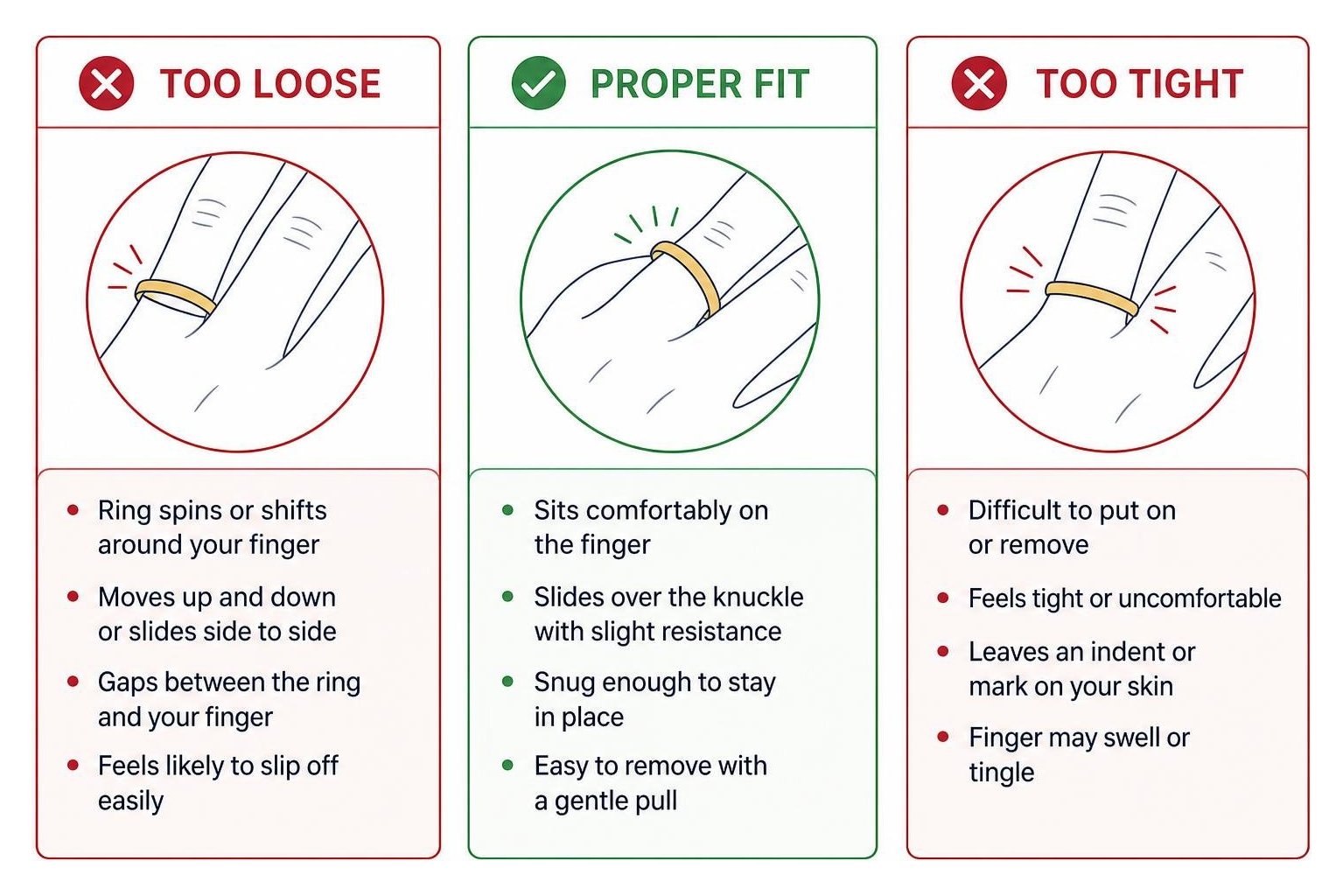
Everyday Signs Your Band Is Too Loose or Too Tight
How do you know when your jewelry needs a professional touch? Look out for these everyday indicators:
-
Signs it is too tight:
- You notice a "muffin top" bulge of skin around the band.
- Deep red indentations or tingling linger after taking the ring off.
- You need soap, lotion, or cold water every single time you remove it.
- The ring will not pass over your knuckle without painful force.
-
Signs it is too loose:
- The top center stone constantly spins sideways into your palm.
- The band slides off your finger when you wash your hands or shake your arm.
- You feel nervous wearing the ring in cool weather because it slips over the knuckle with zero resistance.
Accurate DIY Methods to Measure Your Finger
If you cannot visit a jewelry counter right away, you can find a reliable starting measurement at home using simple tools:
- Plastic Ring Sizing Belts: These inexpensive looped gauges work like a miniature belt. Slip the loop onto your finger, adjust it until it slides comfortably over the knuckle, and read the arrow.
- Paper Strip Method: Wrap a narrow strip of paper snugly around the base of your finger, mark the point of overlap with a fine pen, and measure the length in millimeters against a ruler to find your circumference.
- Printable Sizing Mandrel Charts: Place an existing ring that fits the target finger over matching circles on a 100% scale printed chart to find the inner diameter.
For precise charts and knuckle measuring techniques, explore our complete guide on accurate ring sizing. If you are shopping for a partner, learning about the average male ring size provides a helpful baseline for men's bands.
Which Styles Can and Cannot Be Altered?
Not every ring can be modified on a jeweler's bench. Whether a piece can be resized comes down to the metallurgical properties of the band and the layout of its stones.
| Ring Material / Style | Can It Be Resized? | Sizing Limitations & Notes |
|---|---|---|
| 14k / 18k Yellow & Rose Gold | Yes | Highly malleable; simple to cut, solder, and stretch. |
| White Gold | Yes | Requires rhodium plating after torch or laser work. |
| Platinum (950) | Yes | Requires high-heat torches or laser welders and platinum solder. |
| Sterling Silver (925) | Yes | Highly conductive to heat; straightforward for plain bands. |
| Full Eternity Bands | Rarely | Stones encircle the entire shank; resizing risks breaking stones or disrupting spacing. |
| Tension Settings | No | Stone is held purely by band tension; altering the circle releases the diamond. |
| Tungsten Carbide | No | Extremely hard and brittle; will shatter under cutting or stretching pressure. |
| Titanium & Cobalt Chrome | Extremely Difficult | Aircraft-grade metals require specialized industrial machines and cannot be soldered conventionally. |
| Ceramic & Resin Bands | No | Non-metallic structures crack or melt under heat and physical pressure. |
| Enamel or Plated Base Metals | No | Torch heat scorches enamel and vaporizes micro-thin decorative plating. |
Resizable Precious Metals vs. Alternative Materials
Traditional jewelry alloys like gold, platinum, and silver are prized for their ductility. A jeweler can anneal (heat treat) these metals to relax the crystal lattice, making them flexible enough to stretch, bend, cut, and fuse seamlessly.
Contemporary industrial alloys like tungsten carbide, titanium, ceramic, and stainless steel offer exceptional scratch resistance, but they cannot be resized in a traditional workshop. When these rings no longer fit, they generally need to be replaced with a newly manufactured band.
Eternity Bands, Tension Sets, and Channel Settings
Certain mounting styles present serious structural hurdles:
- Full eternity bands: Because gems cover the complete 360-degree circumference, there is no bare metal section to cut into. Adding metal creates an awkward gap in the stone pattern, while removing metal requires eliminating stones and rebuilding prong seats.
- Tension mounts: These designs suspend a diamond using spring-force pressure from the two open ends of the band. Cutting the ring releases this calibrated force, making it impossible to hold the gem securely without rebuilding the mounting.
- Intricate channel settings: If a channel ring is bent into a smaller radius, the channel walls squeeze together, pushing gemstones against each other until they chip. When sizing up, channel walls widen, leaving stones loose.
The Workshop Process, Safe Limits, and Alternatives
Curious about what happens behind the bench doors? A professional resizing is a delicate combination of metallurgy and micro-construction.
Methods Used in Professional Ring Resizing
Depending on your ring's design, bench jewelers rely on proven techniques outlined in expert techniques for resizing rings:
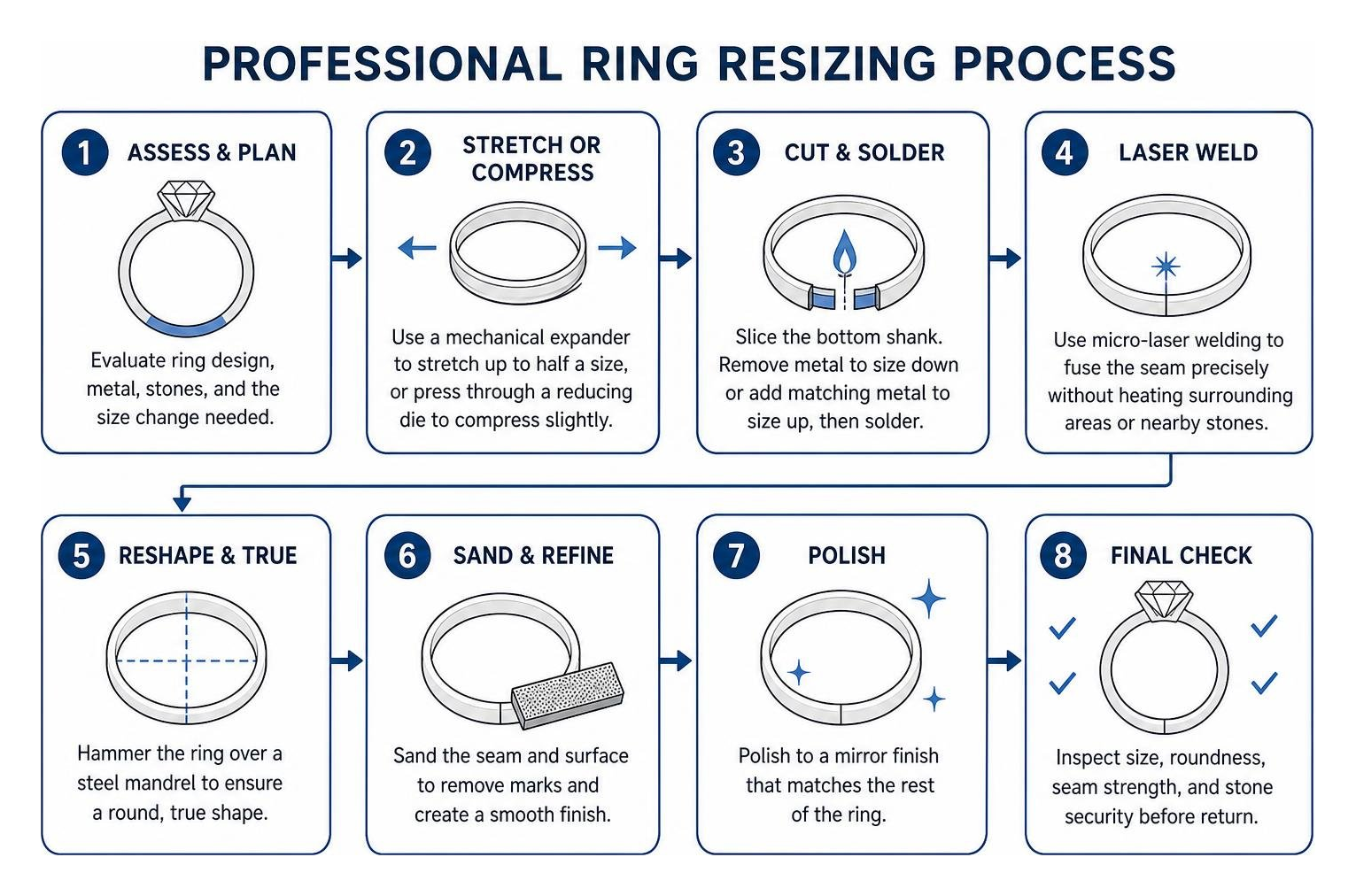
- Mechanical Stretching or Compressing: For plain wedding bands without stones, a jeweler can place the ring on a mechanical expander to stretch the metal up to a half size, or press it through a reducing die to compress it slightly.
- Cutting and Soldering: The jeweler makes a precise slice through the center of the bottom shank. For a smaller size, they clip away the excess metal and torch-solder the ends. For a larger size, they bridge the gap with a matching piece of gold or platinum wire.
- Micro-Laser Welding: Using concentrated laser energy, jewelers can fuse precious metal seams pinpointed under high-magnification microscopes without heating surrounding areas, protecting delicate gemstones nearby.
- Reshaping, Truing, and Polishing: The ring is hammered lightly over a steel mandrel to ensure a round circle, sanded to erase seam lines, and polished to a mirror finish.
Safe Limits and Risks in Diamond Ring Resizing
How far can you safely adjust a diamond ring? As a general rule, fine diamond jewelry should only be adjusted one to two full sizes up or down.
Pushing a band beyond two sizes changes its curvature significantly. Bending a shank outward flattens the crown, which can splay prongs outward and drop the center gem. Conversely, bending a band inward tilts prongs toward each other, pinching the diamond girdle. For in-depth setting safety guidelines, refer to the authoritative guide to engagement ring resizing.
Non-Permanent Alternatives: Sizing Beads and Guards
If your ring spins because you have wide knuckles and narrow finger bases, cutting the band might make it impossible to slide over the knuckle. Non-permanent adjustments offer a practical solution:
- Sizing Beads: A bench jeweler solders two small precious metal spheres on the inner bottom of the shank. They allow the ring to pass over your knuckle, then rest against the narrower finger base to keep the stone upright.
- Spring Inserts (Horseshoe Guards): A flexible, U-shaped metal band lines the lower inside shank, expanding as it passes over the knuckle and springing back into place.
- Fold-Over Sizing Bars: A hinged metal latch fitted across the bottom shank that unclips to slip on easily, then locks shut for a snug fit.
- Silicone Spiral Adjusters: Clear, medical-grade coils that wrap around the outside shank for a temporary, removable fit adjustment.
Frequently Asked Questions About Sizing Fine Jewelry
Can vintage or heirloom rings be resized safely?
Yes, but vintage rings require a thorough structural evaluation first. Decades of wear can leave the bottom shank thin, prongs brittle, or previous solder seams weak. In some antique rings, jewelers may recommend replacing the worn bottom half of the band (a process called "half-shanking") rather than simply stretching or cutting fragile metal. Before altering a valuable family piece, securing a comprehensive jewelry appraisal helps document its condition, metal composition, and gemstone specs.
How much does resizing typically cost?
Most standard sizing jobs fall between $50 and $180. A simple silver or yellow gold downsizing sits at the lower end, while upsizing wide-shank rings, platinum pieces, and pavé-set bands climbs toward $200 or more. For an exhaustive overview of pricing variables across all repair types, check out our full jewelry repair guide.
How do I choose a reputable bench jeweler?
Always look for a full-service fine jeweler who handles repairs on-site rather than shipping your valuables across the country. Ask if their workshop uses laser welding systems and whether they inspect prongs under magnification before returning your piece.
Conclusion
Finding the right fit for your favorite ring brings back the joy and peace of mind of wearing fine jewelry every day. By understanding your metal type, accounting for gemstone complexity, and verifying your accurate measurement, you can step up to the jewelry counter knowing exactly how sizing costs work.
When you are ready for a seamless fit, our master bench jewelers at Creekside Jewelers are here to help. As Colorado's oldest continuously operating jewelry and watch store—family-owned and serving our community from our original location since 1902—we complete all precision metalwork and diamond adjustments directly in our workshop. Bring your favorite piece by our showroom today for expert jewelry repair services in Golden, CO and enjoy a custom fit that lasts a lifetime.