

Average Male Ring Size: The Fast Answer Before You Buy
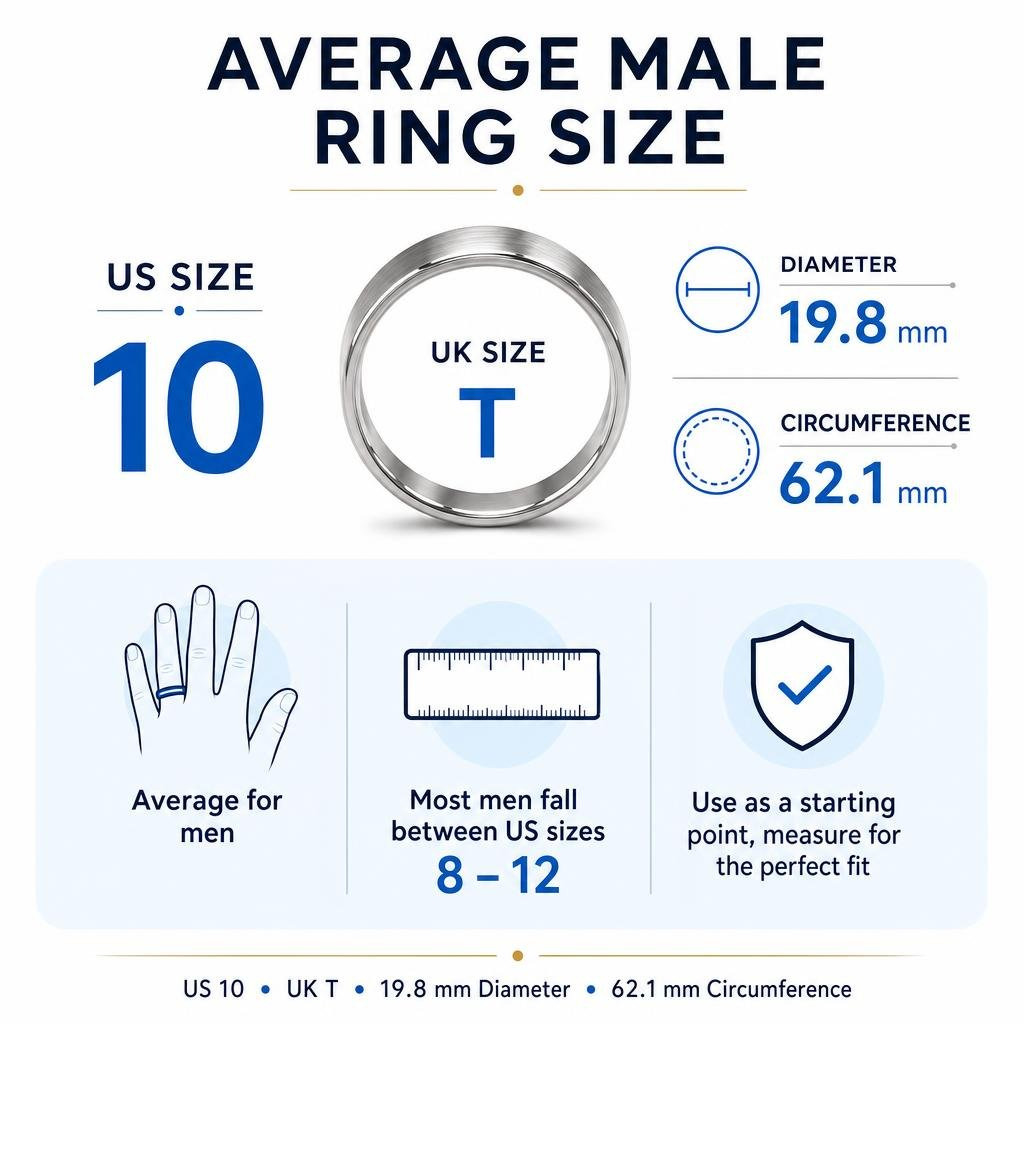
The average male ring size in the United States is size 10. In the UK, the closest average is size T, measuring about 19.8 mm across the inside or 62.1 mm around. Most men fall between US sizes 8 and 12, but an average is only a starting point.
Before buying a wedding band, signet ring, or meaningful gift, measure the specific finger and hand where it will be worn. The dominant hand is often about one-half to one full UK size larger, and an 8 mm or wider band can feel tighter than a slim 3-4 mm band.
A good fit should pass over the knuckle with slight resistance, sit comfortably at the finger's base, and not spin freely. For a surprise purchase, US size 10 or UK size T is a sensible benchmark, but a quick measurement is far more reliable for a ring meant to last.
What Is the Average Male Ring Size in the US and UK?
When browsing fine jewelry collections, you will notice that jewelers keep standard stock readily available in the most common proportions. In the United States, the average ring size for adult men is size 10. Across the Atlantic, the baseline is UK size T, which has an inner diameter of 19.8 mm and an inside circumference of 62.1 mm.
If you are planning a surprise gift, starting near this median gives you the highest mathematical probability of being close to his real fit. According to the Average Men’s Ring Size UK guide, size T remains the single most common baseline across jewelers. However, human hands come in every shape and proportion. While most men fall between a US size 8 and size 12 (UK size Q to Y), finding the exact measurement ensures every piece feels natural from the moment it is slipped on.
US vs UK Average Male Ring Size Comparisons
International jewelry sizing uses different measurement scales, but they all correspond directly to inner diameter and circumference in millimeters.
| US / North America | UK / Australia | EU / Standard Continental | Japan / East Asia | Inner Diameter (mm) | Inside Circumference (mm) |
|---|---|---|---|---|---|
| Size 8 | Q | 57 | 16 | 18.1 mm | 57.0 mm |
| Size 8.5 | Q ½ – R | 58 | 17 | 18.5 mm | 58.3 mm |
| Size 9 | R ½ – S | 59 | 18 | 19.0 mm | 59.5 mm |
| Size 9.5 | S ½ – T | 61 | 19 | 19.4 mm | 60.8 mm |
| Size 10 (US Average) | T (UK Average) | 62 | 20 | 19.8 mm | 62.1 mm |
| Size 10.5 | U – U ½ | 63 | 21 | 20.2 mm | 63.4 mm |
| Size 11 | V – V ½ | 65 | 23 | 20.6 mm | 64.6 mm |
| Size 11.5 | W – W ½ | 66 | 24 | 21.0 mm | 65.9 mm |
| Size 12 | X – Y | 68 | 25 | 21.4 mm | 67.2 mm |
Understanding these conversions makes shopping effortless, whether you are picking out mens wedding bands in Golden CO or ordering specialty vintage designs from overseas.
Sizing Variations Across Body Weight and Height
Finger dimensions correlate moderately with overall body build, bone density, and weight:
- Men under 160 lbs: Frequently wear ring sizes ranging from US 8 to 9.5 (UK Q to S½). Slender frames typically feature thinner finger pads, though prominent knuckles can still dictate a larger size.
- Men between 160 and 200 lbs: Tend to cluster right at the standard median, wearing US sizes 9.5 to 10.5 (UK S½ to U½).
- Men over 200 lbs: Often wear US sizes 10.5 to 12.5 (UK U to Z). Broad hands and heavier manual work naturally create fuller fingers.
Height alone does not dictate finger diameter. A six-foot-tall man with slender hands might wear an 8.5, while a shorter athlete with broad hands might easily wear an 11. Knuckle width relative to the finger base also matters: a tapered finger needs a snug fit so the ring does not slide off, while a prominent knuckle requires a slightly looser baseline to slide over the joint smoothly.
Men's Ring Sizes by Finger: Beyond the Ring Finger
Men wear rings on every finger, from heritage signets on the pinky to modern statement rings on the middle or index finger. Because each digit serves a different physical function, dimensions vary across the hand. For a complete look at all finger proportions, check out this Average Finger Size reference.

How Average Male Ring Size Varies from Pinky to Thumb
Here is how typical male sizes vary across all five fingers:
- Pinky Finger (US 6 – 7 / UK M – O): The pinky is noticeably smaller than the rest of the hand. Pinky rings must fit snugly because their position on the outer edge makes them prone to catching on pockets.
- Ring Finger (US 9 – 10 / UK R – U): The traditional home for wedding bands. It provides a balanced baseline for both comfort and security.
- Middle Finger (US 9.5 – 11 / UK T – W): As the longest and most prominent digit, the middle finger requires a larger band. It shares space with neighboring fingers, so rings with smooth, rounded edges feel best here.
- Index / Pointer Finger (US 8.5 – 10.5 / UK R – V): The index finger undergoes significant movement and grip pressure throughout the day. It needs a secure fit that will not pinch during daily tasks.
- Thumb (US 10 – 14 / UK U – Z+3): The thumb is broad and muscular, requiring the largest size on the hand. Thumb rings work best with flat or low-profile designs.
The Impact of Dominant Hand Differences
Always measure the exact finger on the specific hand that will carry the ring. For almost every man, the dominant hand (the hand used for writing, lifting, and working) is larger than the non-dominant hand.
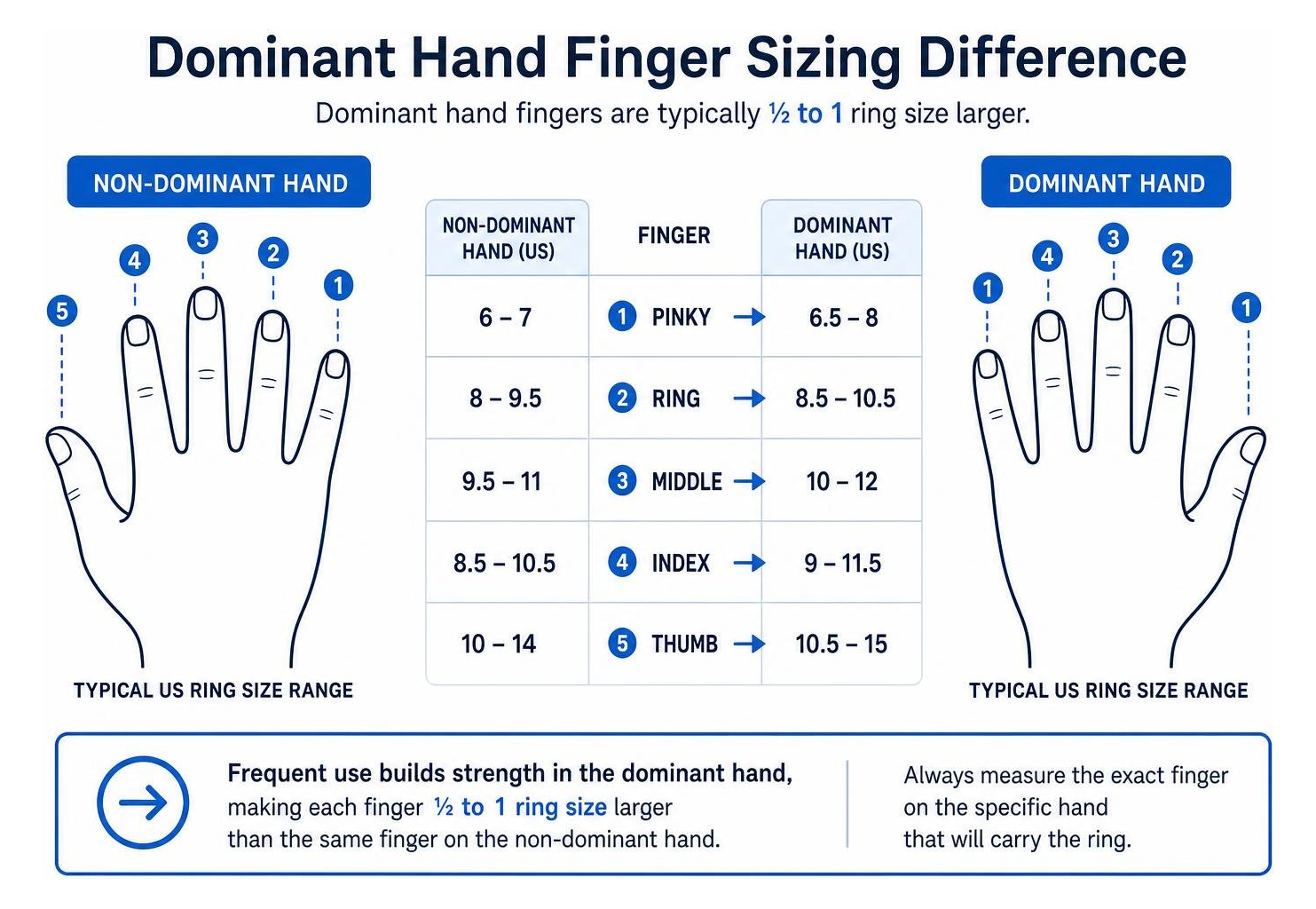
Frequent use builds stronger connective tissue and muscle in the dominant hand, adding roughly one-half to one full size (or ½ to 1 UK size) compared to the non-dominant side. A wedding band fitted perfectly for a non-dominant left ring finger (e.g., US size 10) will often feel uncomfortably tight if moved to the right hand.
Key Factors That Change Ring Fit and Sizing Choices
Achieving an effortless fit involves more than just a single millimeter number. Ring profile, band width, and daily body changes all shape how comfortable a band feels over time.
Band Width and Comfort Fit Adjustments
Band width directly influences surface friction against the skin:
- Narrow to Standard Bands (3 mm – 5 mm): A traditional 5mm mens wedding band slides over knuckles easily and feels lightweight. These fit true to your measured size.
- Wide Bands (7 mm – 9 mm+): Wide profiles cover more surface area, trapping moisture and creating friction. When choosing wide bands or heavier contemporary bands, we recommend sizing up by one-half US size (or a half UK size) to prevent a tight, constricting feel.
- Comfort Fit vs. Standard Fit: Comfort fit bands are domed on the interior surface, while standard bands are flat inside. Because a comfort fit interior slides over knuckles with less friction, many men find they can wear their true standard size even on slightly wider rings.
When exploring different metals and interior profiles, reviewing what is the best material for a mens wedding band can help you match weight, durability, and daily comfort to your routine.
Environmental and Daily Fluctuations
Fingers change size throughout the day based on simple biological and environmental triggers:
- Time of Day: Hands are generally slimmest first thing in the morning and reach their fullest size by late afternoon or early evening.
- Temperature: Cold weather causes blood vessels to constrict, making fingers shrink; warm summer days or vigorous workouts cause fingers to swell temporarily.
- Diet & Hydration: High sodium intake or dehydration can cause mild fluid retention, temporarily increasing finger size.
- Long-Term Changes: Gaining or losing 15 to 20 pounds can change a ring size by a half or full step. Over decades, knuckles also tend to broaden slightly due to natural joint maturity.
To find a reliable baseline, take measurements in the late afternoon at a comfortable room temperature.
How to Measure Ring Size Accurately at Home
If you cannot visit a showroom in person, you can still find your size at home with simple household tools. Before picking out classic wedding bands, take a look through our comprehensive wedding rings for men guide 2026 for styling insights, then use one of the two sizing methods below.
Method 1: The Paper Strip or String Technique
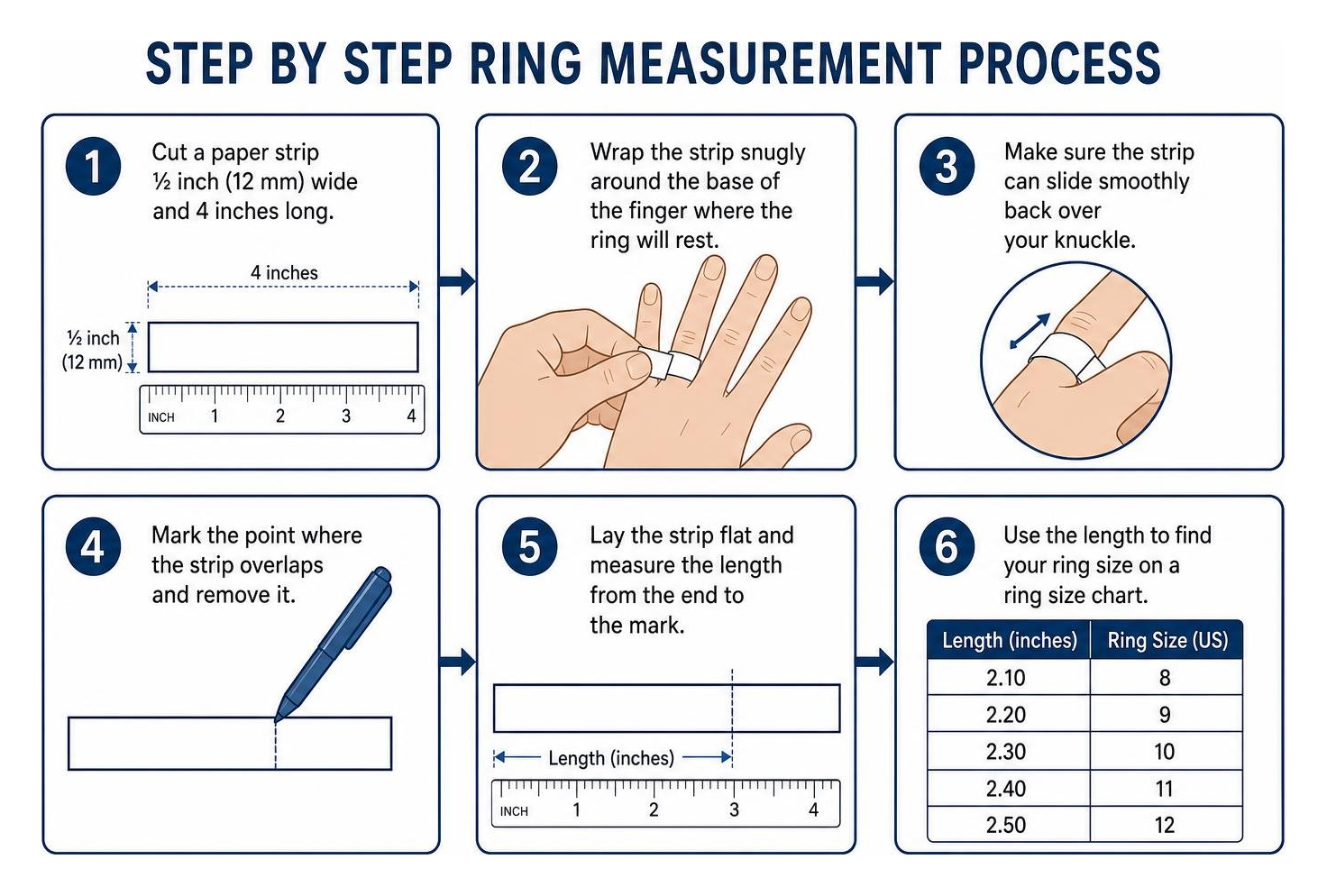
- Cut a narrow strip of plain paper roughly ½ inch (12 mm) wide and 4 inches long. (Paper works better than flexible string, which can stretch and give an inaccurate reading.)
- Wrap the strip snugly around the base of the finger where the ring will rest.
- Make sure the strip can slide smoothly back over your knuckle.
- Mark the exact spot where the paper overlaps with a fine pen.
- Lay the strip flat against a millimeter ruler and measure the length from the starting edge to your pen mark. This is your finger's circumference.
- Compare that millimeter figure to our conversion chart above (for instance, 62.1 mm equals a US Size 10).
Method 2: Measuring an Existing Well-Fitting Ring
If you are quietly planning a surprise gift and need to check his size without tipping him off, measuring a ring he already wears is an easy solution:
- Pick a ring he regularly wears on the intended finger.
- Place the ring flat on a ruler with millimeter markings, or use a digital caliper for precise results.
- Measure straight across the inside edge at the widest point, excluding the thickness of the metal band itself. This measurement gives you the inner diameter.
- Match your inner diameter to our sizing table (e.g., 19.8 mm diameter = US Size 10 / UK Size T).
For specialized or intricate styles, such as mens wedding bands custom created from scratch, working with an exact diameter measurement ensures the finished piece fits comfortably from day one. You can also explore our broader mens wedding bands golden guide to learn more about selecting the right style, metal, and proportions.
Frequently Asked Questions About Men's Ring Sizing
What ring size is considered large for a man?
A US size 12 (UK size X or EU 68) and above is generally considered large for a men's ring. While standard retail showcases carry stock up to size 11 or 12, larger sizes are readily available through custom sizing and specialized casting.
Should you size up or down if between ring sizes?
Always size up to the next half or quarter size if you are between two sizes. A slightly loose ring can easily be fitted with discreet sizing beads or adjusted down later, whereas a tight band can pinch, restrict circulation, and prove difficult to remove over the knuckle.
What is the average wedding band size for men?
The benchmark average men's wedding band size is US size 10 (UK size T). If you are looking for timeless wedding bands or browsing mens wedding rings in Golden CO, testing sample widths in this range is a great place to start your fitting.
Conclusion
Finding the right ring size takes the stress out of buying a band he will wear every day. While US size 10 and UK size T remain the standard averages, taking a few minutes to measure his hand, knuckle, and preferred band width guarantees a secure, comfortable fit.
At Creekside Jewelers, we have been helping generations of couples find and care for their fine jewelry in Colorado since 1902. If you want complete peace of mind, stop by our historic showroom for a complimentary professional sizing, or bring in an existing piece for our on-site jewelry repair and resizing services. We are here to make sure your ring fits seamlessly for a lifetime of memories.