

Get Ring Sizing Right Before You Order
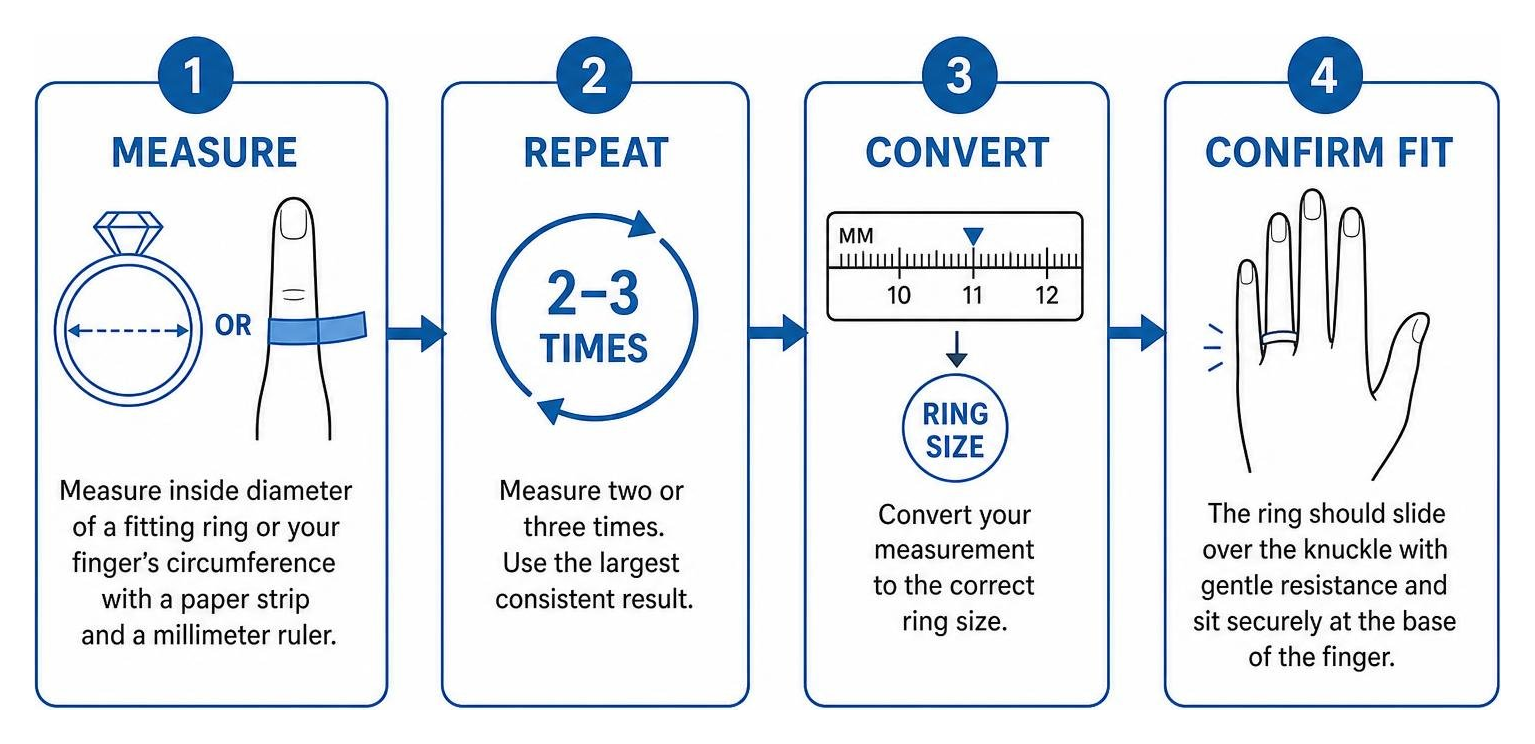
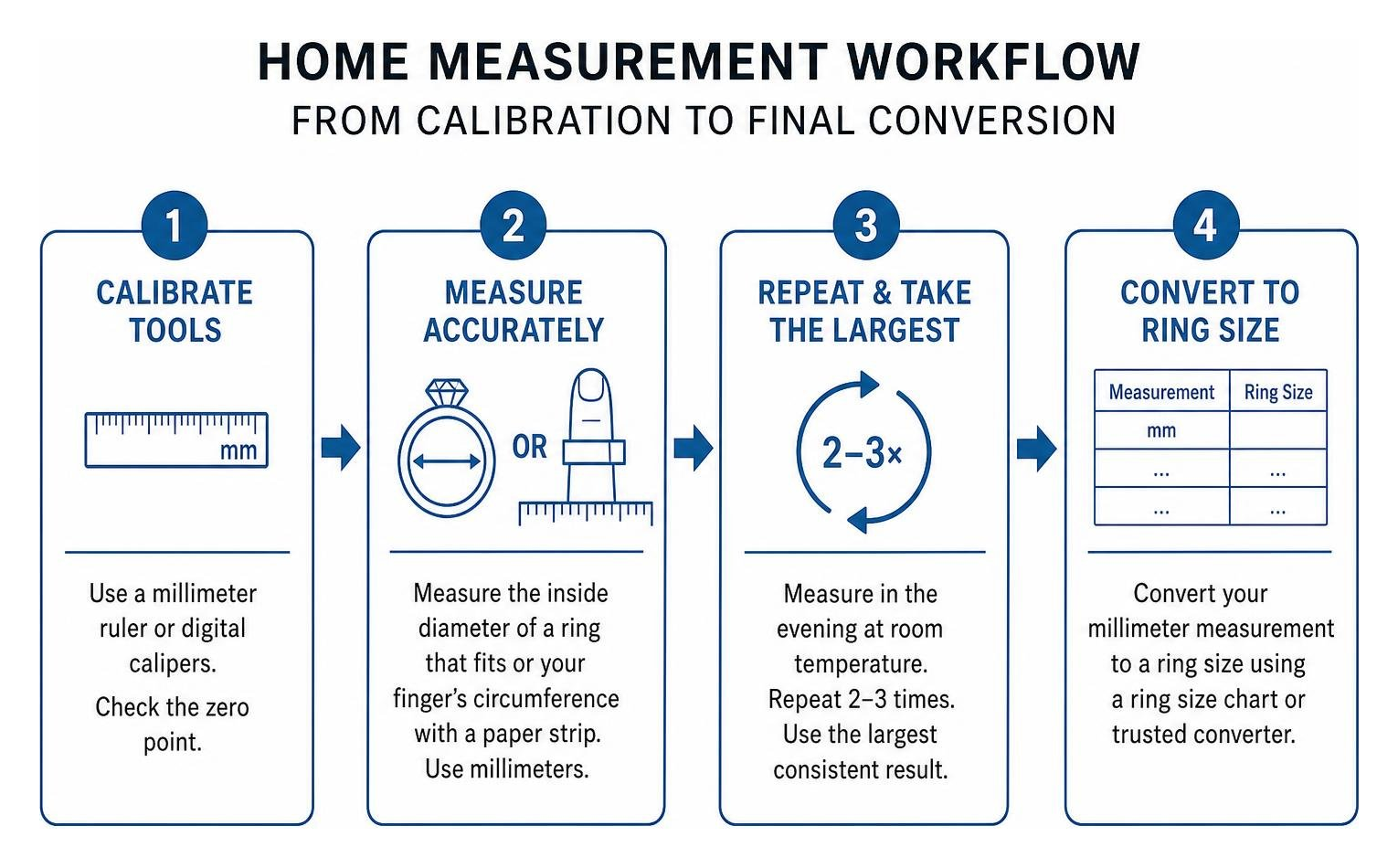
For accurate ring sizing at home, measure either the inside diameter of a ring that already fits or your finger's circumference with a paper strip and a millimeter ruler. Take the measurement in the evening at room temperature, repeat it two or three times, and use the largest consistent result. If you are between sizes, choose the larger size, especially for a wide band or a larger knuckle.
A well-fitted ring should slide over the knuckle with gentle resistance, then sit securely at the base of the finger. Small details matter: heat, activity, salt intake, and band width can each change how a ring feels. Fingers may change by as much as a full size between cold and hot conditions.
For a valuable engagement ring, wedding band, or family heirloom, home measuring is a useful starting point. A professional fitting remains the best way to confirm a final size, particularly for wide bands, non-resizable designs, and custom jewelry.
The Science of Ring Sizing: Accurate Home and Studio Methods
Determining your ring size comes down to precise metric engineering. The global jewelry benchmark, ISO 8653:2016, defines ring dimensions by the inside circumference of the band in millimeters. Because every half size represents a change of roughly 0.4 to 0.5 millimeters in diameter, even the slightest margin of error can turn a comfortable piece into an unwearable one.
At a jeweler's bench, we rely on calibrated steel mandrels, stepped ring gauges, and digital calipers that read down to hundredths of a millimeter. When measuring at home, standard household tools carry a typical margin of error of ±0.1mm to ±0.3mm. To keep your results within safe tolerances, you must use reliable physical references or calibrated digital tools like a Free Online Ring Sizer rather than estimating by eye.
Home Ring Sizing Techniques: Paper, String, and Calipers
Measuring your finger at home can be done using a few different methods, each offering varying levels of precision:

-
Measuring an Existing Ring's Inner Diameter (~98% Accuracy): If you already own a ring that fits the target finger well, measuring its internal opening is the most reliable home method. Place the ring flat on a ruler with crisp millimeter markings or use digital calipers. Measure straight across the widest internal span from inside edge to inside edge. Do not include the metal rim itself.
-
The Paper Strip Method (~97% Accuracy): Cut a straight, non-stretching strip of paper about 1 centimeter wide and 10 centimeters long. Wrap the strip snugly around the base of your finger. Mark the exact spot where the paper overlaps with a fine-tipped pen. Lay the strip flat along a millimeter ruler to find your finger circumference. Divide this circumference by 3.14159 (Pi) if you need the inside diameter.
-
The String Method (Caution Advised): While popular online, household string or yarn can stretch significantly while wrapping or marking. If you use string, wet it slightly so it stays flat, wrap it without pulling taut, and avoid elastic materials.
If you prefer physical tools, downloading a Printable Ring Sizer and Online Tool offers a straightforward way to check sizes against physical cutouts before finalizing your purchase.
Digital Tools and Printable Sizer Calibration
Modern screens and printable templates make at-home sizing simpler, provided they are calibrated correctly:
- Credit Card Calibration: Standard bank cards follow the ISO/IEC 7810 ID-1 standard, which dictates exact dimensions of 85.60 mm by 53.98 mm. Digital screen sizers use this physical constant to calibrate your display's pixel density, achieving measurement accuracy within 0.1 mm to 0.5 mm.
- Printable Sheets: When printing a sizing sheet or cutout gauge, set your printer scaling to "Actual Size" or 100% (disable "Fit to Page"). Verify calibration by placing a physical ruler over the sheet's printed reference line; it must measure exactly 100 mm.
- AI Camera Tools: Camera-based sizing apps use hand-tracking algorithms to calculate knuckle and finger widths. Under good lighting, these provide roughly 85% to 90% accuracy, making them a helpful preliminary tool to double-check with a physical paper strip.
International Size Standards and Conversion Rules
Ring sizes are not universally standardized. Different regions rely on numerical scales, alphabetical letters, or direct metric measurements. Knowing how to convert between these systems prevents ordering errors when purchasing from international designers.

Navigating US, UK, EU, Indian, and Japanese Scales
- United States & Canada: Uses a numerical scale (0 to 16) with quarter and half increments. Each full size increases the inside diameter by roughly 0.8 mm.
- United Kingdom, Australia, & India: Uses an alphabetical scale from A to Z, moving in half-letter steps (such as N or N½). The Indian jewelry market frequently aligns with these British letter designations or direct circumference measurements.
- European Union (ISO Standard): Measures the internal circumference directly in millimeters. A European size 52 means the inside circumference of the band is exactly 52 mm.
- Japan: Uses a whole-number scale (1 through 30) that increases incrementally by inside diameter, distinct from the US numerical system.
| Inside Diameter (mm) | Inside Circumference (mm) | US / Canada | UK / Australia / India | EU Standard (ISO 8653) | Japan |
|---|---|---|---|---|---|
| 14.1 mm | 44.2 mm | 3 | F | 44 | 4 |
| 14.9 mm | 46.8 mm | 4 | H | 47 | 7 |
| 15.7 mm | 49.3 mm | 5 | J½ | 49 | 9 |
| 16.5 mm | 51.9 mm | 6 | M | 52 | 12 |
| 17.3 mm | 54.4 mm | 7 | O | 54 | 14 |
| 18.1 mm | 57.0 mm | 8 | Q | 57 | 16 |
| 19.0 mm | 59.5 mm | 9 | S | 60 | 18 |
| 19.8 mm | 62.1 mm | 10 | T½ | 62 | 20 |
| 20.6 mm | 64.6 mm | 11 | V½ | 65 | 23 |
| 21.4 mm | 67.2 mm | 12 | Y | 67 | 25 |
| 22.2 mm | 69.7 mm | 13 | Z+1 | 70 | 27 |
Global Average Dimensions for Men and Women
Understanding regional averages provides a helpful frame of reference if you are shopping for a gift or double-checking your numbers:
- United States: The average women's ring size is US 6 (16.5 mm diameter, 51.9 mm circumference). Size 6 accounts for approximately 20% of all engagement ring purchases nationwide. The average male ring size in the US is US 10 (19.8 mm diameter, 62.1 mm circumference).
- India: The most common women's ring size is UK/India N (equivalent to US 7, with a 17.3 mm diameter).
- Japan: Women's averages typically range between sizes 11 and 13 (US 5.5 to 6.5), while men average sizes 20 to 22 (US 10 to 11).
Anatomical Factors and Band Architecture That Impact Fit
Finding a comfortable fit involves more than a single circumference number. Finger anatomy, environmental conditions, and the architectural design of the ring band all play major roles in how a ring wears day to day.
Managing Knuckle Proportions, Temperature Fluctuations, and Time of Day
Human hands fluctuate constantly. Fluid retention, activity levels, ambient temperature, and salt consumption can cause fingers to swell or shrink by up to one full size within 24 hours.
- Time of Day: Always take measurements in the late afternoon or evening. Fingers are typically at their narrowest in the morning and expand as you go about your day.
- Temperature Swings: Cold temperatures cause blood vessels to constrict, thinning the fingers, while heat and humidity trigger expansion. Only measure when your hands feel comfortably warm at normal room temperature.
- Large Knuckles: If your knuckle is significantly broader than the fleshy base where the ring sits, a ring sized strictly to the base will get stuck at the joint. Measure both your knuckle circumference and your base circumference, then pick a midpoint size. For rings that spin excessively once past the knuckle, a jeweler can solder internal sizing beads or install a hinged shank to keep the ring upright.
Wide Bands vs. Narrow Bands: Adjusting for Width
The width of a ring band changes the amount of surface contact and friction against your skin:
- Narrow Bands (1.5 mm – 3 mm): Standard solitaires and dainty stackers displace minimal skin and slide easily over the knuckle. Order your exact measured size.
- Medium to Wide Bands (5 mm – 8 mm): Rings 6 mm or wider cover more surface area, creating more drag. As a standard rule of thumb, add a half size (+0.5 US) for bands between 5 mm and 8 mm. Every 2 mm of added band width adds roughly +¼ US size in perceived tightness.
- Extra-Wide Bands (9 mm+): Thick statement bands or stacked bridal sets that sit close together often require ordering a full size (+1.0 US) larger than your baseline narrow measurement.
- Comfort Fit Profiles: Rings crafted with a "comfort fit" profile feature a slightly domed, convex interior. These slide over knuckles with less friction than flat-interior bands, occasionally balancing out the extra width.
Resizing Feasibility and Buying Strategies
Before ordering an unalterable ring or purchasing fine estate jewelry, it helps to understand how future size adjustments work. When handling precious family heirlooms, reviewing professional jewelry appraisal considerations ensures you understand the piece's construction and value before altering the metal.
If a ring feels loose or tight over time, exploring comprehensive jewelry repair options will help restore a secure, comfortable fit.
Secret Ring Sizing Strategies for Surprise Gifts
Planning a surprise proposal without revealing the secret requires creative sleuthing:
- Borrow an Existing Ring: Borrow a ring your partner wears on the correct finger (the left ring finger for engagement rings). Trace the inner circumference onto paper, press the band into a soft bar of soap to leave a clear impression, or slide it down your own finger and mark the stopping point.
- Enlist an Accomplice: Ask a close friend or family member to casually browse jewelry together or ask your partner to try on their rings for fun.
- Compare Hand Proportions: If borrowing a ring is impossible, look at clear photographs of their hands next to everyday objects or compare their hands to yours as a baseline. When guessing, lean toward a standard US 6 or 6.5 for women, as sizing down after the surprise is generally easier than stretching an undersized ring.
Metals and Settings That Cannot Be Resized
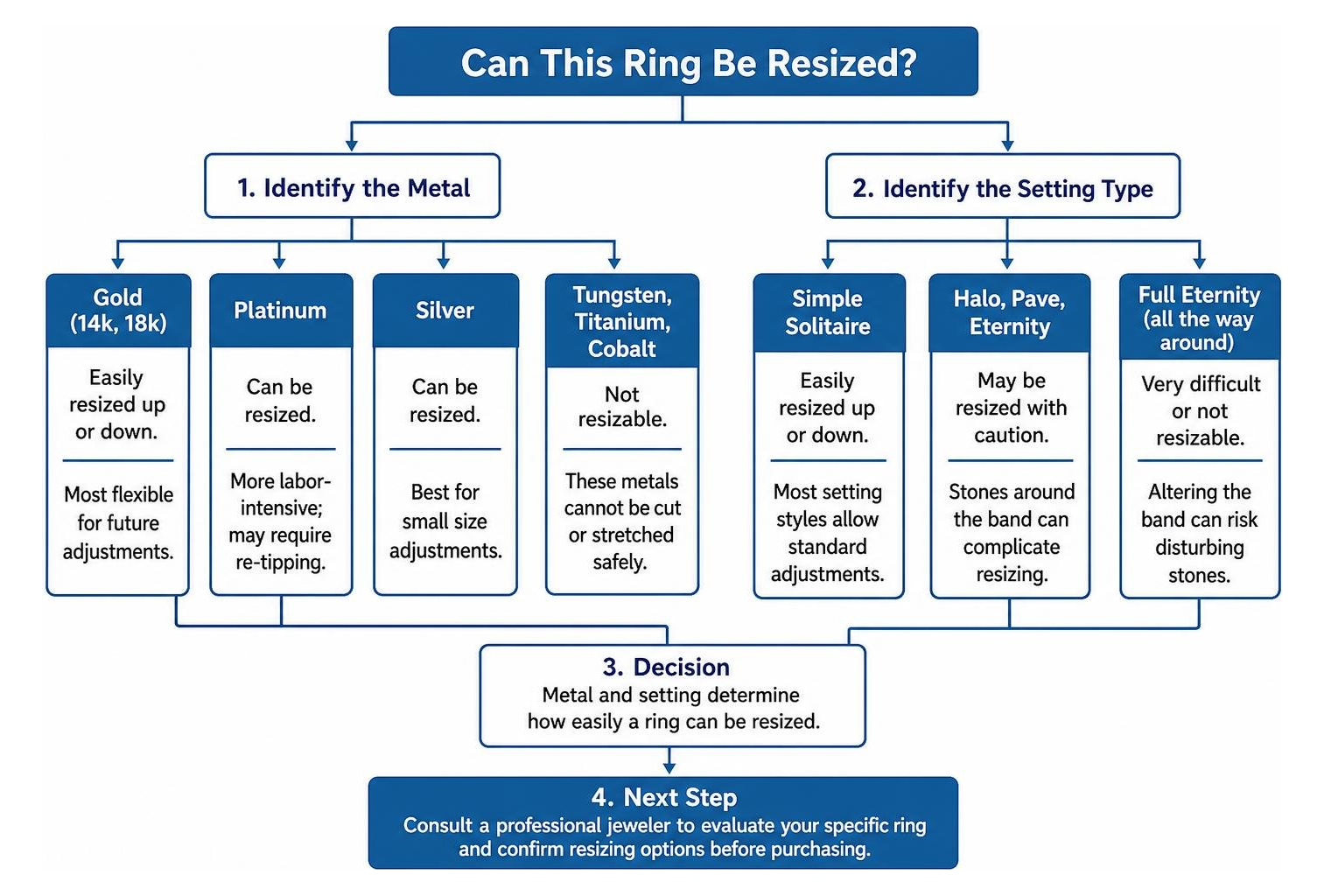
Most traditional gold, platinum, and silver rings can be resized up or down by two full sizes at a jeweler's bench. However, certain modern metals and complex stone settings cannot be modified without destroying their structural integrity:
- Eternity Bands: Because diamonds or gemstones wrap entirely around the perimeter, cutting the band disrupts the stone seats and prong spacing.
- Alternative Metals: Industrial metals like tungsten carbide, titanium, cobalt chrome, and ceramic cannot be cut, soldered, or expanded with traditional bench torches or laser welders.
- Inlaid and Tension Rings: Rings featuring wood, meteorite, opal, or resin channels, as well as tension settings holding a center gem without prongs, will crack under resizing stress.
Before buying an intricate band, review a can my ring be resized evaluation to avoid choosing a design that cannot be adjusted later.
Frequently Asked Questions About Measuring Ring Size
Should I size up or down if my measurement falls between two sizes?
Always choose the larger size. Fingers swell throughout the day and in warm weather, making a slightly loose ring far more comfortable than a constricting one. From a goldsmithing perspective, resizing a ring down to a smaller size is typically simpler, safer for stone settings, and less expensive than stretching or adding metal to enlarge it.
How do I accurately measure a ring size when my knuckle is larger than my finger base?
Measure the circumference of your knuckle and the circumference of your finger base using a paper strip. Calculate the numerical average between the two measurements and choose that size. This allows the band to slide past the knuckle with slight resistance while preventing it from flopping loosely at the base. If top-heavy rings still spin, small platinum or gold sizing beads soldered to the inner shank will stabilize the piece.
What is the most reliable time of day to measure finger size?
The best time to measure is during the late afternoon or evening at a comfortable room temperature. Throughout the day, daily activity and hydration expand your hands to their true maximum resting volume. Measuring early in the morning or when your hands are cold produces artificially small numbers that may feel uncomfortably tight later in the day.
Conclusion
Measuring your ring size at home provides a solid baseline for online browsing and gift planning. However, for heirloom treasures, custom engagement bands, and complex stone settings, visiting a professional bench jeweler remains the gold standard for long-term comfort.
At Creekside Jewelers, we have helped generations find their ideal fit. As the oldest continuously run watch and jewelry store in Colorado, operating in our original location since 1902, our family-owned shop combines traditional bench craftsmanship with on-site custom design. Whether you need a precision fitting, custom fabrication, or master jewelry repair in Golden CO, stop by our studio to ensure your favorite jewelry fits comfortably for years to come.