

What Does Gold Chain Repair Cost?
A simple gold chain repair often costs $30 to $50 for one broken link. Rope chains and other complex repairs may cost $80 to $150 or more. A new clasp, polishing, or rhodium plating can raise the final bill.
To judge whether a quote is fair, ask the jeweler to inspect the whole chain, not just the break. A sound chain with one failed link is often worth repairing. If several links are worn or the chain is hollow or kinked, compare an itemized repair quote with the cost of a similar new chain.
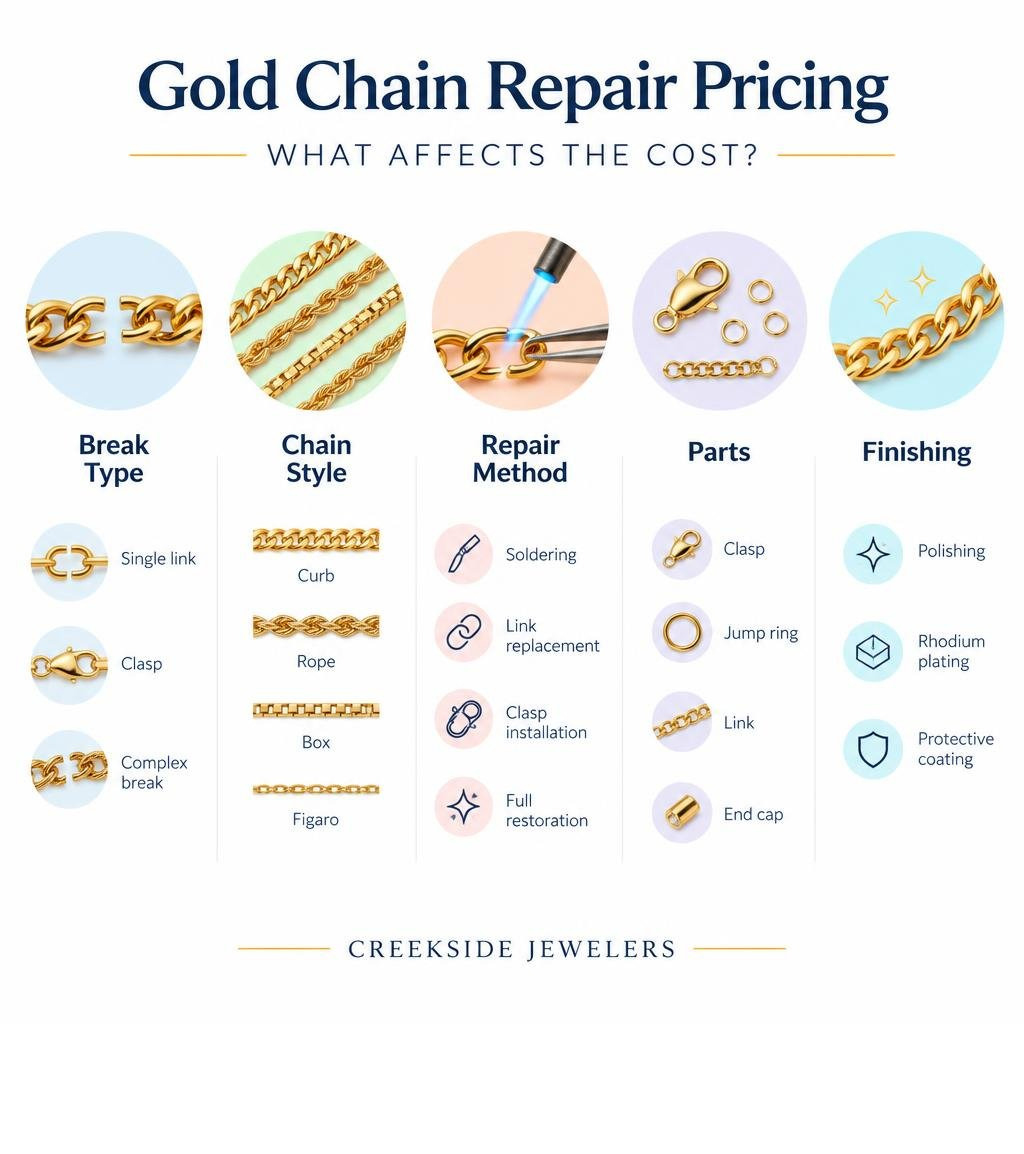
Key Factors Influencing Your Gold Chain Repair Price
When a favorite gold chain snaps, getting it back around your neck should be simple and transparent. However, walking into a jewelry store expecting a single flat rate can sometimes lead to surprise quotes. That is because calculating an accurate gold chain repair price involves far more than just melting a tiny drop of gold over a break.
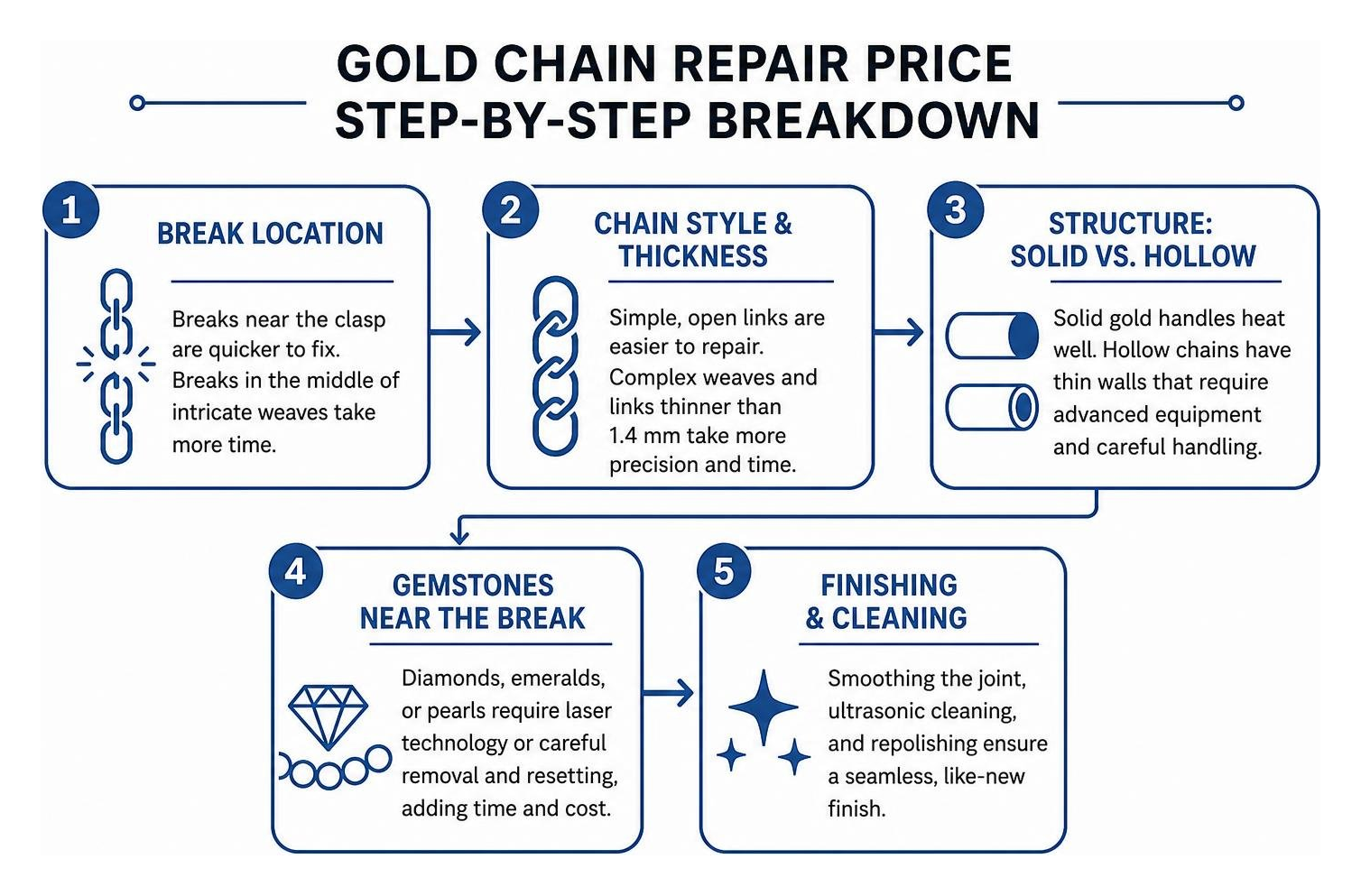
A professional bench jeweler evaluates several mechanical and metallurgical elements before giving an estimate:
- Location of the Break: A break at an open jump ring next to the clasp is fast to resolve, often running between $20 and $40. A break situated directly in the middle of an intricate weave requires careful alignment and individual link work.
- Link Geometry and Thickness: Simple, circular links are far easier to access and manipulate than flat, interlocking, or twisted woven patterns. Fine chains with links thinner than 1.4 mm require high-magnification microscope work.
- Structural Integrity (Solid vs. Hollow): Solid links can withstand direct heat without collapsing. Hollow chains—formed by wrapping thin gold sheets over an acid-etched core—contain empty space inside. Introducing heat risks melting the thin walls, demanding advanced equipment and meticulous handling.
- Presence of Gemstones: If your necklace features accent diamonds, emeralds, or pearls near the fracture, traditional torch heat can crack or discolor the stones. Jewelers must use laser technology or unseat and reset the gems.
- Finishing and Cleaning: A complete repair should never leave dark, discolored patches. Smoothing the joint, ultrasonic cleaning, and repolishing all contribute to labor time.
Understanding these details ensures you know exactly what goes into comprehensive gold necklace restoration. When you need a reliable gold jewelry fix near me, an experienced bench jeweler will always walk you through these variables link by link.
Average Gold Chain Repair Price by Chain Style
The physical architecture of your necklace determines how many bench hours are required to rebuild the joint. Simpler patterns allow for quick soldering, while multi-strand or tightly woven designs demand surgical precision.
- Cable and Curb Chains ($35 – $50): Standard open-link styles like cable, curb, or Figaro chains are straightforward. The jeweler opens the neighboring links, cleans the connection, introduces solder or a laser weld, and polishes the spot smooth.
- Box Chains ($60 – $85): Box chains feature square, flat-sided links with geometric hollows. Aligning the four flat edges without stiffening the surrounding joints requires careful alignment so the chain drapes naturally without catching on skin.
- Rope Chains ($80 – $120+): Rope designs consist of multiple small links woven together in a spiral. A break often snaps several interconnected rings at once. Soldering an 18k rope chain with a traditional torch risks flooding solder into neighboring loops, freezing the movement. Laser welding is strongly recommended to tackle each ring individually.
- Herringbone and Snake Chains ($80 – $150+ / Often Non-Repairable): These styles rely on liquid-smooth, flat, or tightly tubular construction. When a herringbone kinks or tears, reshaping the bent metal is rarely seamless. Soldering typically leaves a rigid spot that will not bend with your collarbone.
| Chain Style | Typical Repair Cost | Difficulty Level | Recommended Repair Method | Flexibility Retained? |
|---|---|---|---|---|
| Curb / Cable | $35 – $50 | Low | Torch Solder or Laser | Yes (100%) |
| Figaro | $35 – $55 | Low to Moderate | Torch Solder or Laser | Yes (100%) |
| Box | $60 – $85 | Moderate | Laser Welding | Yes (95–100%) |
| Rope (Solid) | $80 – $120 | Moderate to High | Laser Welding | Yes (90–95%) |
| Rope (Hollow) | $100 – $150 | Very High | Micro-Laser Welding | Variable |
| Herringbone | $80 – $150 | Extreme | Micro-Laser / Replacement | No (Creates stiff link) |
| Snake | $70 – $130 | High | Laser Welding with Sleeve | Partially stiffened |
For step-by-step diagnostic advice on identifying what style of link failed, our guide on how to fix a broken gold chain details how various link structures respond to tension.
How Gold Karat and Purity Impact Your Gold Chain Repair Price
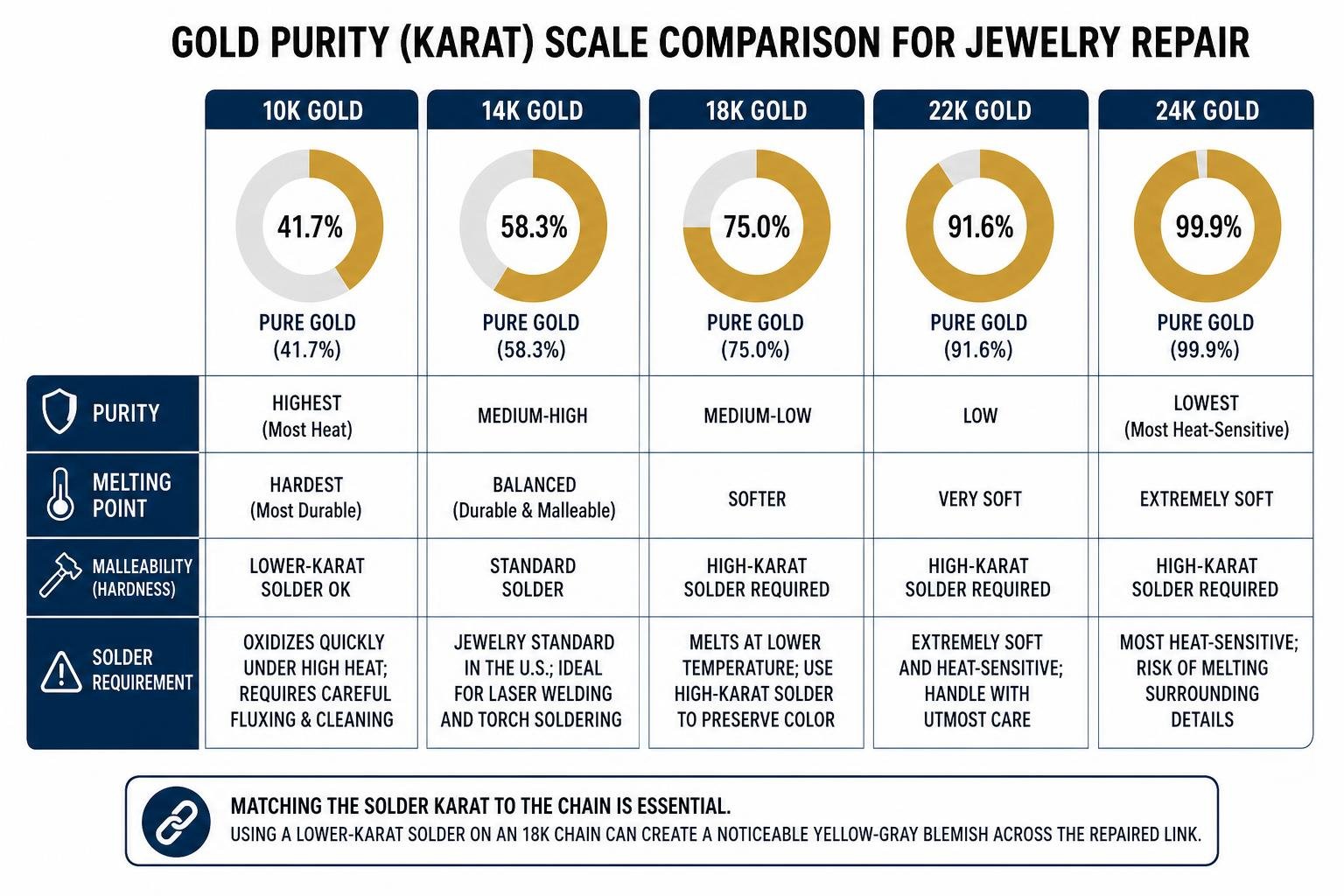
Gold purity directly alters the metal's melting point, malleability, and the type of alloy solder needed for the fix. According to the Gemological Institute of America, karat markings indicate the exact ratio of pure gold to alloyed metals, which is the same scale jewelers rely on when matching solder to a chain.
- 10k Gold (41.7% Pure): Contains a high percentage of base metals like copper and silver. It is durable and harder, but lower karats oxidize quickly under high heat, requiring careful fluxing and cleaning to prevent discoloration.
- 14k Gold (58.3% Pure): The jewelry standard across the United States. It strikes an ideal balance between malleability and melting point, making it standard for both laser welding and torch soldering.
- 18k Gold (75.0% Pure): Softer and richer in color, 18k gold melts at a lower temperature and requires high-karat gold solder to preserve uniform color. Simple repairs on 18k (750/1000) gold typically run between €30 and €55, scaling upward for complex link weaves.
- 22k–24k Gold (91.6%–99.9% Pure): Extremely soft and heat-sensitive. High-purity gold must be handled with utmost care to avoid melting surrounding details during heat application.
Matching the solder karat to the chain is essential. Using a lower-karat solder on an 18k chain can create a noticeable yellow-gray blemish across the repaired link.
Torch Soldering vs. Laser Welding for Gold Necklaces
When you bring a broken chain to a jeweler, the work is primarily performed using one of two methods: traditional torch soldering or advanced laser welding.

1. Traditional Torch Soldering ($35 – $65)
In torch soldering, a micro-torch applies heat across the surrounding metal until a tiny piece of gold alloy solder melts and flows into the joint.
- Pros: Affordable, time-tested, and effective for basic solid chains (cable, curb, Figaro).
- Cons: The flame heats the entire surrounding zone. This thermal spread can damage nearby heat-sensitive gemstones, discolor white gold, or melt hollow links.
2. Precision Laser Welding ($60 – $150)
A laser welder uses a concentrated, microscopic beam of light to fuse the gold metal directly without heating the entire surrounding chain. It can create an authentic parent-metal fusion or feed a hair-thin wire of identical gold karat into the fracture.
- Pros: Produces joints up to three times stronger than standard solder. It generates zero heat transfer, allowing repairs right next to diamonds, emeralds, or delicate hollow walls.
- Cons: Equipment costs and precision labor raise the repair fee, typically adding $30 to $60 compared to basic torch work.
Choosing your repair method based on failure type and link geometry rather than hunting for the lowest baseline price prevents repeated breaks and keeps delicate weaves fluid.
Additional and Hidden Costs in Gold Chain Restoration
A complete, durable repair often requires more than just joining two broken ends together. When evaluating an estimate, review whether these additional services are necessary for your piece:
- Rhodium Plating ($35 – $80): White gold is naturally an off-white alloy finished with an electroplated layer of bright white rhodium. Torch heat or sanding burns away this layer at the repair site. Refinishing and flash plating restore that mirror-bright luster, running $35 to $65 for a standard chain, or up to $200 for heavy Cuban links.
- Clasp Replacement ($25 – $250): Chains often fail because an old spring ring lost internal spring tension, snapping the adjacent ring. Replacing a 5mm gold spring ring runs around $30, while upgrading to a heavy-duty 14k lobster claw clasp ranges from $65 to $250 depending on weight. Learn more about fastener mechanics in our breakdown of broken chain clasps and bracelet clasp replacement options.
- Jump Ring Splice ($20 – $40): If a thick jump ring pulls open without breaking the links, a simple laser-fused jump ring splice will secure the connection without altering chain length.
- Chain Shortening or Lengthening: Removing damaged links to shorten a chain costs roughly $30 to $35 (plus $20 or more for thick Cuban links). Adding length by inserting matching solid links starts from $290 due to gold material weight.
- Express or Rush Fees: Emergency repairs completed while you wait can add a 20% to 30% rush fee on top of standard bench rates.
For a comprehensive overview of how master jewelers appraise restorative work, explore our jewelry repair guide and repair appraisal overviews.

Repair vs. Replace: Evaluating the 30% Rule and Chain Feasibility
Not every broken chain should be soldered. Before committing funds to bench labor, use the 30% Rule to ensure you are making a practical financial decision.
The 30% Rule Decision Framework
If the total estimate to repair and refinish your chain exceeds 30% to 40% of the replacement cost of an equivalent new chain, evaluate the piece's condition:
- If the chain is solid, has high sentimental value, or features unique links, proceed with the repair.
- If the chain shows widespread link thinning, worn joints throughout, or multiple brittle spots, investing in a new piece provides better long-term durability.
When to Replace Rather Than Repair
- Thin Hollow Rope Chains: Once hollow gold walls begin collapsing from everyday wear, fixing one link frequently leads to a new break directly next to the repair.
- Kinked Herringbone Chains: Attempting to solder a severely creased herringbone creates a stiff, unnatural seam that snags clothing and breaks under slight pressure.
- Gold-Plated Chains: Gold-plated or flash-plated pieces (often brass or copper underneath) usually do not justify repair. Applying high heat burns off the thin microns of gold plating. Strip-cleaning and re-electroplating often cost more than purchasing a replacement chain.
- Gold-Filled Chains: Gold-filled metal features a bonded outer sheet of gold over brass. Soldering exposes the base metal, leaving a noticeable dark spot that cannot be easily re-plated.
When in doubt, checking with local jewelry repair shops near me gives you an honest second opinion on structural integrity before you spend a dime.
How to Protect Your Repaired Gold Necklace and Avoid Future Breaks
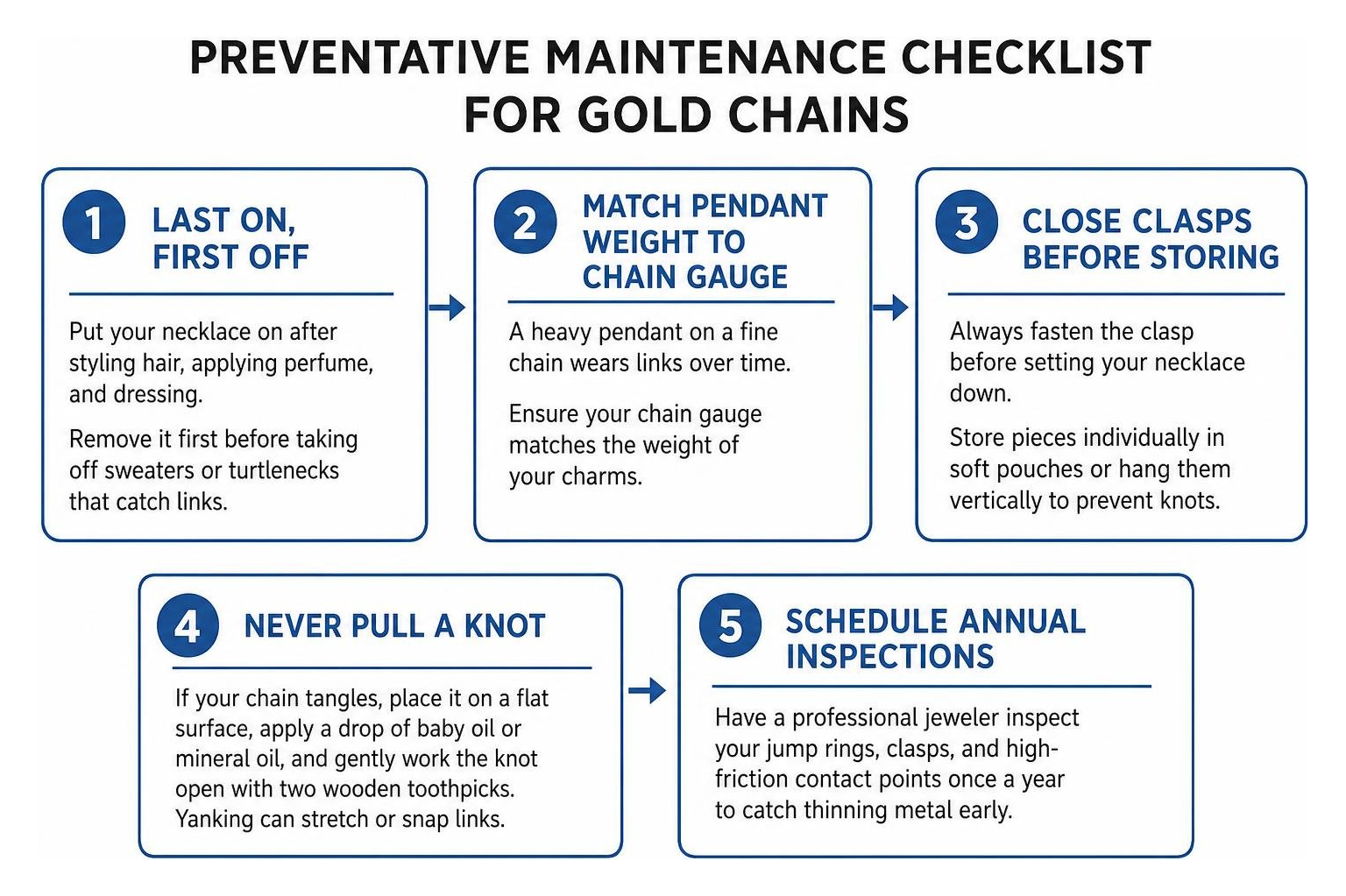
Once your necklace is restored, adopting a few simple daily habits will protect the joints and prevent future trips to the jeweler:
- The "Last On, First Off" Rule: Put your gold necklace on after styling your hair, applying perfume, and dressing. Remove it first before taking off sweaters or turtlenecks, which frequently catch fine links.
- Match Pendant Weight to Chain Gauge: A heavy pendant on a fine 1mm box or cable chain acts like an abrasive saw over time, grinding through the bottom link. Ensure your chain gauge matches the weight of your charms.
- Close Clasps Before Storing: Always fasten the clasp before setting your necklace down. Store pieces individually in soft velvet pouches or hang them vertically to prevent knots.
- Never Pull a Knot: If your chain tangles, place it on a flat glass surface, apply a drop of baby oil or mineral oil, and gently work the knot open with two wooden toothpicks. Yanking a knot can stretch or snap delicate links.
- Schedule Annual Inspections: Have a professional jeweler inspect your jump rings, clasps, and high-friction contact points once a year to catch thinning metal before it gives way.
For insights on choosing qualified craftsmen for routine inspections, read our tips on finding reliable jewelry repair services.
Frequently Asked Questions About Chain Repairs
How much does it cost to solder a single broken link on a gold chain?
Repairing a single open link on a standard solid gold chain (such as a cable, curb, or Figaro) typically costs $30 to $50 using traditional torch soldering. If the chain is thin, constructed from 18k or higher gold, or requires precision laser welding, expect the rate to fall between $60 and $90.
Can a crushed or kinked herringbone chain be repaired?
While a bench jeweler can stabilize a complete break in a herringbone chain using micro-laser welding, it is generally impossible to restore its original liquid-smooth flexibility. The repaired link will remain rigid and slightly elevated, creating a visible seam. If the damage is extensive, replacing the chain is usually the best choice.
Is it worth repairing a gold-plated or hollow gold chain?
Generally, no. Gold-plated chains feature a microscopic gold layer over base metals like brass. Soldering burns this layer away, exposing dark core metal. Hollow gold chains can be laser welded, but if the surrounding links are paper-thin, they will likely crush under minimal tension. Solid gold chains, by contrast, are always prime candidates for durable restoration.
Conclusion
A broken gold chain does not have to stay hidden in your jewelry box. By understanding link styles, gold purity, and the differences between torch soldering and laser welding, you can review repair quotes with confidence and protect your investment.
At Creekside Jewelers, we believe in honest craftsmanship, transparent pricing, and treating your heirlooms with the respect they deserve. As the oldest continuously run jewelry and watch store in Colorado—proudly serving our community in our original location since 1902—our master bench jewelers perform all assessments and fine metal restorations on-site.
Whether you need a quick clasp replacement, an invisible laser weld on an heirloom weave, or a full structural evaluation, visit our specialists for professional jewelry repair in Golden CO and explore our full range of custom repairs today. We also regularly welcome clients seeking expert jewelry repair in Lakewood CO, jewelry repair in Littleton CO, jewelry repair in Westminster CO, jewelry repair in Wheat Ridge CO, jewelry repair in Edgewater CO, and jewelry repair in North Lakewood. Stop by our showroom or bring in your broken chain today for an itemized estimate.