

Why Your Chain Clasp Broke and How to Identify the Damage
A broken clasp is one of the most common jewelry mishaps. In many cases, you can restore it at home by twisting an open jump ring closed with smooth flat-nose pliers, or by swapping the worn fastener for a correctly sized replacement clasp. Because clasps are mechanical fasteners enduring continuous tension, movement, and friction, their components naturally wear down over time. Pinpointing exactly why the break occurred helps determine whether you need a quick ring adjustment, an internal spring replacement, or a trip to a jeweler's bench.
Common Causes of Clasp Failure
- Internal Spring Fatigue: Spring rings and lobster clasps rely on tiny steel springs inside the housing. Over thousands of open-and-close cycles, the metal loses its spring tension. The lever may feel sluggish, stick open, or stop clicking shut entirely.
- Open or Weakened Jump Rings: Many clasps attach to the main chain via an unsoldered jump ring. If your necklace snags on a sweater or gets pulled during exercise, this ring can pull open laterally, allowing the clasp to drop off without actually breaking.
- Metal Wear and Thinning: Daily friction between the clasp loop and the opposing ring slowly grinds away precious metal. Over years of wear, gold and silver loops become razor-thin until they snap under minor pressure.
- Corrosion and Chemical Buildup: Exposure to moisture, sweat, lotions, hairspray, and chlorine can corrode the tiny steel spring inside mechanical clasps, causing it to rust, seize, or shatter.
Diagnosing the Problem
Before attempting any fix, inspect your piece under bright lighting with a magnifying glass or jeweler's loupe. Look at the clasp lever, the connection loop, and the first few chain links.
| Symptom | Underlying Cause | Recommended Solution |
|---|---|---|
| Lever sticks or will not close | Broken or rusted internal spring | Replace the entire clasp unit |
| Clasp is intact but separated from chain | Jump ring pulled open | Reconnect and twist jump ring closed |
| Connection loop snapped completely | Metal wear or excessive tension | Install new clasp and soldered ring |
| Clasp opens spontaneously during wear | Worn catch mechanism or weak tongue | Upgrade to a heavier clasp style |
| Chain snapped near the end terminal | Fatigue on soldered link | Professional micro-soldering |
If your fine gold piece suffered structural damage beyond an open ring, seeking a dedicated gold jewelry fix ensures the precious metal is soldered seamlessly without changing its color or temper.
Choosing the Best Replacement Clasp for Your Necklace
Selecting the right replacement involves balancing daily security, convenience, and visual proportion. A delicate chain will snap if weighed down by a bulky fastener, while a heavy pendant can easily pull open a flimsy closure.
What to Do When a Chain Clasp Broke on a Heavy Pendant
When a chain clasp broke under the weight of an oversized pendant or statement piece, replacing it with the identical small clasp often leads to repeat failure. Heavy pendants generate downward momentum with every step you take, transferring direct strain onto the fastener.
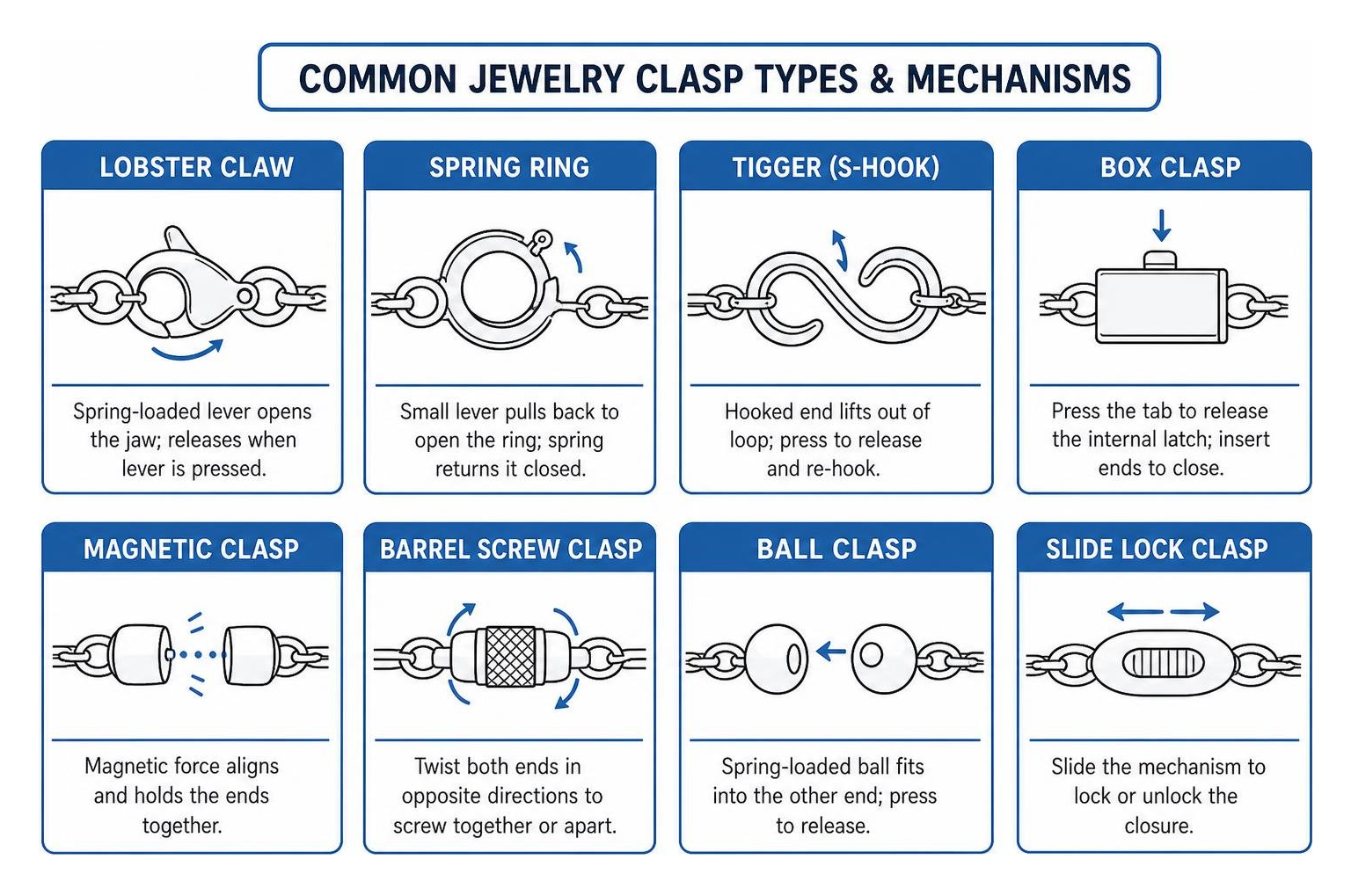
- Lobster Claw Clasps: The industry standard for reliable strength. Lobster clasps feature a solid metal body and a spring-loaded lever that closes securely into a recessed groove. They handle everyday movement exceptionally well and are available in flat, curved, and swivel variations.
- Spring Ring Clasps: Best suited for lightweight, delicate chains. While subtle and classic, their hollow internal cavity leaves little room for a heavy spring, making them vulnerable to heavier pendants.
- Box Clasps with Safety Catches: A decorative housing where a notched metal tongue clicks inside, reinforced by one or two wire safety latches on the outside. Common on tennis necklaces, pearls, and heirloom pieces.
- Toggle Clasps: An open hoop and a T-bar that slips through sideways. Toggles work purely on gravitational tension and chain weight. They are easy to fasten for those with reduced hand mobility, though they require adequate pendant weight to stay engaged.
- Magnetic Clasps: Convenient for individuals who struggle with tiny levers, but they should always be paired with a safety chain when holding valuable stones.
If you are dealing with wristwear rather than neckwear, similar principles apply. You can explore specialized closure mechanisms in our dedicated guide to bracelet clasp replacement.
Sizing and Material Compatibility for Jewelry Chains
A replacement clasp must align with your chain's metallurgy, millimeter gauge, and aesthetic profile.
- Metal Matching: Always pair like metals. Attaching a base metal clasp to a 14k gold chain can cause accelerated galvanic wear and discoloration. Use 14k or 18k solid gold for karat gold chains, 925 sterling silver for silver chains, and 316L stainless steel for steel chains.
- Proportional Sizing: Measure the chain link diameter. An ultra-fine 1mm cable chain pairs best with a 4.5mm to 6mm spring ring or an 8mm lobster clasp. A medium 2mm to 3mm rope chain generally requires a 10mm to 12mm lobster clasp.
- Gauge of Connecting Jump Rings: Ensure the wire gauge of your jump ring (typically 20-gauge or 22-gauge for standard chains) passes cleanly through the chain's end loop without stretching it out of shape.
Step-by-Step Guide to Replacing a Broken Clasp at Home
If the damage is limited to an open jump ring or a worn clasp on an open-link chain, you can perform the replacement at home with a few precision tools.
Required Tools and Materials
- Two pairs of smooth-jaw flat-nose or chain-nose jewelry pliers (avoid serrated pliers, which gouge precious metals)
- A new, correctly sized replacement clasp
- A matching jump ring (if the original is distorted or missing)
- A soft, non-slip jewelry mat or microfiber towel
- Magnification and steady lighting
Step-by-Step Replacement Instructions
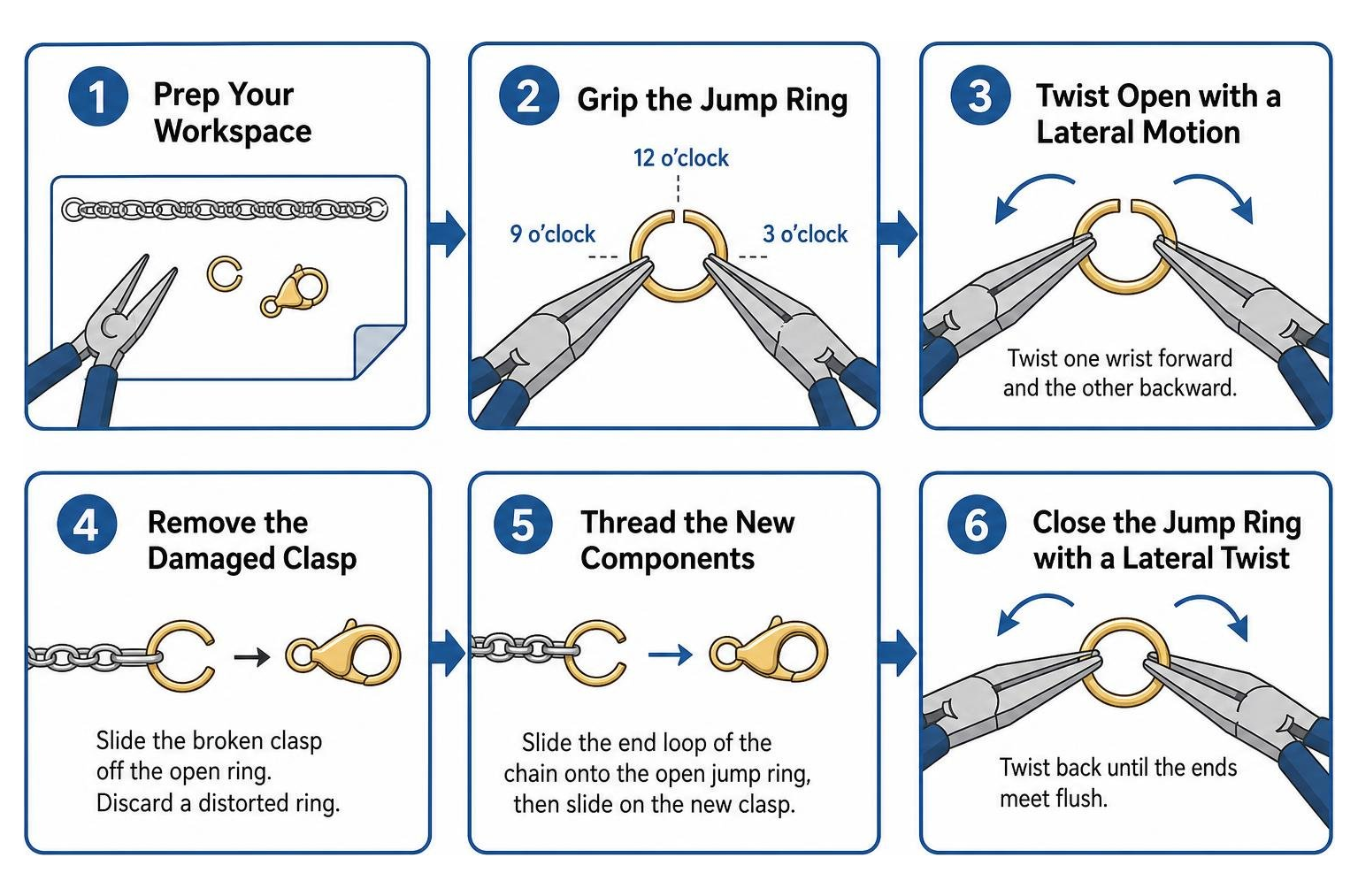
- Prep Your Workspace: Lay out your jewelry mat. The soft fabric stops dropped jump rings and springs from bouncing onto the floor.
- Grip the Jump Ring: Using both pairs of pliers, grip each side of the jump ring slit. Your pliers should sit at roughly the 3 o'clock and 9 o'clock positions relative to the opening at 12 o'clock.
- Twist Open with a Lateral Motion: Gently twist one wrist forward and the other backward. Never pull the ring outward to the sides into an "O" or "U" shape, as this permanently weakens the metal and ruins its circular curve.
- Remove the Damaged Clasp: Slide the broken clasp off the open ring. If the ring itself is distorted, slip it off the chain and discard it.
- Thread the New Components: Slide the end loop of the necklace chain onto the open jump ring, followed by the attachment ring of your new clasp.
- Close the Jump Ring: Reverse your twisting motion using both pliers. Move the ends past each other slightly, then bring them back together so the metal ends meet flush with a slight click. Inspect the seam to ensure no gap remains where a chain link could slip out.
When working with fine precious metal chains, understanding material durability as outlined by the Gemological Institute of America ensures you handle delicate links without causing unnecessary stress to the metal.
When a Chain Clasp Broke Along with Woven or Soldered Links
Not all clasp breaks can be solved with a simple pair of pliers. Woven styles such as rope chains, box chains, wheat chains, and snake chains do not use independent open loops at their terminals. Instead, they feature specialized end caps or end tabs that are permanently soldered to the woven wire matrix.
If the chain broke inside the end cap, if the end loop snapped off completely, or if fine links unravel, do not attempt a DIY squeeze fix. These intricate structures require professional micro-torch or laser soldering. Consult our complete jewelry repair guide to understand how jewelers rebuild broken chain terminals and restore structural integrity.
Maintenance Habits to Prevent Future Clasp Failures
Routine care extends the lifespan of your jewelry clasps by years, preserving internal spring tension and preventing sudden loss of your favorite necklaces.
- Perform a Quarterly Spring Check: Every few months, gently pull the clasp lever back and let it snap forward. If it moves slowly, catches halfway, or sits loose inside the channel, replace it before wearing the necklace outside.
- Fasten Clasps Before Storing: Always close the clasp before setting a chain down. Storing open necklaces allows the delicate clasp mechanism to tangle around nearby links, bending the internal lever.
- Hang Chains Vertically: Store your necklaces on dedicated hooks or a velvet-lined hanging organizer. Storing chains loose in a drawer causes knots that place heavy strain on clasp joints when untangled.
- Remove Before Sleep and High-Movement Activities: Tossing and turning in bed snags chains on pillowcases and sheets, exerting severe leverage against clasp jump rings. Take off your jewelry before sleeping, working out, or swimming.
- Put Jewelry on Last: Apply perfumes, lotions, body oils, and hairspray before putting on your necklace. Chemical residues seep inside the internal spring chamber, gumming up mechanisms and accelerating spring corrosion.
Frequently Asked Questions About Chain Clasp Repairs
Can I fix a broken clasp without pliers?
While you can temporarily slide a split-ring (similar to a miniature key ring) through a chain link using your fingernails, it is not recommended for valuable pieces. Attempting to bend standard jewelry jump rings with tweezers, scissors, or bare fingers will warp the metal, leave sharp burrs, and leave gaps where the chain can easily slide out. Smooth flat-nose pliers provide the controlled leverage necessary to close metal seams flush.
How much does it cost to replace a necklace clasp?
The cost depends directly on the metal type, clasp weight, and whether professional soldering is required. A basic sterling silver lobster clasp replacement might cost between $15 and $35. In contrast, 14k or 18k solid gold clasps range from $60 to over $200 depending on gold weight, market spot price, and whether bench jewelers need to laser-weld the connection rings for permanent security.
Is superglue safe to reattach a broken clasp or chain?
No. Superglue should never be used on jewelry. Cyanoacrylate glues form a brittle bond that cannot withstand the dynamic pulling forces of a necklace. Furthermore, glue seeps into adjoining chain links, freezing their fluid movement and locking them into rigid, unwearable angles. When the piece is eventually brought to a jeweler, the glue must be chemically burned or soaked away before any clean soldering can take place.
Reliable Clasp and Chain Restoration
A snapped clasp does not mean your favorite necklace has to stay locked away in a drawer. With the right pair of smooth flat-nose pliers and a properly sized replacement, many open-ring issues can be resolved right at your desk.
However, when fine heirloom chains, solid gold pieces, or complex woven end caps break, professional attention is the safest path forward. At Creekside Jewelers, we have provided dedicated care and on-site craftsmanship as Colorado's oldest continuously operating jewelry store since 1902. Whether you need a simple jump ring soldered or a heavy-duty clasp upgrade, visit us for professional jewelry repair in Golden, CO to keep your favorite pieces secure for years to come.