

Why Estate Diamond Stud Earrings Are Worth Your Attention
Estate diamond stud earrings are pre-owned diamond studs that have been previously worn or owned — and they represent one of the smartest ways to buy fine diamond jewelry today.
Quick answers for buyers:
| Question | Short Answer |
|---|---|
| What are estate diamond studs? | Pre-owned diamond stud earrings, ranging from recent to 100+ years old |
| Are they good value? | Yes — typically 20–50% less than retail for equivalent quality |
| What quality grades are available? | Full range, from H-I/SI1 to E/VS1 and beyond |
| Price range? | ~$398 for 0.30ctw up to $49,500 for 7.39ctw GIA-certified pairs |
| Are they certified? | Many come with GIA or IGI reports — always ask |
| Where to buy safely? | Established jewelers with gemologist appraisals and clear return policies |
Whether you want a timeless everyday pair or a statement heirloom piece, the estate market offers remarkable quality at prices that new retail simply can't match.
Think about it: a pair of 18K white gold estate diamond studs at 2.52ctw can be found for $13,000 — diamonds that would cost significantly more bought new. At the entry level, a 0.30ctw pair in 14K yellow gold runs around $398.
The variety is just as impressive as the value. Estate collections span styles from simple solitaires to ornate vintage designs — across eras like Art Deco, Edwardian, and Mid-Century — with metals including platinum, 18K gold, and 14K gold.
But buying pre-owned diamonds requires knowing what to look for. The sections below walk you through everything: definitions, quality evaluation, pricing, authenticity, care, and where to shop with confidence.
The Value Proposition of Estate Diamond Stud Earrings
When you step into pre-owned fine jewelry, you quickly realize that the retail markup on brand-new diamond studs can be astronomical. Choosing pre-owned diamond studs allows you to bypass the initial depreciation that happens the moment a new piece leaves a traditional showroom.
Beyond the financial perks, there is a distinct romantic appeal to estate pieces. These earrings carry a narrative. When you wear them, you are participating in a long history of celebration, style, and personal expression. Every pair tells a story, offering a level of individuality that mass-produced modern jewelry simply cannot replicate.
Sustainability is another major driver for modern jewelry buyers. Choosing pre-owned jewelry is an inherently eco-friendly decision. It requires no new mining, reduces the demand for newly sourced metals, and maximizes the utility of beautiful resources that are already in circulation. For ethically minded consumers in Colorado, buying estate is the ultimate way to enjoy luxury guilt-free.
Defining Estate Diamond Stud Earrings vs. Vintage and Antique
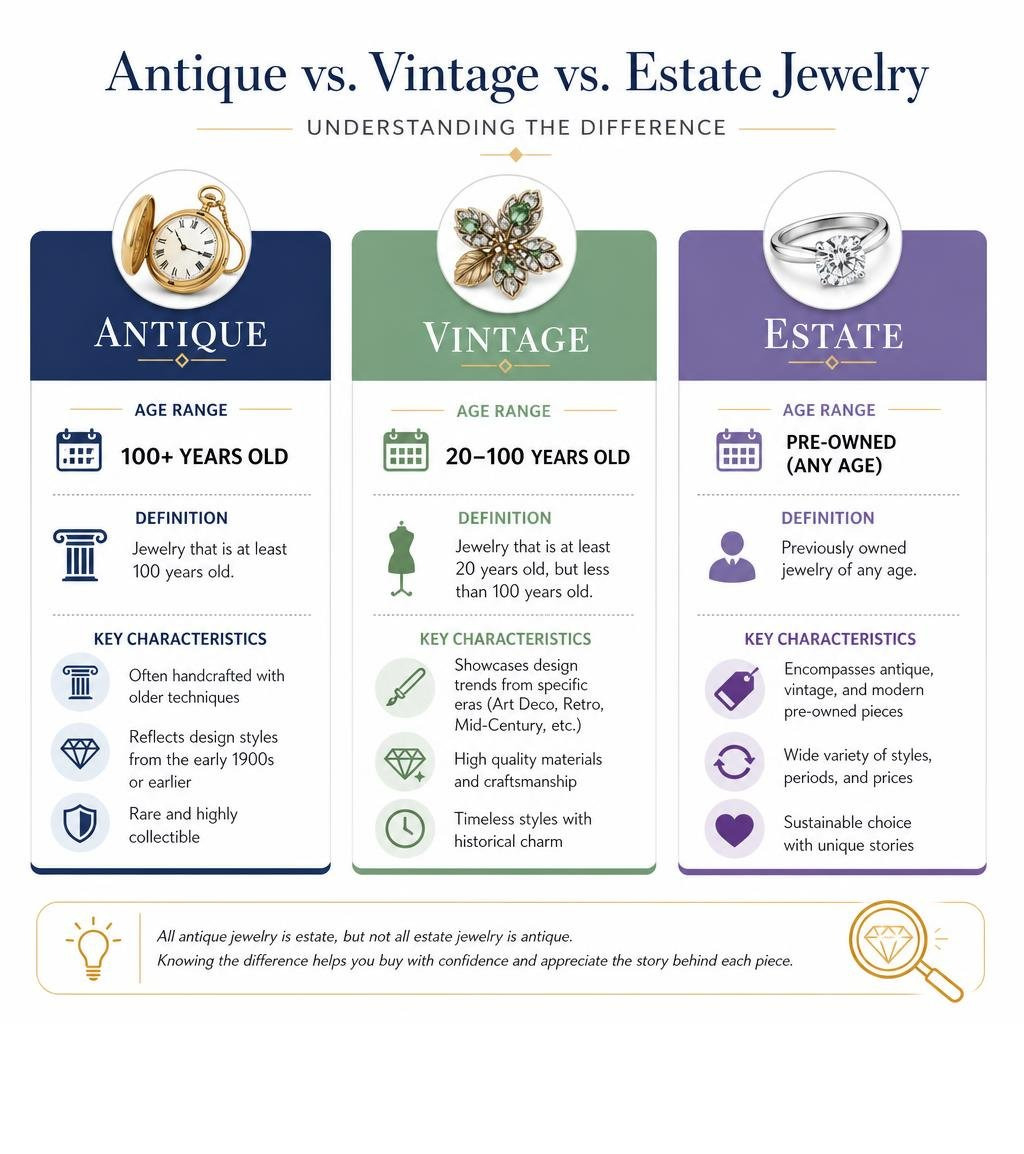
To navigate the market like a seasoned collector, it helps to understand the terminology. While these terms are sometimes used interchangeably by casual shoppers, they have distinct definitions in the jewelry industry:
- Estate Jewelry: This is an umbrella term for any jewelry that has been previously owned. It does not matter if the piece was made last year or two centuries ago; if it has a history of ownership, it is estate.
- Vintage Jewelry: To be classified as vintage, a piece must typically be at least 20 to 30 years old, but less than 100 years old. Vintage diamond studs often reflect the design trends of specific decades, such as the bold geometries of the 1980s or the structured styles of the mid-20th century.
- Antique Jewelry: An antique piece is one that is at least 100 years old. Antique diamond studs are incredibly rare because keeping two matching earrings together for over a century without losing one is a minor miracle!
For a deeper dive into these distinctions, check out our comprehensive estate diamond earrings guide 2026.
Value and Investment Potential vs. New Earrings
When you buy a brand-new pair of diamond studs from a conventional retail store, you pay for the raw materials, the manufacturer's labor, the brand's marketing budget, and the retailer's overhead. The second you walk out the door, that piece depreciates, much like a new car driven off the lot.
With estate diamond stud earrings, that initial retail markup has already been absorbed by the original owner. This means you are paying much closer to the intrinsic value of the diamonds and the precious metal.
Furthermore, high-quality estate jewelry holds its value remarkably well. Because you bought the piece at a fair market rate, its future resale or trade-in value remains stable. Over time, rare vintage cuts and signed designer pieces can even appreciate in value as they become harder to find. It is a wearable investment that you can enjoy every single day.
How to Evaluate Quality, Metals, and Settings
Evaluating pre-owned jewelry requires a blend of gemological science and an appreciation for historical craftsmanship. Unlike buying brand-new, identical studs from a catalog, every estate pair has unique characteristics.
Evaluating the Quality of Estate Diamond Stud Earrings
When shopping for estate diamond stud earrings, the classic "Four Cs" remain your primary guide, but with a few vintage twists:
- Cut: Modern estate studs usually feature the Round Brilliant cut, which is engineered for maximum fire and brilliance. However, older estate studs might feature historical cuts like the Old European Cut or the Old Mine Cut. These older cuts have larger facets and a different kind of warm, romantic glow. To understand how different cuts behave, see our guide on which diamond cut sparkles the most.
- Color: Diamond color is graded from D (completely colorless) to Z (light yellow or brown). Many beautiful estate studs fall in the G-I range, offering a white appearance to the naked eye while saving you thousands of dollars compared to D-F colorless stones.
- Clarity: This measures the internal and external imperfections (inclusions and blemishes). Grades like VS1 or VS2 mean the diamond is eye-clean, meaning you cannot see any flaws without a jeweler's loupe. Even SI1 or SI2 clarity diamonds can offer incredible visual beauty at an accessible price point.
- Carat Weight: This is the physical weight of the diamond, often expressed as carat total weight (ctw) for the entire pair. Remember to verify whether the listed carat weight represents the combined weight of both earrings or the weight of a single stone.
To master these concepts before you shop, we highly recommend reading our four cs of diamonds breakdown and our ultimate diamonds complete guide 2026.
Common Metals and Settings in Estate Jewelry
The choice of metal and setting style directly impacts both the durability and the aesthetic appeal of your earrings. You can find a wide variety of precious metals in curated estate collections.
- Platinum: Renowned for its weight, durability, and hypoallergenic properties. Platinum does not wear away over time, making it an incredibly secure home for valuable estate diamonds. Its bright white sheen also prevents any yellow light from reflecting into the stones.
- 18K Gold: Composed of 75% pure gold, 18K gold offers a rich, luxurious color. It is highly valued in estate jewelry, though it is slightly softer than 14K gold.
- 14K Gold: Composed of 58.5% pure gold, 14K gold is the industry standard for everyday durability. It is highly resistant to scratching and prong wear, making it perfect for active daily wear.
- Yellow Gold vs. White Gold: Yellow gold has enjoyed a massive resurgence and beautifully complements warmer diamond color grades (like H, I, or J). White gold provides a sleek, contemporary look that makes colorless diamonds pop.
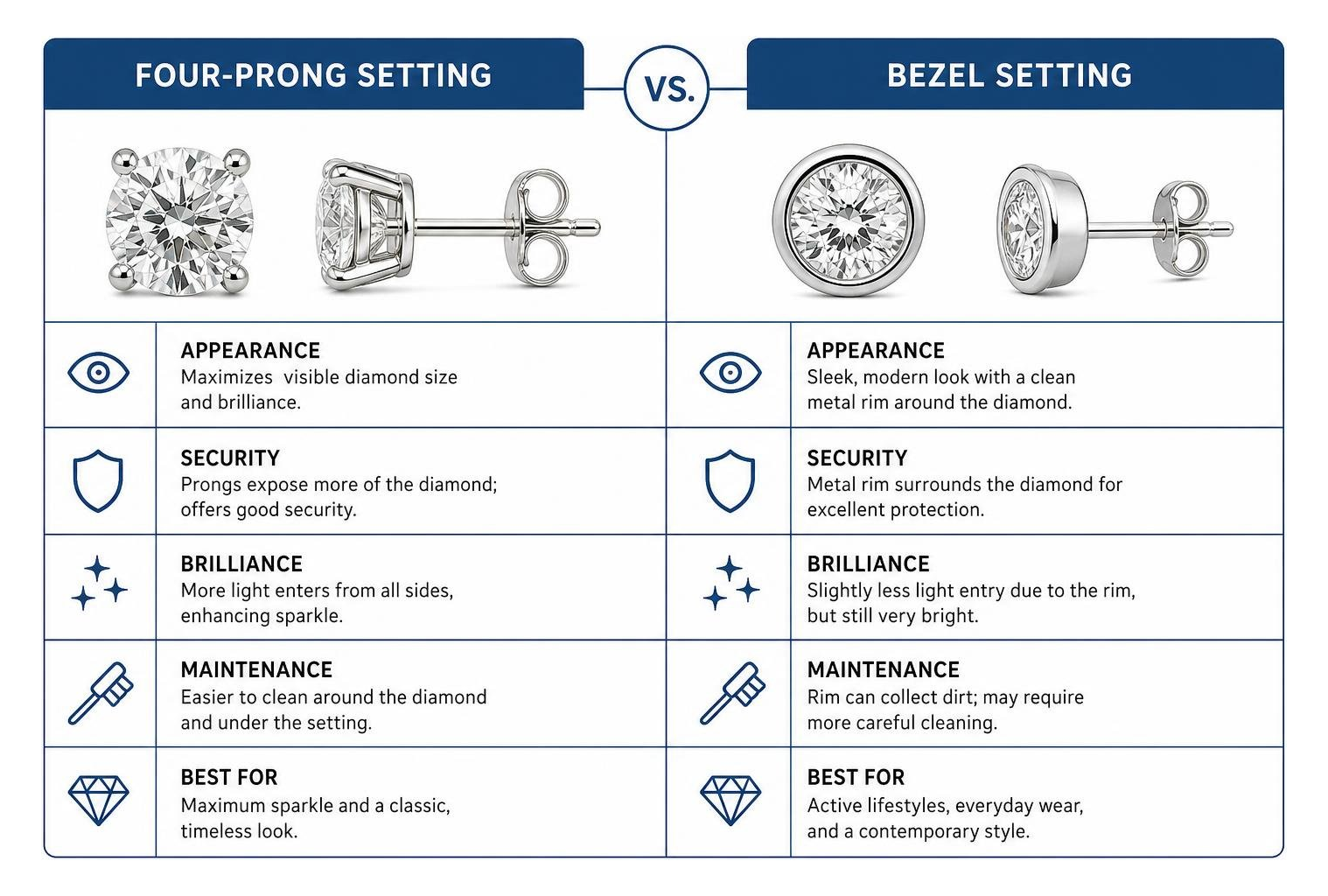
When it comes to settings, the classic four-prong setting is the most popular because it allows maximum light to enter the diamond from all angles, enhancing its natural sparkle. A bezel setting, which wraps a collar of metal completely around the rim of the diamond, offers a sleek, modern look and unmatched security for the stone.
To learn more about how different metals and settings interact with various stones, read our guide to understanding gemstones.
Smart Buying: Pricing, Policies, and Maintenance
Buying estate jewelry should be an exciting, worry-free experience. By arming yourself with knowledge about pricing, authentication, and proper maintenance, you can buy with absolute confidence.
Verifying Authenticity and Certification
Because estate diamonds are pre-owned, verifying their authenticity is paramount. You must ensure that the stones are natural, earth-mined diamonds rather than synthetic alternatives. If you are curious about the technical differences, read our article on are lab-grown diamonds real diamonds.
For high-value estate studs, always ask for official grading reports from trusted, independent gemological laboratories like the Gemological Institute of America (GIA) or the International Gemological Institute (IGI). These reports provide an unbiased blueprint of the diamond's exact specifications.
Additionally, a professional in-house appraisals document signed by a certified gemologist is essential for securing insurance coverage for your new treasure. This ensures your investment is fully documented and protected.
Care, Maintenance, and Professional Repairs
Once you find the perfect pair of estate diamond stud earrings, keeping them radiant is simple if you follow a few basic care guidelines:
- Clean Regularly: Diamonds are natural grease magnets. Oils from your skin, hairspray, and lotions can quickly dull their sparkle. Soak your earrings in a gentle solution of lukewarm water and mild dish soap, then gently brush them with a soft-bristled toothbrush.
- Store Safely: Diamonds are the hardest natural substance on earth, which means they can easily scratch your other jewelry-and each other! Always store your studs in separate compartments, soft fabric pouches, or their original boxes.
- Inspect Periodically: Before putting your earrings on, give them a quick visual inspection. Check to see if the prongs look even and make sure the stones do not wiggle in their settings.
If you ever notice a loose stone, a bent prong, or if you simply want your vintage earrings professionally polished and sanitized, it is time to seek expert help. For a complete look at keeping your jewelry in pristine condition, consult our jewelry repair near complete guide.
Frequently Asked Questions
Which designer brands are most sought after in estate jewelry?
Signed estate jewelry from iconic luxury houses like Tiffany & Co., Cartier, Van Cleef & Arpels, and Mikimoto is highly sought after. These pieces carry a premium because of their legendary design heritage, exceptional quality control, and prestige. When buying signed pieces, always look for clear maker's marks and serial numbers stamped on the metal. These details verify the piece's origin and ensure you are getting a genuine designer creation.
What are typical return policies for estate jewelry?
Because every estate piece is unique, return policies can vary. Reputable brick-and-mortar jewelers typically offer return windows ranging from 3 to 30 days for a full refund or store credit, provided the jewelry is returned in its original, unworn condition.
Many online estate sellers use specialized, tamper-evident security tags. If these tags are removed or altered, the return is invalidated. Always review the seller's specific terms regarding return shipping costs, restocking fees, and credit card processing fees before completing your purchase.
Can estate earring backings be altered?
Absolutely. If you find a gorgeous pair of estate studs but prefer a different type of backing, a skilled jeweler can easily modify them.
Standard friction backs (butterfly backs) can be swapped for highly secure screw backs or premium lock-and-release mechanisms (like La Pousette backs). If you have unpierced ears, many estate studs can even be converted into elegant clip-on styles without compromising the beauty of the design.
Conclusion
Finding the perfect pair of estate diamond stud earrings is a thrilling journey that combines history, sustainable luxury, and unmatched financial value. By choosing pre-owned, you get more diamond, higher-quality metals, and unique design character for your investment.
At Creekside Jewelers, we have been helping our community celebrate life's most precious moments for over a century. As the oldest continuously run watch and jewelry store in Colorado — proudly family-owned in our original Golden, CO location since 1902 — we specialize in matching our clients with extraordinary estate treasures.
Whether you are looking to buy a stunning pair of pre-owned studs, design a custom masterpiece, or require expert on-site repairs, our team is here to guide you with warmth, honesty, and expertise.
Ready to expand your jewelry knowledge? Explore Creekside Jewelers Education Hub today, or stop by our historic Golden showroom to discover our latest estate acquisitions in person!