
Understanding the nuances of historical eras makes exploring vintage engagement ring styles an exciting adventure. Each period reflected the social movements, technological advances, and artistic tastes of its time. When you shop for an authentic vintage piece, you are choosing a wearable fragment of history crafted by master artisans who cut gemstones by hand and worked without modern electric machinery.
Today, vintage engagement rings—specifically pieces from the Victorian, Edwardian, and Art Deco eras—account for roughly 15-20% of the entire antique and estate jewelry market. The unique personality of these pieces comes down to three main components: the precious metal used, the diamond cut, and the decorative technique.
To give you a clear overview, here is how the primary design features compare across the four main vintage eras:
| Era | Primary Metals | Signature Gemstone Cuts | Distinctive Features |
|---|---|---|---|
| Victorian (1837–1901) | Yellow Gold, Rose Gold, Silver-topped Gold | Old Mine Cut, Rose Cut, Cushion Cut | Floral patterns, serpentine motifs, cluster settings, hidden romantic engravings |
| Edwardian (1901–1915) | Platinum, Light Yellow Gold | Old European Cut, Rose Cut | Fine filigree, hand-applied milgrain, bow and ribbon lace motifs, diamond-heavy designs |
| Art Deco (1915–1935) | Platinum, White Gold | Asscher Cut, Emerald Cut, Old European Cut | Geometric symmetry, bold colored gemstone accents (sapphires, emeralds), step cuts |
| Retro (1935–1950) | Warm Yellow Gold, Rose Gold | Emerald Cut, Synthetic Gemstone Accents | Large sculptural designs, illusion settings, bold bow and scroll ribbon work |
Victorian Era (1837–1901): Romantic Motifs and Rose Gold Vintage Engagement Ring Styles
The Victorian era was defined by nineteenth-century royal fashion and deeply romantic cultural influences. Jewelry from this period is generally divided into three phases: Early Romantic, Middle Grand, and Late Aesthetic. Early Victorian designs drew heavily from nature, featuring floral motifs, hearts, hands, and serpentine designs symbolizing eternal devotion.
Rose gold and rich yellow gold dominated this period. Interestingly, rose gold has seen a 45% resurgence in demand among vintage ring buyers since 2020, as modern couples fall in love with its soft, warm blush tone all over again.
In terms of gemstones, old mine-cut diamonds were the highlight of the Victorian era. These diamonds feature a square-like cushion shape with a high crown, small table, and open culet. Because they were hand-cut by candle or gas light to maximize sparkle in dim settings, they emit a warm, dreamy glow rather than the stark, bright flash of modern brilliant cuts. You will often see these diamonds placed in cluster settings resembling blossoming flowers or set along intricate bypass bands. If you adore soft romanticism, exploring Vintage-Inspired Engagement Rings: A Timeless Choice for Colorado Couples offers fantastic inspiration.
Edwardian Era (1901–1915): Delicate Platinum Lace and Intricate Milgrain
During the early twentieth century, jewelry aesthetics shifted toward light, airy, and ultra-feminine grace. The invention of the jeweler’s oxyacetylene torch allowed craftsmen to work with platinum like never before. Because platinum is remarkably strong, jewellers could create unbelievably thin, lace-like mountings that held gemstones securely while using minimal visible metal.
Edwardian rings are famous for two distinct artistic techniques:
- Filigree: Thread-like wires of precious metal bent and soldered into intricate lacework.
- Milgrain: Small bead-like ridges stamped or chiseled along the edges of metal settings, giving borders a textured, delicate finish.
Old European-cut diamonds—the direct predecessors of the modern round brilliant—were the prized central stones of the Edwardian period. With round perimeters, high crowns, and 58 facets, they sparkle brilliantly within platinum bow motifs, garland wreaths, and tiara-inspired head shapes. During this era, pearl accents were also extremely popular for halo framing and accenting. For more insights into pearls in fine jewelry, read our Estate Pearl Engagement Ring Guide 2026.
Due to the intense labor involved in hand-stamping milgrain and fabricating delicate platinum frameworks, an original Edwardian ring often commands an average price 20-40% higher than a comparable modern reproduction.
Art Deco Era (1915–1935): Geometric Glamour and Bold Gemstones in Vintage Engagement Ring Styles
If soft lacework represents the Edwardian period, crisp geometry and high energy represent Art Deco. Emerging after World War I, Art Deco reflected modern industrial growth, jazz culture, and architectural marvels like the Chrysler Building. Today, Art Deco remains among the most sought-after vintage engagement ring styles, seeing a 30% increase in online search interest over the past five years.
Art Deco rings favor symmetry, straight lines, octagonal frames, and step-cut gemstones. Platinum remained the metal of choice, though white gold emerged as a popular alternative. Key elements include:
- Geometric Patterns: Square, hexagon, and shield-shaped halos holding center diamonds.
- Calibre-Cut Gemstone Accents: Custom-cut sapphires, emeralds, or onyx stones fitted tightly together along geometric borders without gaps.
- Step Cut Diamonds: Emerald cuts and newly developed Asscher cuts featuring long, parallel facets that create a sophisticated "mirror-hall" visual effect.
The contrast between brilliant white diamonds and rich blue sapphire or green emerald calibré borders creates a striking look that remains effortlessly stylish modern decades later.
Retro Era (1935–1950): Bold Yellow Gold and Hollywood Glamour
The Retro era—often called Retro Modern—was born out of the Great Depression and World War II. Platinum was declared a strategic military supply during the war, forcing jewelers to turn to yellow gold and rose gold. To make a big visual splash with less metal weight, jewelers created bold, sculptural, roll-and-scroll designs inspired by Hollywood glamour.
Retro engagement rings feature large cocktail-style mountings, sweeping ribbon motifs, and illusion settings. Illusion settings use faceted, mirrored precious metal plates around a diamond to make a modest center stone appear significantly larger. Center stones were frequently emerald-cut diamonds or large colored gemstones, accented by small synthetic rubies and sapphires, which were widely produced during wartime metal and stone shortages.
Evaluating Authentic Vintage vs. Modern Reproductions and Condition Factors
When shopping for vintage engagement ring styles, you will encounter two distinct categories: true historical estate pieces (crafted 50 to 180 years ago) and modern vintage-inspired reproductions. Knowing how to distinguish between the two ensures you get the exact history and quality you pay for.
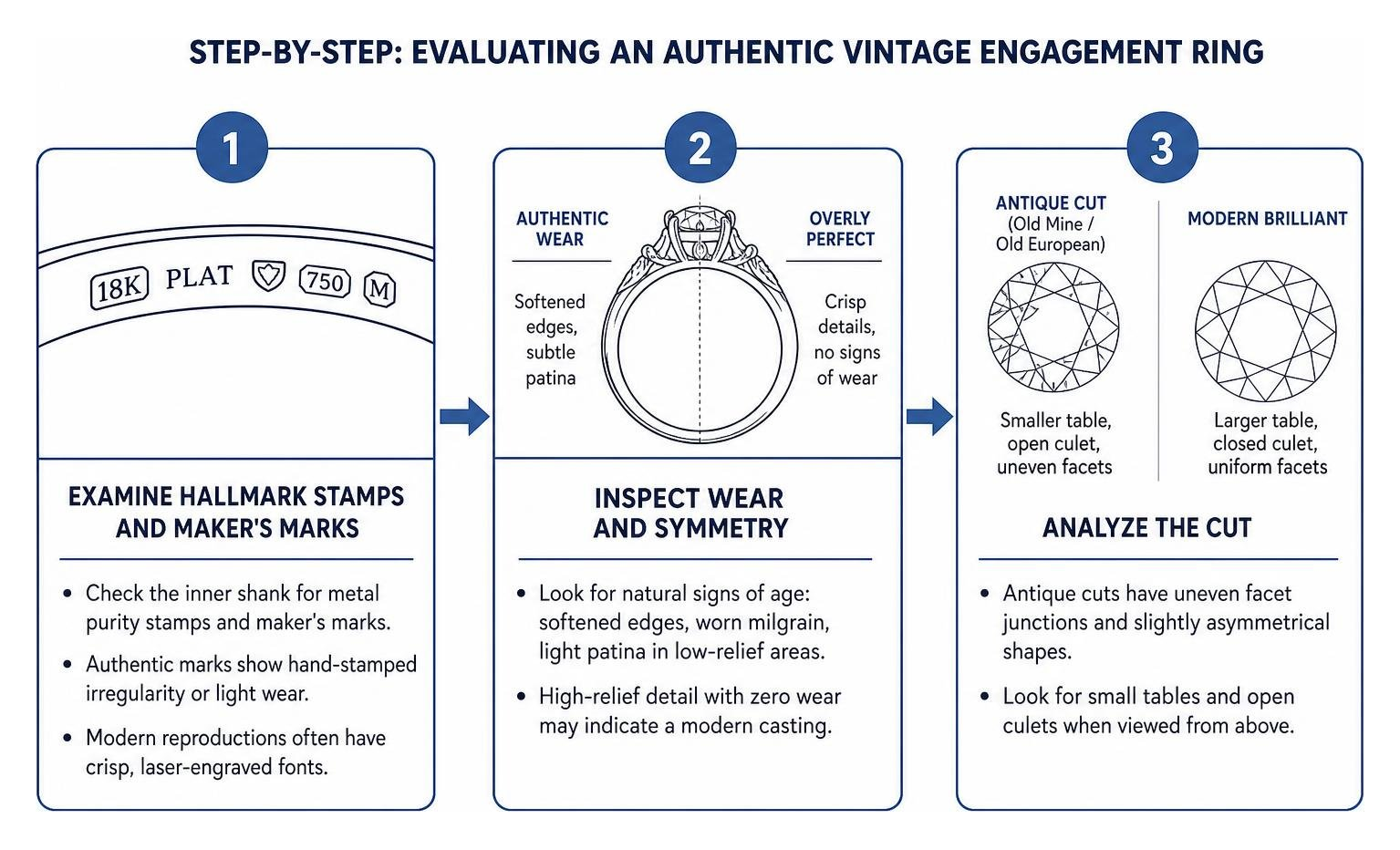
Here is how you can evaluate authentic vintage rings:
- Examine Hallmark Stamps and Maker's Marks: True antique rings often feature stamped stamps on the inner shank indicating metal purity (e.g., "18K", "PLAT", or British hallmarks) alongside a maker's mark. Modern reproductions frequently display clean, laser-engraved font, whereas authentic historical marks show slight hand-stamped irregularity or light wear.
- Inspect Wear and Symmetry: A ring worn for 80 years will show subtle, natural signs of age. Look for soft smoothing on the outer band, slight smoothing of milgrain borders, or light patina in low-relief areas. If a ring features high-relief milgrain without a trace of softening anywhere, it might be a contemporary casting.
- Analyze the Cut: Modern brilliant diamonds are cut with precise laser machinery to exact uniform standards. Antique old mine and old European cuts feature uneven facet junctions, slightly asymmetrical perimeters, small tables, and open culets visible when looking straight down through the top of the stone.
- Evaluate Structural Integrity and Resizing Limits: Pay close attention to the bottom of the band (the shank). Thin, paper-thin shanks may require a jeweler to rebuild or re-shank the ring. Be cautious with intricate filigree or full-eternity bands spanning 300 degrees; resizing these can distort delicate lacework or loosen channel-set stones.
If you are currently looking for authentic historical rings in your community, exploring options through a local jeweler specializing in a Vintage Engagement Ring Near Me allows you to physically inspect these details under a loupe before buying.
Pros, Cons, and Value: How Vintage Ring Costs Compare to Contemporary Rings
Choosing a vintage engagement ring offers clear benefits, but it also comes with practical considerations. Weighing the advantages against potential trade-offs helps you determine if an estate ring fits your lifestyle.
The Advantages of Vintage Engagement Rings
- Unmatched Artistry: Antique rings were individually hand-carved, pierced, and set by master artisans. The human touch behind antique filigree cannot be replicated by modern mass casting.
- Eco-Friendly Sustainability: Choosing an estate ring is an environmentally friendly option. It requires zero new mining, zero modern industrial refining, and leaves a minimal environmental footprint.
- Superior Value: On average, vintage rings offer exceptional value compared to brand-new retail rings. While top-tier Edwardian platinum pieces carry a premium due to rare craftsmanship, many vintage styles cost 15% to 30% less than modern equivalents of the same metal weight and diamond quality because you avoid initial manufacturing and retail markup costs.
- Historical Character: Carrying a ring that survived World War eras or turn-of-the-century celebrations creates an emotional connection impossible to buy off a factory line.
Potential Trade-offs to Keep in Mind
- Delicacy and Wearability: Antique mountings—especially thin Edwardian filigree or Victorian silver-topped settings—may not suit heavy daily wear, hands-on jobs, or rigorous physical activities.
- Irreplaceable Designs: Unlike a mass-produced modern ring, an antique piece is one-of-a-kind. If lost or severely damaged, finding an exact duplicate is nearly impossible.
- Maintenance Requirements: Prongs and bezel borders on antique rings have held gemstones for decades. They often require retipping or minor structural reinforcement shortly after purchase.
How to Care For and Maintain Your Vintage Engagement Ring
Because vintage rings have survived decades of history, keeping them beautiful for the next generation requires thoughtful care.
To clean and maintain your ring safely, follow these essential practices:
- Gentle Hand Washing: Soak your ring in a bowl of warm water mixed with a few drops of mild dish soap. Use a soft-bristled baby toothbrush to gently scrub behind the stone center and underneath filigree galleries. Rinse thoroughly in a clean bowl (never directly over an open drain!) and pat dry with a lint-free cloth.
- Schedule Bi-Annual Prong Inspections: Have a trusted jeweler check your ring’s setting integrity every six months. A quick check under a microscope catches loose stones or worn prongs before a gemstone falls out.
- Store Separately: Store your vintage ring in its own fabric-lined jewelry box or soft pouch. Diamonds easily scratch metals and softer colored gemstones like emeralds, sapphires, or pearls.
- Remove During Rough Activities: Take your ring off before gardening, weightlifting, swimming, or doing heavy household cleaning with chemicals like bleach or ammonia.
Building a complete routine for caring for historic jewelry is simple once you know what to watch for. If you appreciate estate jewelry and want to expand your collection, explore our comprehensive Estate Diamond Earrings Guide 2026 for details on preserving historic diamond settings.
Frequently Asked Questions About Vintage Engagement Rings
What is the most popular vintage engagement ring style?
Art Deco is currently the most popular vintage engagement ring style. Its bold geometric patterns, symmetrical frames, and colorful gemstone accents (like sapphire border halos) match both classic and contemporary wardrobes, contributing to a 30% increase in search popularity in recent years.
How can I tell if a vintage ring can be resized safely?
Check the thickness of the bottom band (the shank) and how far the side details extend around the ring. Rings with plain lower shanks can usually be resized up or down 1 to 2 sizes easily. However, rings with filigree running around the entire band or delicate side accents may distort or lose stones if resized too dramatically. Always consult a jeweler specializing in antique restoration before attempting a resize.
Are vintage engagement rings more affordable than modern rings?
In many cases, yes. Because vintage rings bypass contemporary manufacturing and diamond mining overhead, they often cost 15% to 30% less than modern retail rings of similar quality. However, rare Edwardian platinum filigree or signed Art Deco pieces with exceptional provenance can command a premium price due to their high historical value and rare hand craftsmanship.
Conclusion
Choosing among various vintage engagement ring styles is a magical journey. Whether you fall in love with the blush tones of a Victorian rose gold cluster, the airy elegance of an Edwardian filigree setting, the bold symmetry of an Art Deco sapphire halo, or the warm glamour of a Retro gold scroll, your ring will carry a unique history that speaks to your personal love story.
At Creekside Jewelers, we have helped couples find forever pieces since 1902. As the oldest continuously run jewelry store in Colorado, operating in our original location, our family-owned tradition was built on fine hand-craftsmanship and honest expertise. We personally curate extraordinary estate pieces and offer on-site repairs to ensure your ring shines for generations to come.
If you are ready to find a piece of history that feels like it was custom-made for you, learn Why Creekside Jewelers is the Best Place to Buy Engagement Rings in Colorado or stop by our store to discover our estate collection today.