

What Lab Grown Diamonds Really Are
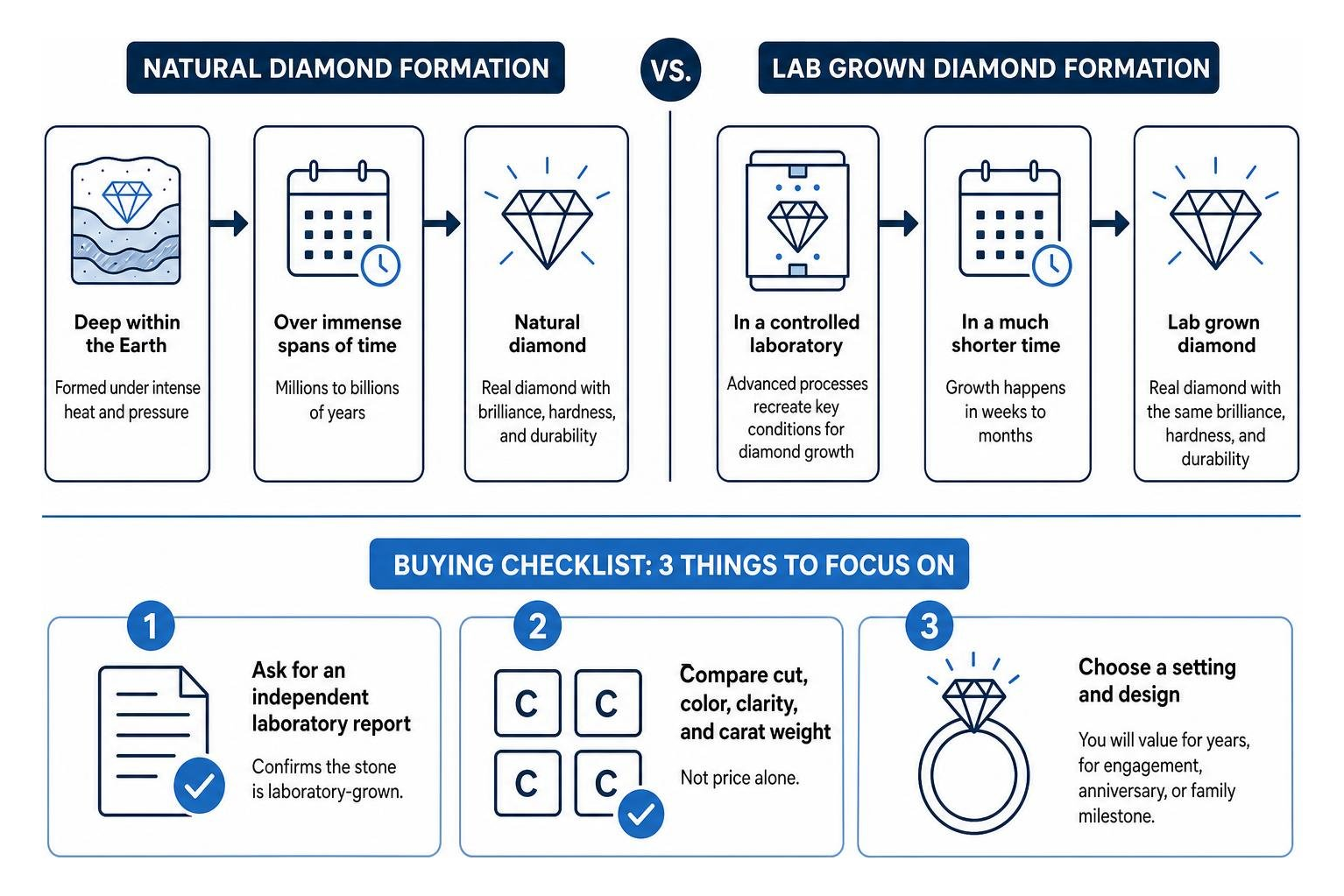
Lab Grown Diamonds are real diamonds created in a controlled laboratory rather than deep within the Earth. They have the same basic carbon crystal structure as natural diamonds and share their famous brilliance, hardness, and durability. They are not the same as diamond look-alikes such as cubic zirconia or moissanite.
For a confident purchase, focus on three things:
- Ask for an independent laboratory report that confirms the stone is laboratory-grown.
- Compare cut, color, clarity, and carat weight, not price alone.
- Choose a setting and design you will value for years, whether it marks an engagement, anniversary, or family milestone.
Modern growth methods can produce diamonds with striking beauty in a wide range of sizes and qualities. Yet origin still matters: natural diamonds formed over immense spans of time underground, while lab-grown stones are made through advanced processes that recreate key conditions for diamond growth.
This guide explains how Lab Grown Diamonds are made, how experts identify them, what grading reports mean, and the practical trade-offs to consider before choosing a stone for fine jewelry.
Understanding the Difference: Simulants, Moissanite, and Lab-Created Stones
When exploring sparkling gemstones, it is easy to get overwhelmed by terminology. Not everything that dazzles the eye possesses the structural integrity or chemical makeup of a diamond. Diamond imitations fall into distinct categories: diamond simulants and authentic laboratory-created diamonds.
Simulants such as cubic zirconia (CZ) and synthetic moissanite merely imitate the appearance of a diamond. Cubic zirconia is synthesized zirconium dioxide. While it delivers clear brilliance when new, it is softer, denser, and prone to scratching or clouding over time.
Moissanite, made of silicon carbide, is an entirely separate gemstone with distinct optical properties. Because moissanite is doubly refractive, it splits light beams entering the stone, creating a disco-ball effect with vibrant rainbow fire that differs from the crisp, balanced scintillation of a diamond. Many jewelry buyers often ask whether lab created stones and moissanite are identical, but their physical structures, refractive performance, and chemical compositions are fundamentally different.
A laboratory-grown diamond features an isometric carbon crystal lattice identical to an earth-mined stone. It does not imitate a diamond; it is an authentic diamond created through scientific ingenuity.
| Feature | Cubic Zirconia (CZ) | Moissanite | Lab Grown Diamond | Natural Diamond |
|---|---|---|---|---|
| Chemical Composition | $\text{ZrO}_2$ (Zirconium Dioxide) | $\text{SiC}$ (Silicon Carbide) | $\text{C}$ (Pure Carbon Lattice) | $\text{C}$ (Pure Carbon Lattice) |
| Mohs Hardness | 8 – 8.5 | 9.25 | 10 | 10 |
| Refractive Index | 2.15 – 2.18 | 2.65 – 2.69 | 2.42 | 2.42 |
| Dispersion (Fire) | 0.058 – 0.066 | 0.104 | 0.044 | 0.044 |
| Refraction Type | Singly refractive | Doubly refractive | Singly refractive | Singly refractive |
| Thermal Conductivity | Thermal insulator | Highly conductive | Extremely high | Extremely high |
How Lab Grown Diamonds Are Created: HPHT vs. CVD Methods

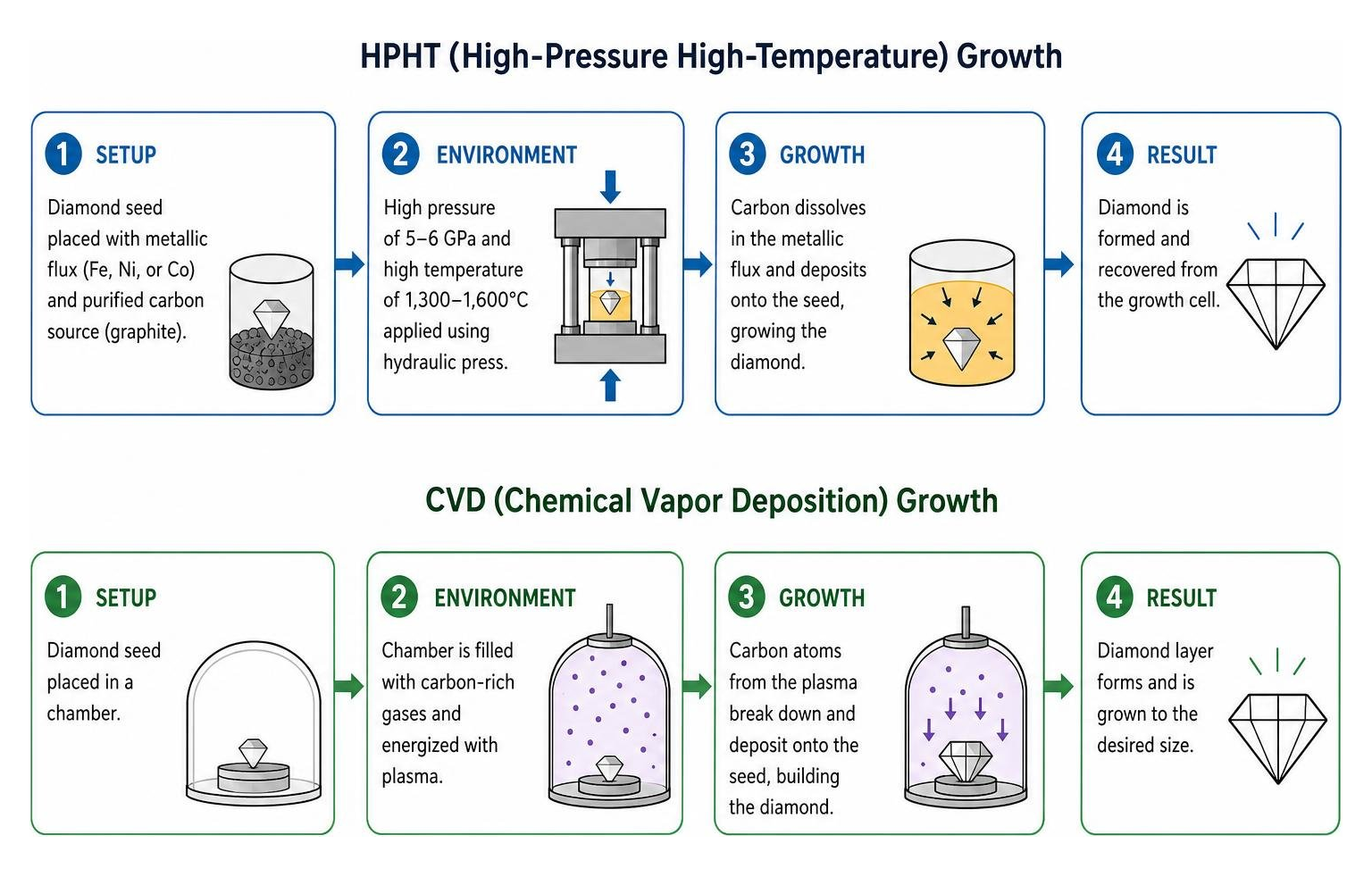
Creating a diamond in a laboratory requires replicating the extreme thermal and pressure conditions found deep within Earth's mantle or utilizing modern plasma physics. Two primary manufacturing methods dominate the industry: High-Pressure High-Temperature (HPHT) and Chemical Vapor Deposition (CVD).
1. High-Pressure High-Temperature (HPHT)
The HPHT method simulates the geological conditions roughly 150 to 190 kilometers beneath Earth's crust.
- The Setup: A tiny diamond seed is placed in a mechanical growth cell alongside a metallic flux (often iron, nickel, or cobalt) and highly purified carbon source graphite.
- The Environment: Massive hydraulic presses (such as cubic or split-sphere BARS apparatuses) generate colossal pressures of 5 to 6 GPa (gigapascals) while heating the chamber to temperatures between 1,300°C and 1,600°C.
- The Process: Under these conditions, the metallic flux melts, dissolving the pure carbon source. The dissolved carbon atoms migrate through the molten metal toward the cooler diamond seed, crystallizing upon it layer by layer to form a rough diamond.
2. Chemical Vapor Deposition (CVD)
The CVD method approaches synthesis from an atomic perspective, building crystals out of energized gas.
- The Setup: A thin slice of diamond seed is placed inside a sealed vacuum chamber.
- The Environment: The chamber is evacuated and filled with carbon-rich gases, primarily methane ($\text{CH}_4$) combined with hydrogen ($\text{H}_2$).
- The Process: Microwave beam energy ionizes the gas into a glowing plasma ball at temperatures ranging from 700°C to 1,200°C. This energy breaks the molecular bonds of methane, freeing carbon atoms. The released carbon atoms rain down onto the substrate seed, bonding in an orderly lattice to grow a diamond plate over several weeks.
The History and Evolution of Lab Grown Diamonds
Diamond synthesis was once thought to be science fiction. The earliest successful laboratory synthesis of diamond crystals took place in the early 1950s, with Union Carbide synthesizing CVD diamonds in 1952 and researchers achieving reproducible HPHT diamonds shortly thereafter. These early stones were small, dark, and heavily included, making them suitable only for industrial cutting tools and abrasives.
By the 1970s, researchers had refined HPHT methods enough to produce the first gem-quality stones. However, the operational cost remained high. Over the past several decades, advanced plasma physics, computer-controlled chambers, and refined multi-seed CVD techniques made large, high-clarity stones commercially accessible. This evolution explains why lab created gems are rising in popularity across the fine jewelry industry in 2026.
Natural vs. Created Stones: Physical Properties and Lab Identification
When we look at both stones side by side, natural and laboratory-created diamonds share identical physical, chemical, and optical properties:
- Hardness & Durability: Both score a perfect 10 on the Mohs hardness scale. Because of this structural hardness, scratch resistance and durability are unmatched by any simulant, making them impervious to daily abrasion from everyday surfaces.
- Refractive Index & Fire: Both possess an index of refraction of 2.42 and a dispersion value of 0.044, delivering identical sparkle, brilliance, and scintillation.
- Chemical Composition: Both are formed entirely of carbon atoms arranged in an isometric cubic crystal system. When consumers ask about confirming if lab gems are genuine diamonds, gemological physics affirms that they are real diamonds in every measurable parameter.
How Laboratories Distinguish Origin
Because natural and lab-created diamonds share the same physical makeup, traditional jeweler tools like basic thermal probes or standard 10x magnification loupes cannot reliably tell them apart.
To determine diamond origin, leading gemological institutions like the Gemological Institute of America (GIA) use advanced analytical instrumentation:
- Spectroscopic Testing: Instruments examine atomic-level trace impurities and crystal defects. For example, natural diamonds almost always incorporate aggregated nitrogen pairs (Type Ia diamonds), whereas CVD diamonds are typically Type IIa (devoid of measurable nitrogen) and may show distinct silicon-vacancy or nickel-related optical centers.
- GIA iD100® Desktop Screening: This specialized desktop device measures photoluminescence and UV fluorescence signatures, screening out simulants and lab-created diamonds from natural stones in under two seconds.
- Fluorescence & Phosphorescence Imaging: HPHT diamonds often exhibit distinct geometric growth patterns (cuboctahedral zoning) and persistent phosphorescence under deep shortwave ultraviolet light, whereas natural diamonds typically exhibit octahedral growth sectors.
GIA Certification Standards for Lab Grown Diamonds
Grading laboratories evaluate lab-created diamonds against the established 4Cs: Cut, Color, Clarity, and Carat Weight. Just like mined gems, lab stones vary naturally during growth. Contrary to popular belief, they are not automatically perfect; evaluating clarity grading and internal inclusions is essential because metallic flux entrapment or internal graining can occur.
To safeguard consumers, reputable laboratories apply strict standards:
- Laser Inscription: The diamond's girdle is micro-laser inscribed with a unique report number and the explicit phrase "LABORATORY-GROWN" to ensure transparency throughout the supply chain.
- Digital Verification: Every certificate can be instantly validated through digital report check systems to verify its grading specifications.
- Comprehensive Documentation: The report outlines precise dimensional proportions, polish, symmetry, color nuance, and post-growth treatment history, serving as an authoritative reference alongside any comprehensive diamond reference guide.
Selecting the Right Stone: Value, Sizing, and Jewelry Styles
Choosing between natural and lab-grown diamonds comes down to personal values, style goals, and budget considerations.
Because laboratory production runs on scalable scientific processes, lab-grown diamonds typically cost significantly less than natural diamonds of equivalent carat weight, cut quality, and clarity. This affordability allows buyers to maximize their visual presentation, making choices like selecting a 2 carat lab created stone accessible for budgets that might otherwise accommodate a smaller mined gem.
When evaluating lab created diamonds for engagement rings, you can allocate more of your budget toward premium metals and custom detailing. Pairing exceptional lab-grown centers with custom engagement ring settings allows you to achieve intricate filigree, hidden halos, or bezel profiles suited to your exact tastes.
Reviewing a dedicated lab created ring design guide will help you pair your diamond's shape—whether an elongated oval, emerald cut, or round brilliant—with the right prong arrangement and band proportions. Partnering with seasoned professionals and finding top jewelry retailers ensures that your center stone is cut to ideal optical proportions rather than cut simply to preserve rough weight.
Frequently Asked Questions About Diamond Alternatives
Can a jeweler tell if a diamond is lab-grown without specialized equipment?
No. Under a standard 10x jeweler's loupe or standard tabletop binocular microscope, a lab-grown diamond displays identical optical behavior, facet reflections, and brilliance as an earth-mined diamond. Standard handheld thermal or electrical conductivity testers will register both as authentic diamond material. Only professional gemological screening tools, such as the GIA iD100® or deep spectroscopic photoluminescence equipment, can definitively identify laboratory growth features.
Do lab-created diamonds hold their value over time?
Lab-created diamonds should be purchased for their personal meaning, visual beauty, and immediate cost savings rather than as financial investments. Because manufacturing efficiencies and laboratory capacities continue to expand, wholesale market pricing for lab-grown rough has trended downward over time. Earth-mined diamonds carry higher rarity premiums and tend to maintain more stable historical secondary market values.
Are post-growth treatments permanent on lab-created stones?
Yes. Some CVD diamonds undergo post-growth HPHT annealing to enhance color—transforming faint brownish tones into colorless or near-colorless grades—by repairing structural strain within the carbon lattice. These high-pressure, high-temperature treatments permanently alter the crystal matrix at the atomic level. They will never fade, alter, or revert over time, even under the heat of a jeweler's bench torch during ring resizing.
Conclusion
Making an educated decision about fine jewelry starts with transparent facts. Lab-grown diamonds offer an exciting blend of modern technology, exceptional durability, and striking visual brilliance. Whether you prefer the geological heritage of a natural stone or the innovative engineering of a laboratory-created gem, the right choice is the one that fits your aesthetic vision and celebration of life's milestones.
As Colorado's oldest continuously operating watch and jewelry store since 1902, our team at Creekside Jewelers pairs old-world integrity with modern gemological expertise. If you are interested in comparing stones in person, exploring local lab grown diamonds in Arvada CO provides hands-on guidance to help you select a piece of fine jewelry you will cherish for generations.