

What Makes Estate Emerald Earrings the Ultimate Rare Gemstone Find
Estate emerald earrings are among the most sought-after rare gemstone jewelry pieces available today. Here's a quick overview of what they are and why collectors love them:
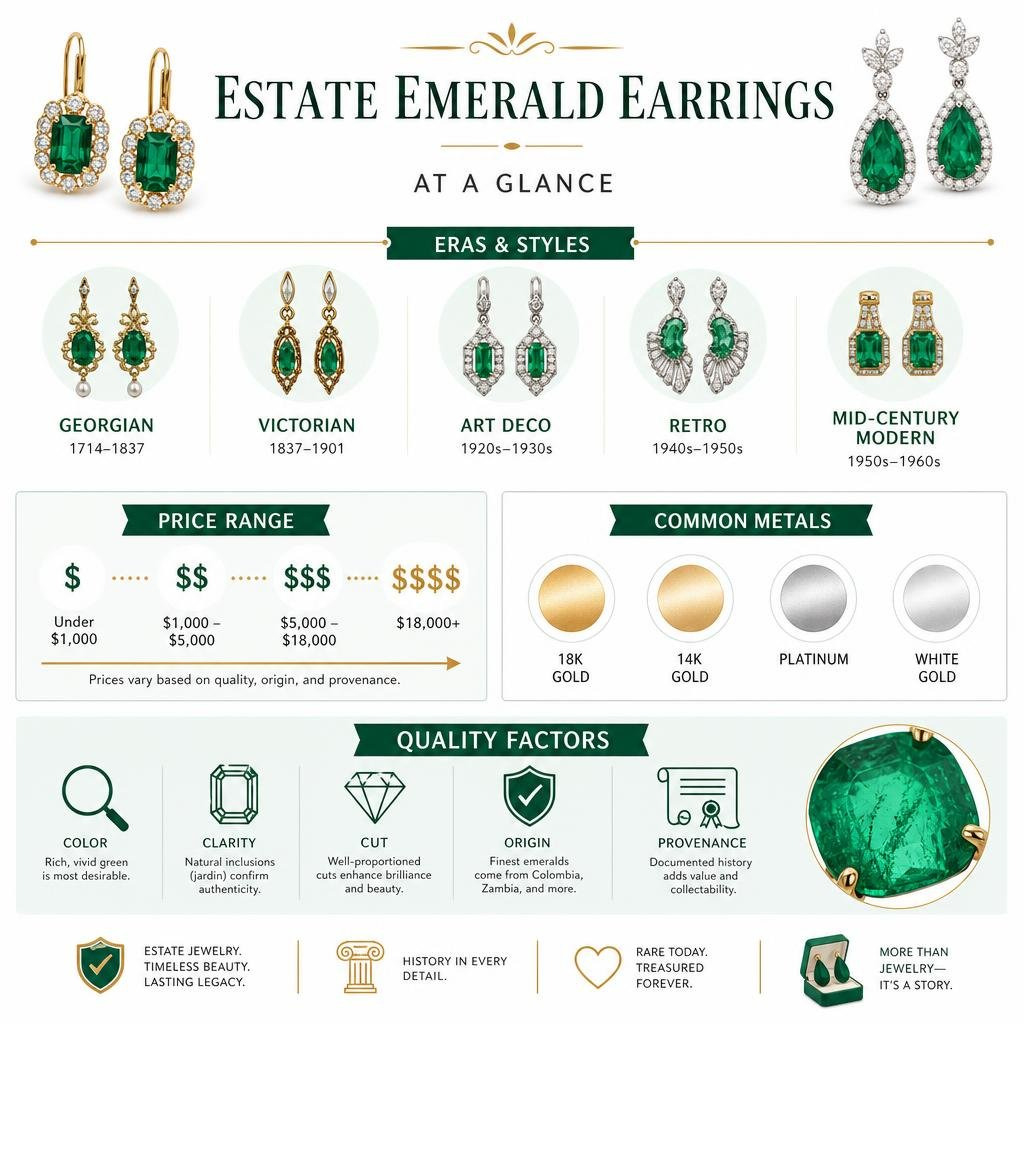
What are estate emerald earrings?
- Previously owned fine jewelry featuring natural emerald gemstones
- Can range from antique pieces (100+ years old) to vintage (20–99 years) to modern estate (pre-owned contemporary)
- Found in iconic styles from Georgian, Victorian, Art Deco, Retro, and Mid-Century Modern eras
- Set in metals including 18K gold, 14K gold, platinum, and white gold
- Prices range from under $1,000 to well over $18,000+ depending on quality, origin, and provenance
There are currently over 5,350 estate and antique emerald earrings listed on major platforms like 1stDibs alone — in styles from simple studs to dramatic chandelier drops.
What sets these earrings apart isn't just their beauty. It's their history. A pair of estate emerald earrings might have graced a royal court, a Hollywood premiere, or a family heirloom collection passed down through generations. Each piece carries a story that no new jewelry can replicate.
Emeralds themselves are extraordinary gemstones. Most natural emeralds contain visible inclusions — called jardin, the French word for "garden" — that resemble tiny moss or foliage patterns inside the stone. Rather than being flaws, these natural markings are proof of authenticity and give every emerald its own fingerprint.
In this guide, we'll walk you through everything you need to know: how to identify eras and styles, evaluate quality, understand pricing, and care for your investment.
Defining the Allure of Estate Emerald Earrings
When you hold a pair of estate emerald earrings, you hold a piece of history. Unlike modern, mass-produced jewelry, estate pieces bring an undeniable sense of character and soul. The rich, deep green tones of an emerald paired with the unique craftsmanship of a bygone era create an unmatched aesthetic.
But what exactly do we mean when we call jewelry "estate"? To truly appreciate these rare treasures, it helps to understand how the jewelry industry categorizes them. You can dive deeper into the science and lore of these precious stones in our guide on Understanding Gemstones.
What Makes Estate Emerald Earrings Unique?
The primary appeal of estate jewelry lies in its previous ownership and historical significance. These are not pieces stamped out by the thousands in a modern factory. Many estate earrings feature hand-carved details, hand-set stones, and metalwork techniques that are rarely used today due to the high cost of skilled manual labor.
Because they were previously owned, they often carry fascinating stories. From royal estates to mid-century socialites, the provenance (the documented history of ownership) of these pieces adds an elite layer of prestige. Furthermore, purchasing estate jewelry is an environmentally friendly, sustainable way to enjoy luxury, as it requires no new mining.
Antique vs. Vintage vs. Estate Classifications
Though often used interchangeably by casual shoppers, "estate," "vintage," and "antique" have distinct definitions in the fine jewelry world:
- Estate: A broad umbrella term for any jewelry that has been previously owned. This includes everything from a pair of earrings purchased last year to a 200-year-old heirloom.
- Vintage: Jewelry that is at least 20 years old but less than 100 years old. Currently, in 2026, this spans from the mid-2000s back to the late 1920s.
- Antique: Jewelry that is at least 100 years old. As of 2026, any piece crafted in or before 1926 is officially classified as an antique.
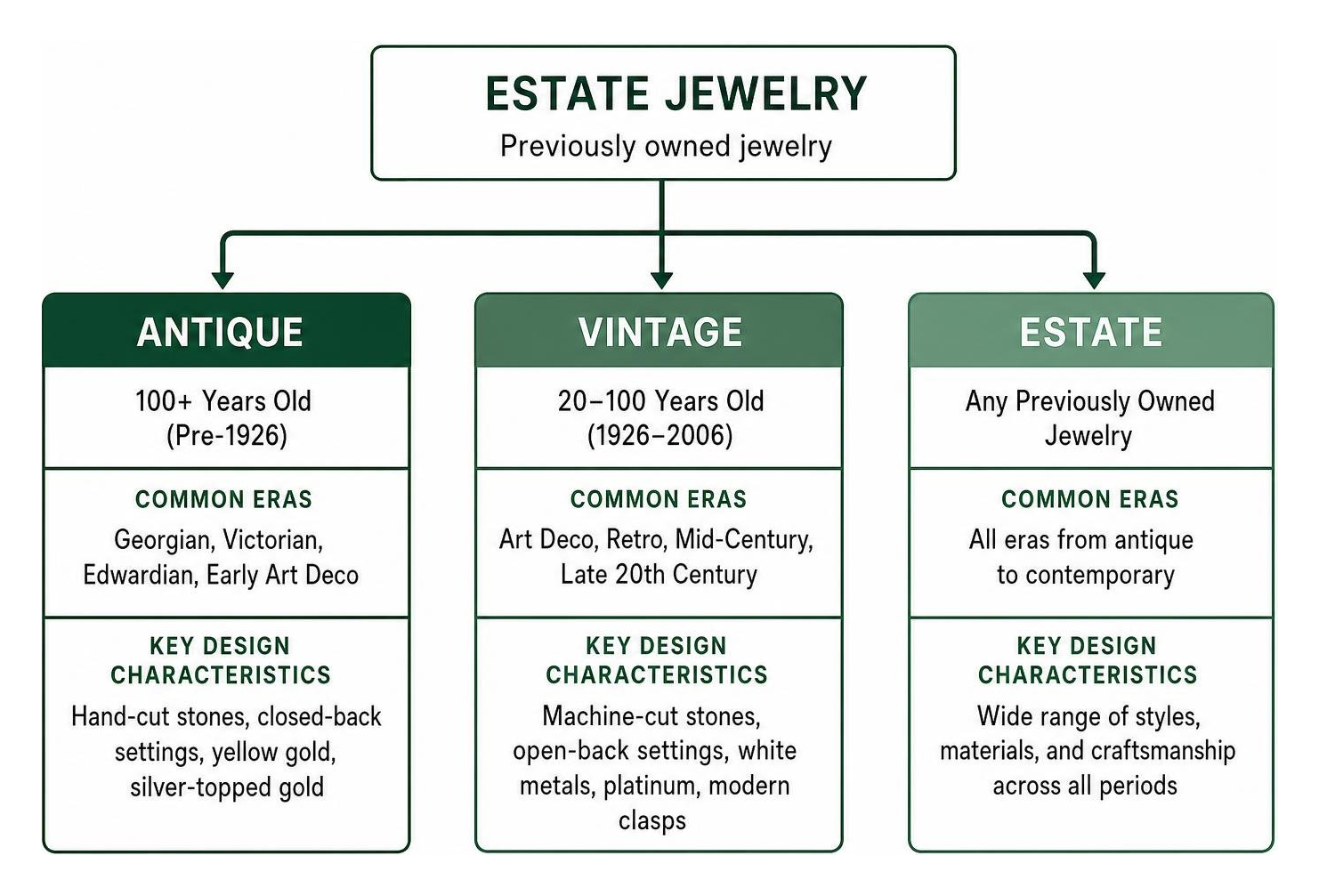
To help you visualize these differences, here is a quick reference table:
| Classification | Age Requirement (as of 2026) | Common Eras | Key Design Characteristics |
|---|---|---|---|
| Antique | 100+ Years Old (Pre-1926) | Georgian, Victorian, Edwardian, Early Art Deco | Hand-cut stones, closed-back settings, yellow gold, silver-topped gold. |
| Vintage | 20 to 99 Years Old (1926–2006) | Late Art Deco, Retro, Mid-Century, Late 20th Century | Bold geometric patterns, platinum, heavy yellow gold, chunky cocktail styles. |
| Modern Estate | Under 20 Years Old (Post-2006) | Contemporary, 21st Century | Sleek, minimalist lines, micro-pave diamonds, advanced laser-welded settings. |
Historical Eras and Iconic Styles of Estate Earrings
Every design era has a distinct voice. When searching for the perfect estate emerald earrings, identifying the historical period will help you find a style that aligns with your personal taste.
Art Deco and Retro Masterpieces
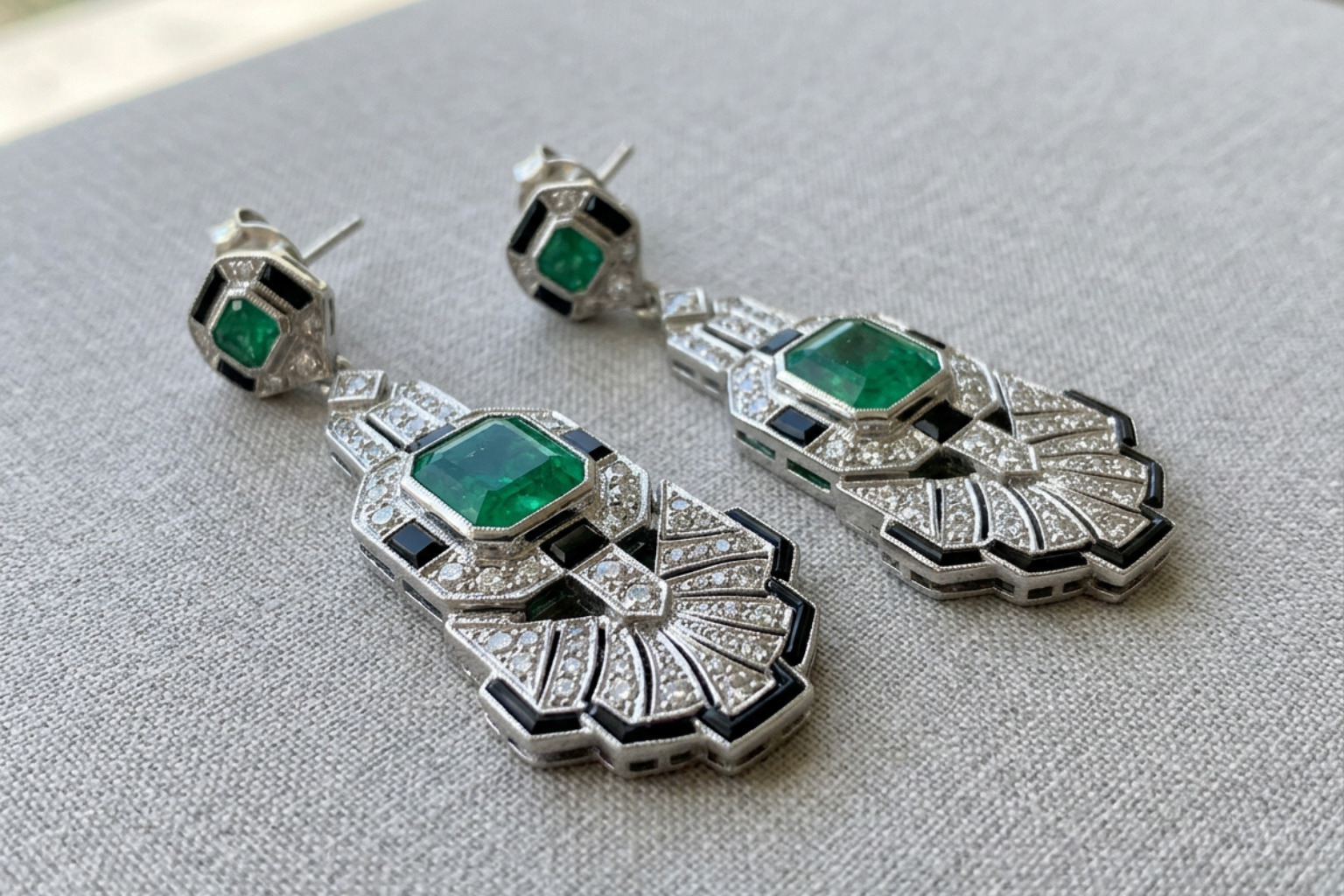
The Art Deco era (1915–1930s) is arguably the most famous period for emerald jewelry. Characterized by bold geometric patterns, symmetrical lines, and high-contrast color pairings, Art Deco earrings often feature vibrant green emeralds contrasted against brilliant white diamonds and black onyx, all set in cool platinum or white gold.
By the Retro era (1940s), wartime metal shortages influenced jewelry design. Platinum was reserved for military use, forcing jewelers to work with rose and yellow gold. Retro emerald earrings are famous for their large, sculptural, and voluptuous gold ribbons, scrolls, and fan shapes, often accented with smaller emeralds and rubies.
Classic Victorian and Georgian Designs
If you prefer soft, romantic, or dramatic historic styles, look further back:
- Georgian Era (1714–1837): Georgian earrings are exceptionally rare. They often feature "closed-back" settings, where the back of the gemstone is completely enclosed by metal. Jewelers of this era frequently placed highly reflective, colored foil behind the emeralds to artificially enhance their saturation and brilliance in candlelight.
- Victorian Era (1837–1901): Driven by Queen Victoria's love for colorful gemstones, Victorian jewelry often featured nature-inspired motifs like flowers, leaves, and serpents. You will find stunning drop and chandelier earrings during this era, often combining emeralds with pearls or old-mine cut diamonds.
A beautiful example of historical inspiration can be found in 18th-century Spanish "Catalan" or Iberian chandelier earrings. These modular "day-to-night" designs allowed the wearer to detach the heavy bottom drops for simple daytime wear, then reattach them for formal evening events at court.
Evaluating Quality: The 4Cs, Cuts, and the Jardin
Evaluating an estate emerald requires a slightly different mindset than grading a diamond. While diamonds are prized for their flawless clarity, emeralds are celebrated for their rich color and unique internal characteristics.
Understanding these differences is crucial. You can read more about how gemstone structural integrity affects jewelry wearability in our article on the Durability of Precious and Semi Precious Gemstones.
The Role of the Jardin (Inclusions) in Estate Emerald Earrings
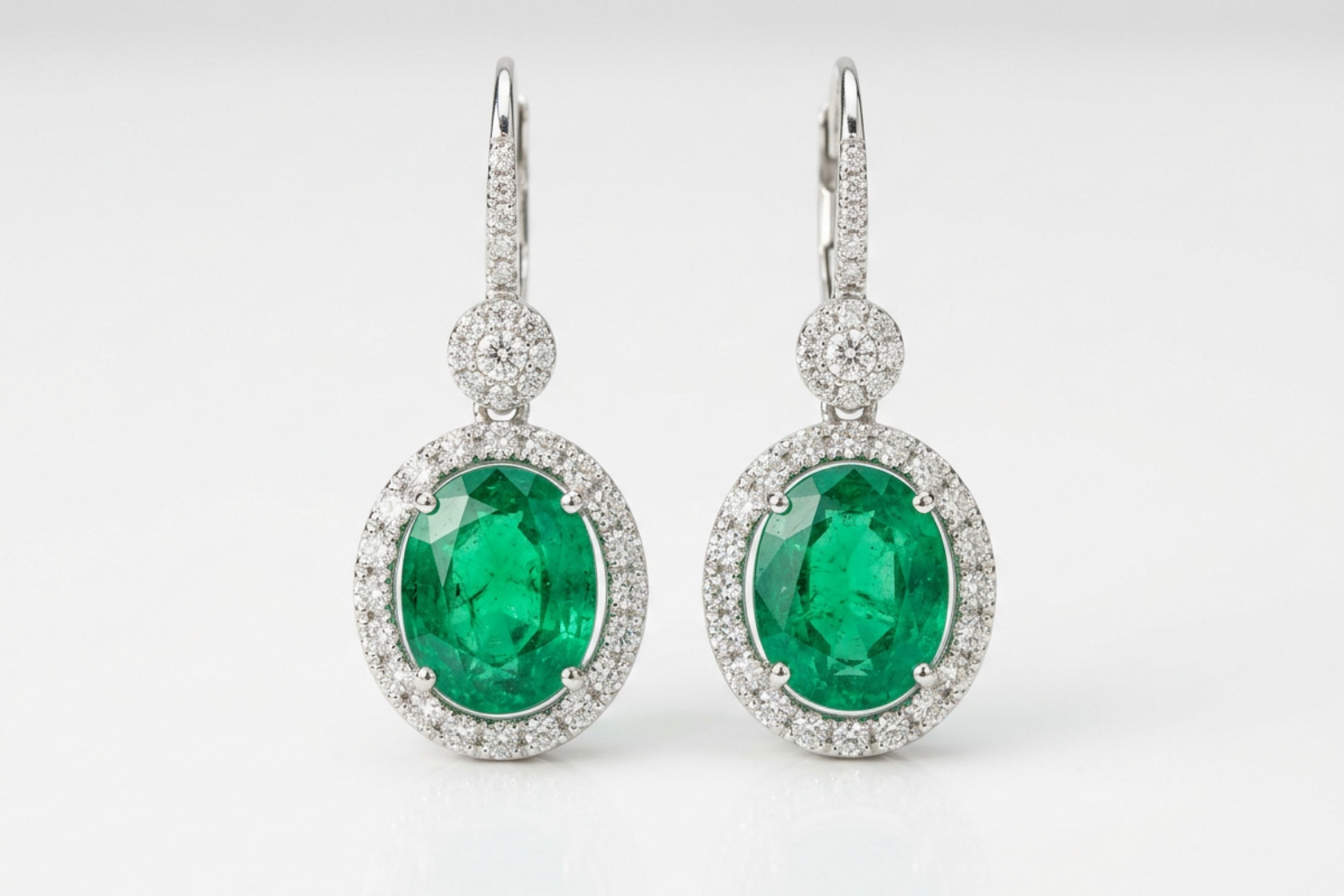
In emeralds, inclusions are not "flaws"—they are a poetic landscape. Known as the jardin (the French word for "garden"), these internal inclusions consist of tiny liquid bubbles, gas pockets, and microscopic mineral crystals that grow inside the stone.
Because synthetic or lab-grown emeralds often lack these complex, organic patterns, a distinct jardin is one of the easiest ways to verify that an estate emerald is natural and genuine.
Due to these natural fissures, almost all natural emeralds (historic and modern) undergo a standard treatment process where they are filled with natural cedarwood oil to improve their clarity and protect the stone.
Popular Gemstone Cuts for Estate Emeralds
The cut of an emerald dictates how it interacts with light and showcases its color:
- Emerald Cut: This iconic rectangular step-cut was specifically designed for this gemstone. The step-like facets highlight the deep saturation of the green while minimizing the physical stress on the crystal during the cutting process.
- Cabochon: A smooth, rounded dome with a flat base and no facets. Cabochon-cut emeralds are highly favored in estate jewelry because they emphasize the pure, velvety depth of the gemstone's color and highlight the natural jardin.
- Pear and Oval Cuts: Often used in drop and dangle earrings, these faceted cuts maximize the surface area, making the gemstones appear larger and reflecting light beautifully.
Metals, Settings, and Structural Engineering
Estate earrings are typically crafted in high-quality precious metals:
- Gold (14K, 18K, and 22K): Yellow gold is the traditional favorite for emeralds, as its warm tones naturally complement and enrich the green of the stone. High-purity 22K gold is especially common in vintage Eastern and Indian estate designs.
- Platinum and White Gold: Popularized during the Edwardian and Art Deco eras, these bright white metals provide a crisp, clean contrast that makes the green of the emerald pop.
For heavier statement drop earrings (such as a pair of 17-gram statement drops), structural engineering is vital. Look for pieces equipped with Omega clips or heavy-duty screw backs. These mechanisms distribute the weight of the earring evenly across the earlobe, preventing the earring from drooping forward and ensuring comfortable, secure wear.
For a comparison of how white metals and diamond pairings behave in estate settings, refer to our Estate Diamond Earrings Guide 2026.
Smart Buying: Authentication, Pricing, and Care
Buying fine estate jewelry requires due diligence. Because you are purchasing a unique piece of history, understanding how to verify its authenticity and care for it properly will protect your investment for decades to come.
Understanding Price Drivers and Provenance
The price of estate emerald earrings can range from under $1,000 for simple 14K yellow gold stud earrings with diamond halos to upwards of $18,000+ for high-jewelry drops. Several key factors drive these prices:
- Gemstone Origin: Emeralds from Colombia are historically the most prized and command a significant premium due to their unmatched, warm bluish-green hue. Zambian and Brazilian emeralds are also highly regarded for their excellent clarity and deep green tones.
- Carat Weight and Diamond Accents: The physical size of the emeralds and the total carat weight (ctw) of accompanying diamonds heavily influence the price. For example, a pair of 16.0-carat cabochon emerald earrings with 2.9 carats of rose-cut diamonds will naturally command a luxury price tag.
- Designer Provenance: If a pair of earrings can be traced to a famous design house (like Fabergé, Cartier, or Tiffany & Co.) or historic royal estates (such as the Medici family), the historical value can double or triple the price.
To find out what your own pieces might be worth or to verify a potential purchase, you can learn more about our professional Appraisals services.
How to Authenticate and Care for Your Investment
To ensure you are getting a genuine piece, always ask for certification from an independent, reputable gemological laboratory, such as the Gemological Institute of America (GIA) or American Gemological Laboratories (AGL). These certificates will verify the stone's origin and the level of clarity enhancement (oiling) present.
Once you own a pair of these delicate treasures, proper maintenance is key:
- NEVER use ultrasonic cleaners or steam: The high-frequency vibrations and intense heat of ultrasonic machines will strip the natural oils out of the emerald's fissures, leaving the stone dry, brittle, and highly prone to cracking.
- The Safe Cleaning Method: Gently wipe the earrings with a dry, ultra-soft microfiber cloth. For a deeper clean, use lukewarm water mixed with a drop of mild, chemical-free dish soap. Gently brush around the setting with a very soft-bristled toothbrush, rinse with clean warm water, and dry thoroughly.
- Storage: Always store your emerald earrings in a separate, soft fabric pouch away from harder gemstones like diamonds and sapphires, which can easily scratch the surface of an emerald.
If your vintage pieces ever require a check-up, prong tightening, or restoration, our master jewelers are here to help. Read our Jewelry Repair Near Complete Guide to see how we keep historic treasures in pristine, wearable condition.
Conclusion
Whether you are drawn to the geometric, icy contrast of Art Deco platinum, the warm, regal glow of Victorian yellow gold, or the velvety dome of a dramatic cabochon drop, estate emerald earrings stand out as the ultimate statement piece. They are a rare intersection of natural geological wonder, artistic history, and timeless style.
At Creekside Jewelers, we have been helping jewelry lovers in Golden, Colorado, discover and maintain their dream collections since 1902. As the oldest continuously run jewelry store in the region, our family-owned team is dedicated to providing expert guidance, custom designs, and on-site repairs.
Ready to learn more about fine jewelry? Explore the Creekside Jewelers Education hub, or read our companion guide on Custom Jewelry Guide 2026 to see how we can help you design a modern masterpiece inspired by the great eras of the past.