

Anatomy and Symbolism of 3 Stone Split Shank Engagement Rings
A three-stone split shank setting creates an undeniable presence on the hand. While a standard solitaire relies solely on a single gem to capture attention, this combination builds an entire architectural framework around the center stone. The band splits as it reaches the crown, creating an airy opening (often called negative space) that guides your eyes directly up to the trio of sparkling stones.
By branching out toward the side stones, the split shank increases finger coverage. This makes the entire ring look wider, more substantial, and noticeably grander without requiring an impossibly massive center diamond. It blends dynamic curves with balanced symmetry, offering plenty of room for creative accent details like pavé diamonds, hand-engraved filigree, or sleek, mirror-polished metal.
The Meaning Behind the Three-Stone Setting
The three-stone ring, traditionally known as a trilogy or trinity ring, is steeped in romantic lore. The most famous interpretation represents a couple's journey through time:
- The Left Stone: Your shared past and the memories that brought you together.
- The Center Stone: Your present commitment, typically represented by the largest gem.
- The Right Stone: Your future dreams, adventures, and eternal promise.
Beyond the timeline of romance, many view the three gems as symbols of friendship, love, and fidelity—the core pillars of a lasting marriage. In religious and spiritual traditions, the trilogy can also represent the Holy Trinity.
This deep emotional resonance is a major reason why three-stone settings represent roughly 25% of all diamond engagement ring sales. Whether you are marking a fresh beginning or a major anniversary milestone, browsing a curated engagement collection reveals just how timeless this trio remains across generations.
How the Split Shank Enhances Visual Balance and Stability
Have you ever seen a top-heavy ring constantly flop to the side of someone's finger? That spinning motion happens when a large gemstone sits on a narrow, single band.
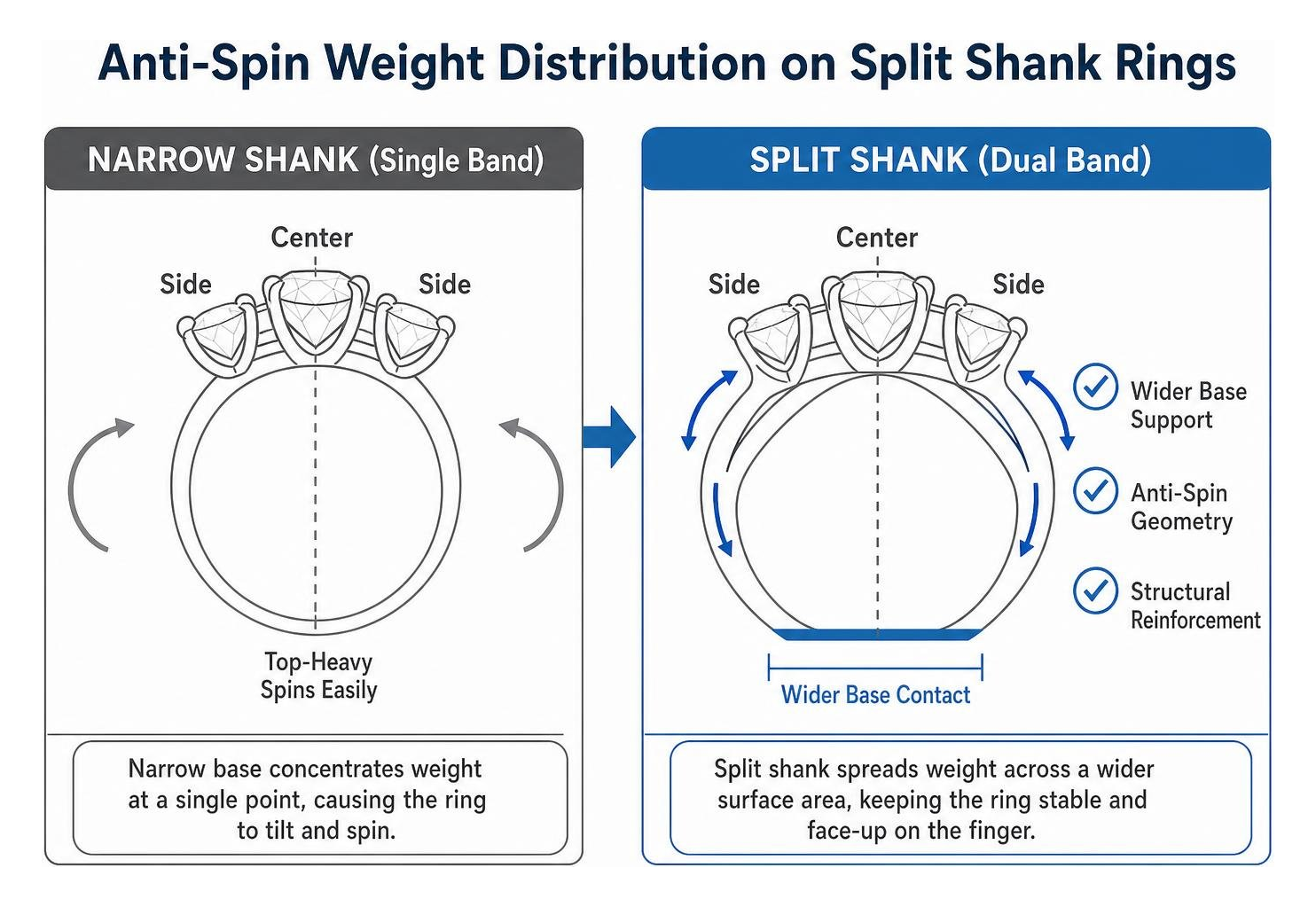
A split shank naturally solves this problem:
- Wider Base Support: By branching the band into two distinct strands on either side of the head, the ring distributes its physical weight over a larger surface area on the finger.
- Anti-Spin Geometry: The wider footprint prevents top-heavy settings from pivoting, keeping your gems positioned right where they belong—sparkling face-up.
- Structural Reinforcement: The double contact points create a robust anchor for the main gallery, protecting the prongs and gallery rail against everyday bumps.
- Flattering Proportions: The tapering negative space balances the optical weight of three prominent gems, making even substantial designs look graceful rather than bulky.
Thanks to this blend of security and elevated design, split shank mountings have seen a 30% increase in popularity over the past five years, solidifying their place as a premier choice for luxury bridal jewelry.
Diamond Cuts, Gemstone Combinations, and Metal Options
Because a three-stone ring features multiple focal gems, choosing complementary shapes and materials is the most exciting part of the design process.
Center and Side Stone Cut Pairings for 3 Stone Split Shank Engagement Rings
The relationship between the center stone and its flanking side gems sets the entire mood of the ring. Here are some of our favorite harmonious pairings:
- Oval Center with Pear-Shaped Side Stones: The pointed tips of the pear diamonds gently direct the eye inward toward the brilliant oval, blending seamlessly into the diverging lines of a split band.
- Round Brilliant Center with Tapered Baguettes: A mid-century classic. The clean, step-cut facets of the baguettes provide a sleek geometric contrast to the fiery sparkle of a round diamond.
- Emerald Cut Center with Trapezoid or Baguette Sides: An Art Deco dream that emphasizes symmetry, clean lines, and vintage sophistication.
- Cushion Cut Center with Round Brilliant Sides: Soft, romantic curves that maximize sparkle across the entire finger.
For modern couples shopping in September 2026, pairing these shapes with lab grown diamonds in golden co has become an incredible way to maximize carat weight and optical clarity within budget. Alternatively, incorporating colored gems—such as deep blue sapphires, vibrant emeralds, or fiery rubies as side accents—adds a splash of individuality to your heirloom piece.
Selecting Precious Metals for Durability and Contrast
The metal you choose affects not only the ring's color profile but also its long-term durability and maintenance needs:
- Platinum: The most durable and secure choice. Platinum is naturally hypoallergenic, heavy on the finger, and develops a rich patina over time without ever wearing away metal. It holds diamonds exceptionally securely in intricate split configurations.
- 14k and 18k White Gold: Offers a bright, silvery sheen that enhances white diamonds. It requires occasional rhodium plating to maintain its crisp, mirror-like finish.
- 14k and 18k Yellow Gold: Brings warmth and vintage charm. Yellow gold creates a striking contrast against bright, colorless diamonds and pairs beautifully with floral or milgrain detailing.
- Rose Gold: Modern and romantic, rose gold flatters a wide variety of skin tones and adds a unique, contemporary warmth to structural split shanks.
- Two-Tone Bands: Combining a platinum or white gold head with a yellow or rose gold split band offers the best of both worlds—maximum gemstone brightness on top, paired with warm contrast along the band.
Comparing Settings: Split Shank vs. Single Shank
To help you decide if an architectural split band matches your lifestyle better than a traditional single band, let's examine how they compare:
| Feature | Split Shank Setting | Traditional Single-Shank Setting |
|---|---|---|
| Finger Coverage | High; covers a broad portion of the finger | Minimal to Moderate; focuses strictly on the center |
| Ring Stability | High; wide base prevents top-heavy spinning | Moderate; prone to rotating if stone is large |
| Pavé Accent Potential | Exceptional; dual bands allow extensive accent diamonds | Limited; single row of accent stones |
| Metal Weight | Heavier; uses more precious metal for structure | Lighter; simpler and slimmer profile |
| Wedding Band Fit | Usually requires contoured, curved, or open bands | Readily pairs flush with classic straight bands |
| Maintenance Needs | Requires cleaning within gaps and checking more prongs | Simpler routine cleaning; fewer accent prongs |
Design Variations and Wedding Band Pairings for 3 Stone Split Shank Engagement Rings
Because split shanks have an expanded footprint, finding the right wedding band requires a little extra thought. While standard straight bands can leave a noticeable gap between the two rings, many brides love pairing their ring with:
- Contoured & Curved Bands: Specially curved to trace the exact outer arc of your split shank and side stones, sitting perfectly flush against the engagement ring.
- Chevron or V-Shaped Bands: The sharp or soft point of a chevron ring nests beneath the center stone, adding dynamic geometry.
- Open Cuff Bands: Modern bands with an intentional gap at the top that lets the three-stone head sit right in the center without touching.
- Vintage Milgrain & Pavé Details: If your engagement ring features beaded milgrain edges, choosing a matching band ties the entire bridal set together seamlessly.
If you are exploring off-the-shelf and bespoke options, you can browse dedicated wedding bands or discover custom jewelry in golden co to craft a wedding band that matches your ring's exact contours.
Cost Factors, Comfort Sizing, and Care Guidelines
The average cost of a three-stone split shank engagement ring generally ranges from $3,000 to $15,000, though high-carat natural diamonds or elaborate custom mountings can go higher.
Several factors influence the final price tag:
- The 4Cs (Cut, Color, Clarity, Carat Weight): Because you are purchasing three focal diamonds instead of one, balancing color and clarity across all three stones ensures they look uniform and bright together. The Gemological Institute of America developed this grading framework, and understanding it helps you compare stones with confidence.
- Accent Diamonds: A split shank covered in micro-pave diamonds adds labor and material costs compared to a solid, high-polish metal band.
- Metal Choice: Platinum's density and purity make it more expensive than gold, while intricate custom metalwork requires master bench jeweler time.
Sizing and Daily Comfort
Because split shanks are wider across the top and sides, ring sizing requires precision:
- The Wide-Band Effect: Wider bands fit more snugly than thin bands of the exact same size. You might need to size up by a quarter or half size for maximum comfort.
- Tapered Undersides: Look for split shanks that merge back into a single, smooth band at the base of the finger. This allows your fingers to close naturally and makes future ring resizings straightforward.
Cleaning and Maintenance
Split shanks feature unique nooks and negative space that catch lotions, soaps, and dust over time. Keeping your ring brilliant is easy with proper home habits and regular maintenance:
- Weekly Soak: Soak the ring in warm water mixed with mild dish soap for 15 minutes.
- Gentle Brushing: Use a soft, baby-grade toothbrush to clean behind the stones and between the split rails.
- Rinse & Dry: Rinse thoroughly in warm running water (with the sink drain safely plugged!) and dry with a lint-free microfiber cloth.
- Routine Checkups: Schedule a professional inspection twice a year. Having an expert evaluate prong integrity and gemstone tightness through trusted jewelry repair in Golden, CO ensures your stones stay safe for a lifetime.
Frequently Asked Questions About Split Shank Rings
How do you clean the hard-to-reach gap in a split shank ring?
To clean the negative space between the split rails, soak your ring in warm soapy water for 15 to 20 minutes to loosen trapped debris. Then, use a soft-bristled baby toothbrush to gently sweep between the bands. An ultrasonic cleaner can also remove built-up oils, provided your side stones are not fracture-filled or soft gems like emeralds or opals.
What type of wedding band fits flush with a split shank ring?
Because the base of a split shank setting is wider than a traditional solitaire, straight wedding bands will usually leave a visible space. To achieve a flush, seamless look, choose a custom-contoured curved band, a pointed chevron ring, or an open cuff design that cradles the three-stone head.
Are split shank settings more prone to diamond loss?
No. The split shank design itself is structurally very stable and provides a wide, rigid platform for the center head. However, if your split shank is lined with delicate micro-pavé accent diamonds, it has more individual prongs than a plain metal band. Regular prong inspections with a trusted jeweler ensure all tiny accent stones remain tight and secure.
Conclusion
A three-stone split shank engagement ring brings together rich symbolism, brilliant craftsmanship, and structural stability. By blending the past, present, and future trilogy with dynamic architectural bands, this style ensures your engagement ring catches the light from every angle.
At Creekside Jewelers, we have helped generations of couples find and create their dream rings. As Colorado's oldest continuously run jewelry and watch store—family-owned and serving our community in our original location since 1902—we bring over a century of bench expertise to every piece we touch. Whether you are searching for loose diamonds or looking to design a one-of-a-kind ring from scratch, we invite you to explore our selection of diamonds in golden co and let us bring your vision to life.