

How to Compare Fine Watches
The best fine watch depends on how you plan to enjoy it. If you want a piece to wear often, compare movement reliability, comfort, water resistance, and service needs. If you want an heirloom, look closely at craftsmanship, materials, and whether its design will still feel meaningful years from now.
These priorities explain why a one-of-a-kind mechanical clock, an elegant gold dress watch, and a durable everyday watch can all represent fine watchmaking. This guide compares the craft and purpose behind each, so you can decide what matters most to you.

Monumental Complications and Haute Horlogerie Innovations
At the peak of haute horlogerie, timepieces transcend everyday timekeeping to become mechanical sculpture and philosophy. A prime example of this rare category is an extraordinary astronomical clock that required seven years of intensive development.
Unveiled alongside an exhibition of historic masterworks at the Louvre Museum, this monumental creation pays homage to the intellectual curiosity of the Age of Enlightenment. It bridges centuries of scientific enquiry by bringing together over 15 distinct expert disciplines—ranging from master clockmakers, astronomers, and mechanicians to sculptors, jewelers, and musical composers. By connecting contemporary high horology with historic artifacts from Antiquity, the Renaissance, and the 18th century, such creations prove that the human drive to measure and conceptualize time remains timeless.
Defining Artistry in Fine Watches: Mechanical Automata and Astronomy
What establishes this monumental clock as a historic world first is its use of an automaton as a direct, functional time-telling complication. Rather than serving as decorative entertainment, the clock's sculpted central figure—an Astronomer—actively indicates the passing hours and minutes through physical choreography.
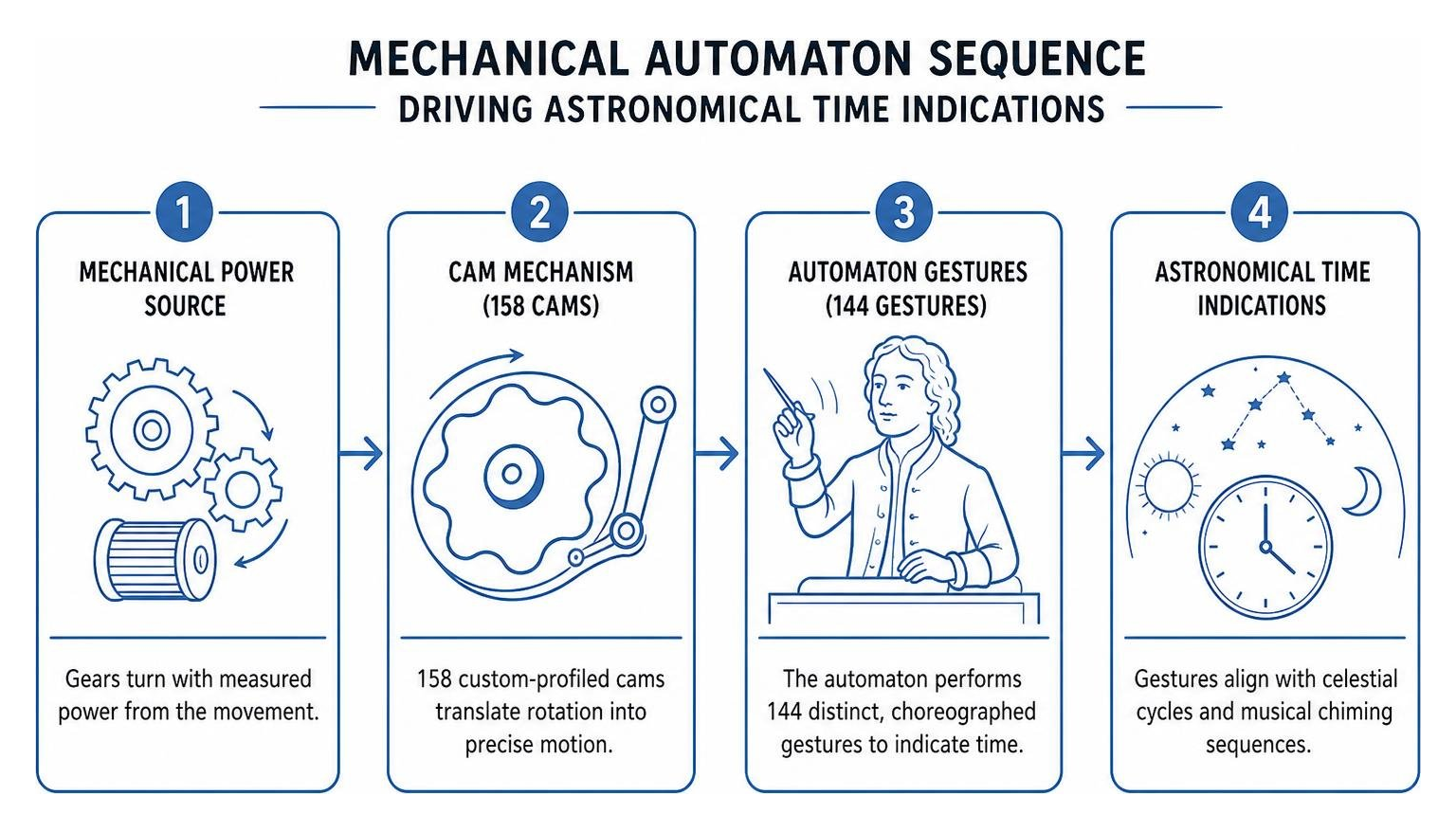
The engineering behind this motion is astonishingly intricate:
- 144 distinct gestures: The automaton executes fluid physical movements, rivaling the subtle footwork and posture of a classical ballet routine.
- 158 custom-profiled cams: A complex mechanical memory system translates the rotation of gears into expressive, lifelike articulation.
- Astronomical synchronization: The gestures are calculated to align with celestial cycles and musical chiming sequences composed specifically for the movement tiers.
Automata represent one of the oldest and most challenging branches of mechanical art. Whether displayed as an astronomical showpiece or miniaturized within our curated fine watches collection, kinetic complications demonstrate the limitless potential of pure mechanical engineering.
Multidisciplinary Craftsmanship and Métiers d'Art Miniaturisation
The physical construction of grand complications demands an unprecedented integration of structural architecture and decorative arts (Métiers d'Art). Monumental clocks are typically constructed across three defined dimensions:
- The Base and Foundation: Providing structural balance and housing foundational gear trains, often sculpted from rare geological specimens.
- The Kinetic Core: Housing the mechanical heart, striking trains, and automaton memory mechanisms.
- The Celestial Dome: Representing the heavens through astronomical charts and rotating planetary indications.
Executing these elements requires patient overcoming of material challenges. During the creation of this monumental clock, sourcing a single piece of optically pure rock crystal for the base took two full years.

Similarly, decorating the celestial dome required six months of laboratory testing before master artisans applied a single stroke of pigment to the star map. When combined with hand-engraving, grand feu enamelling, micro-marquetry, and precision gemsetting, these decorative techniques transform raw gold and crystal into narrative art.
Furthermore, translating such monumental scale into a Métiers d'Art wristwatch proves that the same astronomical accuracy and artistic finishing can live comfortably on the human wrist.
Precision Engineering in Everyday Fine Watches
While monumental works showcase what is mechanically possible, daily luxury watches focus on precision, durability, and wearable refinement. For most collectors, a fine timepiece must maintain chronometric accuracy across decades of continuous wrist wear while resisting magnetic fields, thermal shifts, and physical shocks.
Classic Dress Watch Mastery: Modern Chronometric Standards
A refined dress watch represents an exercise in disciplined balance. Models like an 18 ct yellow gold dress watch demonstrate how historic styling can house modern horological engineering.
To achieve uncompromised purity and luster, the manufacturer operates its own dedicated foundry, casting custom 18 ct gold alloys under stringent laboratory controls. The case features a distinctive split bezel—domed on the upper rim and fluted along the lower edge—producing a dynamic interplay of light.
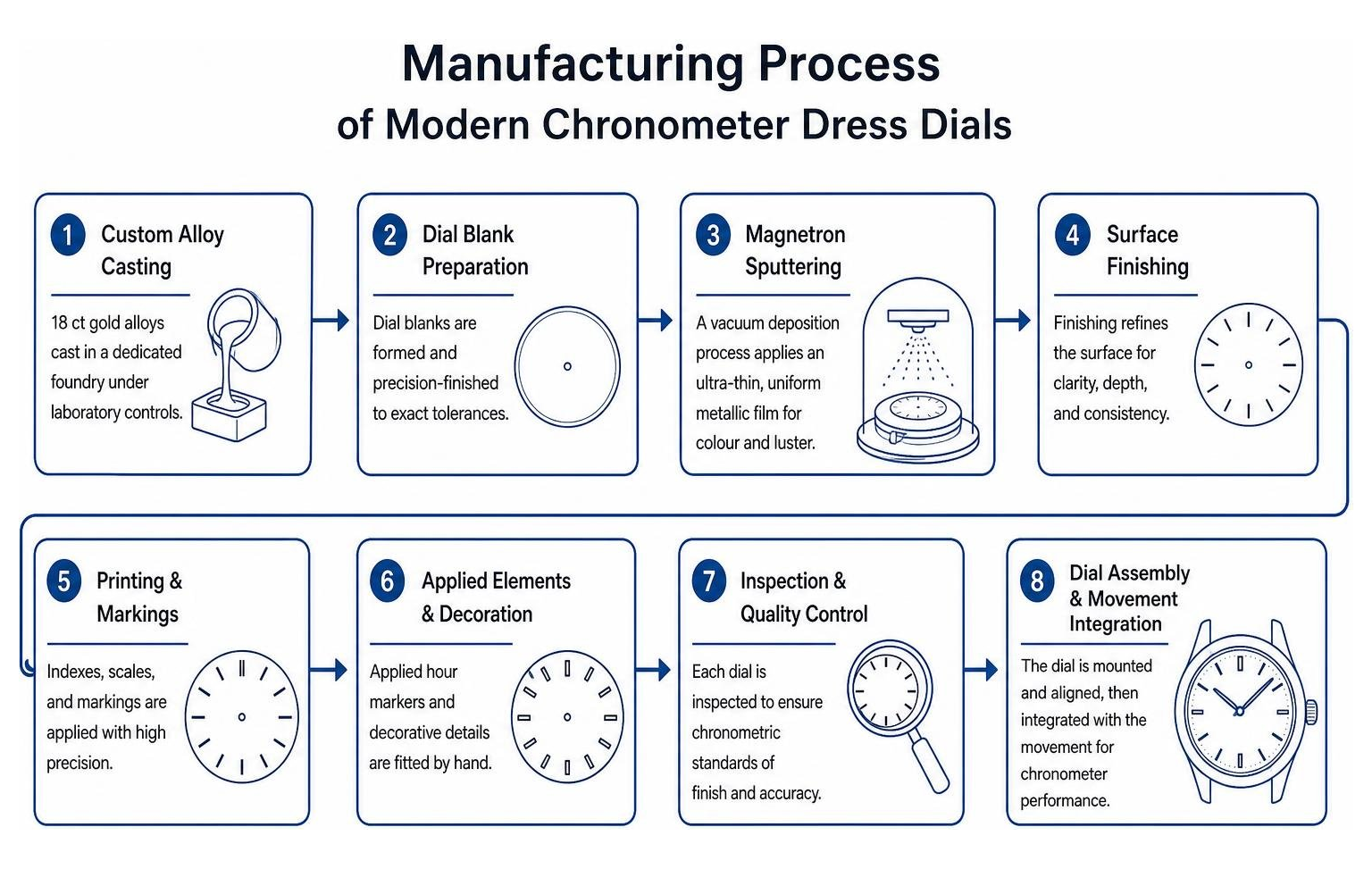
The dial coloration is achieved via magnetron sputtering, a high-tech vacuum deposition process that applies an ultra-thin, uniform metallic film over the surface. Beneath the dial beats a self-winding mechanical movement providing a 66-hour power reserve and high-precision chronometer certification (tested to an accuracy of –2/+2 seconds per day after casing). Paired with an ergonomic dual clasp designed to stay perfectly centered on the wrist, it demonstrates how traditional elegance benefits from cutting-edge manufacturing.
To preserve this degree of accuracy over generations, scheduling routine automatic watch service ensures lubricants remain fresh and balance assemblies operate at peak amplitude.
Enduring Luxury: Patented Alloys and Dial Architecture in Fine Watches
Daily-wear luxury watches demand superior metallurgical resilience. Standard pink gold alloys can lose their warm luster over decades due to environmental exposure and chemical interactions with chlorine or sweat. To solve this, proprietary formulations—such as patented 18 ct rose gold alloys enriched with platinum—permanently lock in the rose hue.
This material integrity is showcased in a rose gold luxury watch with a deep black dial that receives six successive layers of lacquer inside an airtight, controlled-atmosphere cleanroom, ensuring a pristine surface before natural stone hour markers are hand-riveted into position.
Supported by a 55-hour power reserve, a temperature-stable silicon hairspring, and 100 meters (330 feet) of water resistance, it offers go-anywhere versatility. For sports enthusiasts who prefer robust steel chronographs, racing-inspired sports watches deliver a comparable dedication to functional casing and timing precision.
Comparative Evaluation: Monumental Horological Art vs. Daily Precision
Understanding the fine watch landscape requires comparing the differing philosophies of one-of-a-kind art pieces against serialized high-precision wristwatches.
| Feature / Dimension | Monumental Horological Art | Classic Haute Dress Watch | Essential Daily Luxury Watch |
|---|---|---|---|
| Primary Philosophy | Philosophical inquiry, mechanical sculpture, artistic legacy | Timeless elegance, micro-engineering, formal refinement | Everyday resilience, chronometric reliability, ergonomic comfort |
| Movement Architecture | 158 cams, mechanical memory, integrated automaton | Self-winding caliber, silicon hairspring, 66-hour reserve | Self-winding caliber, silicon hairspring, 55-hour reserve |
| Materials Used | Rare rock crystal, bespoke alloys, precious gemstones | In-house 18 ct yellow gold, alligator leather | Proprietary 18 ct rose gold, multi-layer lacquer |
| Water Resistance | N/A (Static climate-controlled environment) | 50 metres / 165 feet | 100 metres / 330 feet |
| Artisanal Disciplines | 15+ (automata, gemsetting, painting, acoustic composition) | Metallurgy, magnetron sputtering, fine chamfering | Controlled-atmosphere lacquering, hand-riveting |
| Collector Purpose | Museum centerpiece, landmark historical patron piece | Executive dress wear, heirloom formal collection | Daily signature timepiece, multi-generational heirloom |
Regardless of where a timepiece falls on this spectrum, investing in mechanical timekeeping requires confidence in long-term performance, supported by comprehensive watch warranty coverage.
Frequently Asked Questions About Fine Watches
What makes an automaton a functional time-telling complication?
A traditional automaton operates as an entertaining animation that runs independently of time measurement when triggered. In contrast, a functional time-telling automaton complication connects directly to the movement's central gear train via stepped cams and mechanical memory racks. The physical gestures of the figure—such as pointing toward calibrated numerals or tracing celestial arcs—are synchronized precisely to indicate the true astronomical or solar hour.
How do proprietary gold alloys impact timepiece longevity?
Standard gold alloys mix pure 24 ct gold with copper and silver to achieve strength and color. However, exposure to moisture, salt, and atmospheric elements can slowly oxidize the surface over decades. Proprietary alloys smelted in private foundries introduce stabilizing noble metals (such as platinum in specialized rose gold alloys). This locks the crystalline matrix, ensuring the metal will never tarnish, fade, or discolor over centuries of wear.
Why do high-complication timepieces require years of development?
High-complication timepieces demand bespoke engineering from the ground up. Integrating hundreds of unique components requires extensive mechanical simulation, acoustic tuning for chiming gongs, and rigorous testing for kinetic friction. Sourcing rare, flawless materials—such as optical-grade rock crystal or specific precious gems—can take years, while hand-painting celestial maps and regulating balance springs requires hundreds of hours of manual labor by elite master artisans.
Preserving Horological Art Across Generations
Fine watchmaking represents a unique intersection of scientific precision, metallurgical mastery, and human expression. Whether admiring a seven-year monumental clock that captures the spirit of the Enlightenment or strapping on an 18 ct gold chronometer engineered for daily life, mechanical timepieces connect us to a rich heritage of craftsmanship.
As the oldest continuously operating watch and jewelry store in Colorado, we have been family-owned in our original location since 1902. Our master bench jewelers and watch specialists provide complete care—from expert guidance to precision on-site maintenance and repairs. We invite you to explore our distinctive selection of luxury watches in Golden CO and discover a timepiece built to last for generations.