

Your Automatic Watch Is Working Harder Than You Think
Automatic watch service is the routine maintenance a mechanical timepiece needs — typically every 3 to 5 years — to keep it running accurately and protect it from internal wear.
Quick answer: What you need to know
- How often: Every 3-5 years (industry standard); every 5-7 years per most manufacturers
- Cost: Starts around $299 for a standard service
- What's included: Full disassembly, ultrasonic cleaning, lubrication, regulation, and pressure testing
- Signs you need it now: Losing or gaining time, rattling sounds, moisture under the crystal, or a loose rotor
- Time to complete: Typically 2-6 weeks depending on the watch and parts needed
Here's something most watch owners don't think about: your automatic watch never really rests.
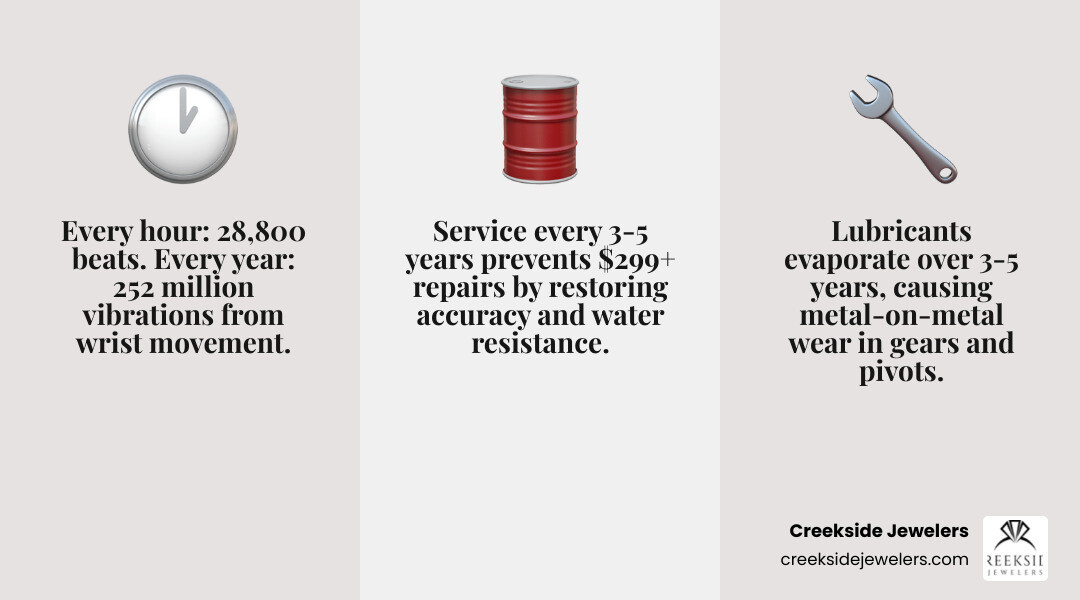
Every hour, its movement beats 28,800 times. Every year, that adds up to over 252 million vibrations. That's 252 million tiny movements grinding through microscopic gears, springs, and pivots — all lubricated by oils that slowly evaporate over time.
When those lubricants dry out, metal begins to wear against metal. The damage is invisible until it isn't — and by then, a simple service has turned into a costly repair.
If you own a watch that matters to you — whether it was a gift, an inheritance, or a piece you saved up for — this guide will show you exactly what a professional service involves, when you need one, and how to protect your investment for decades to come.
What is included in a professional automatic watch service?
Think of a professional automatic watch service as a complete "reset" for your timepiece. It isn't just a quick oiling or a exterior polish; it is a meticulous surgical procedure performed under high magnification. At Creekside Jewelers, we believe in transparency, so here is exactly what happens when your watch goes behind the scenes.

1. Full Disassembly and Inspection
The process begins with the watchmaker carefully removing the movement from the case. Every single component—often numbering over 100 tiny parts—is taken apart. We aren't just looking for broken pieces; we are looking for "scoring" on pivots and wear on the teeth of gears.
2. Ultrasonic Cleaning
Once disassembled, the parts are placed in specialized baskets and run through an ultrasonic cleaner. This multi-stage process uses specific chemical solutions to strip away old, gummy oils, microscopic metal shavings, and any dust that has found its way inside.
3. Precision Lubrication and Reassembly
This is where the artistry happens. Using several different types of synthetic lubricants, the watchmaker reassembles the movement. Not every part gets the same oil; some require high-viscosity grease for heavy-pressure areas, while the escapement requires a very thin, specialized oil. This Professional Watch Overhaul Process ensures that friction is minimized across all 252 million annual vibrations.
4. Timing Regulation
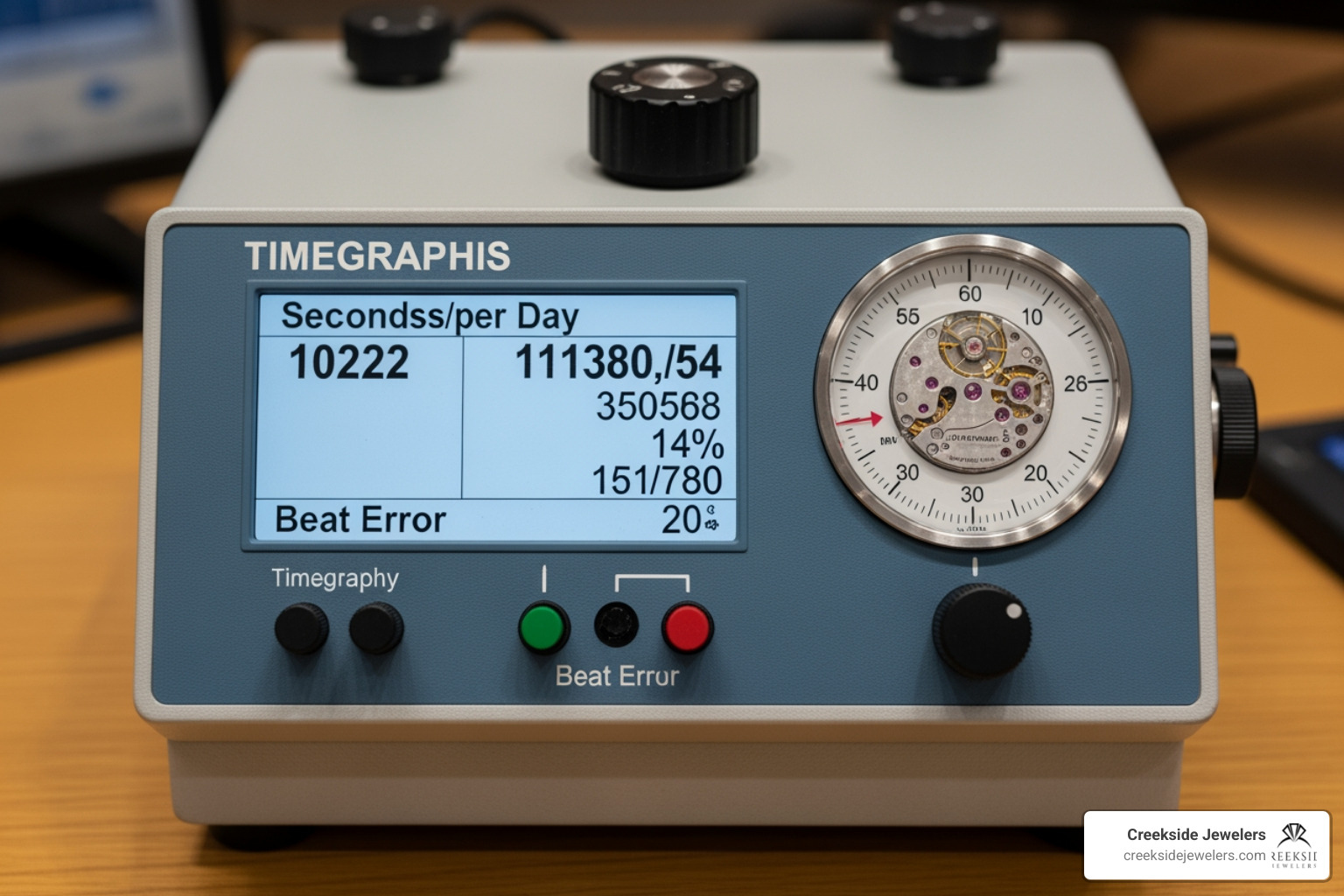
After reassembly, the watch is placed on a timing machine (a "timegrapher"). This device listens to the "heartbeat" of the watch and displays its accuracy in seconds per day. The watchmaker adjusts the hairspring or balance weights to ensure it keeps time within factory specifications.
5. Water Resistance and Quality Assurance
Finally, the case is fitted with new gaskets (seals) and subjected to a pressure test to ensure it is still water-resistant. We then place the watch on a 24-hour winding machine to simulate the movement of a human wrist, ensuring the automatic rotor is winding the mainspring efficiently before it ever leaves our shop.
How to identify if your timepiece requires an automatic watch service
Not sure if your watch is actually an automatic? Look for the sweeping second hand. Unlike quartz watches that "tick" once per second, an automatic second hand moves in a smooth, continuous glide. You can also check the case back; many modern watches have a "display back" (a window) where you can see a weighted rotor that spins as you move.
If you feel a gritty sensation when manual winding, or if the power reserve doesn't last through the night anymore, it's a clear sign you are due for Watch Maintenance Basics.
When to schedule maintenance: The 5-year rule
In horology, we often debate the "perfect" interval. While some modern brands claim their watches can go a decade without a check-up, the reality of physics remains: synthetic oils eventually evaporate.
Manufacturer Recommendations vs. Reality
Most luxury manufacturers provide specific windows for a complete overhaul. Here is how they generally stack up:
| Brand | Recommended Service Interval |
|---|---|
| Rolex | Every 10 years (though 7 is safer) |
| Breitling | Every 5 years |
| Omega | 5 to 8 years |
| Cartier / JLC | Up to 8 years |
| Industry Standard | 3 to 5 years |
The Cost of Procrastination
Waiting until the watch stops completely is a "reactive" approach that often leads to higher costs. When oils dry up, the pivots (the ends of the gear axles) begin to grind into the brass plates of the movement. What could have been a $300 service can quickly turn into a $1,000 repair if multiple parts need to be replaced.
Over a lifetime (from age 25 to 80), servicing a watch every 7 years might cost around $5,014. If you neglect it and only fix it when it breaks, the cumulative damage can actually make the lifetime cost much higher due to the price of rare replacement parts.
Signs your timepiece needs immediate attention
Sometimes you can't wait for the five-year mark. If you notice any of the following, bring it in immediately:
- Timing Drift: If your watch suddenly gains or loses more than 15-20 seconds a day.
- Moisture: A "fogged" crystal is a watch emergency. This means a seal has failed, and moisture is currently rusting your steel components.
- Rattling: This often indicates a loose rotor or a screw that has backed out of the movement.
- Magnetism: If your watch is suddenly gaining minutes per hour, it has likely been magnetized.
Maintenance and care: Extending the life of your movement
While a professional automatic watch service is inevitable, how you treat your watch daily determines how much "extra" work we have to do when it lands on our bench.
The Power of Regular Wear
Automatic watches love to move. Regular wear keeps the lubricants distributed throughout the movement. If you have a large collection, consider a high-quality watch winder to keep the "heart" beating, but ensure it is set to the correct turns-per-day (TPD) for your specific caliber.
Environmental Hazards
Extreme temperatures are the enemy of accuracy. Leaving your watch on a hot car dashboard in the Colorado sun can cause lubricants to thin and migrate away from where they are needed. Similarly, always ensure your crown is screwed down tight before getting anywhere near water. Even a "water-resistant" watch can be ruined if the crown is left open or if you operate the chronograph pushers while submerged.
The Magnetism Myth
Magnetism is a silent killer of accuracy. We are surrounded by magnetic fields—iPad covers, magnetic purse clasps, and even speakers. If your hairspring becomes magnetized, the coils stick together, making the watch run incredibly fast. Fortunately, this is a quick fix for a professional, but it is a common reason for a "false alarm" service need. You can find more Scientific research on magnetism and mechanical watches to understand how these invisible fields affect your gear train.
Common mistakes that necessitate an automatic watch service
- Winding while wearing: Never wind your watch while it's on your wrist. The angle puts lateral pressure on the winding stem, which can bend or snap it.
- The "Death Zone" Date Change: Never change the date manually between 9:00 PM and 3:00 AM. During these hours, the watch's internal gears are already engaged to flip the date. Forcing it manually can snap the delicate teeth of the date wheel.
- Skipping Pressure Tests: 58% of enthusiasts only check water resistance every 3+ years. In reality, gaskets should be pressure-tested every year if you plan on swimming with the watch.
Frequently Asked Questions
How much does it cost to service an automatic watch?
A standard automatic watch service generally starts at $299. However, this varies significantly based on the brand. A simple Seiko or ETA-based movement is much more affordable to service than a complex Patek Philippe or a vintage chronograph.
The $100 Question: Should you service a $100 automatic watch? Economically, the service costs more than the watch. However, if that watch was a gift from a grandfather or worn on your wedding day, the "sentimental value" often outweighs the market price. If it has no sentimental value, replacing the movement entirely is often cheaper than a full overhaul.
How long does a typical service take?
Patience is a virtue in watchmaking. A typical timeline looks like this:
- Diagnostic & Quote: 48–72 hours
- Parts Sourcing: 3–4 weeks (especially for vintage or high-end Swiss brands)
- Actual Repair: 1 week
- Quality Assurance & Testing: 72 hours Expect a total turnaround of 5 to 10 weeks for prestigious brands, though simpler jobs may be faster.
Can I service my own automatic watch?
We strongly advise against DIY servicing. Modern movements require microscopic precision—sometimes a fraction of a drop of oil is all that's needed. Too much oil is just as bad as too little. Furthermore, opening a watch in a non-clean-room environment introduces dust and skin cells that act like sandpaper inside the movement. If you have a shattered crystal, microscopic glass particles can migrate into the gears, requiring a level of cleaning that only professional ultrasonic equipment can provide.
Conclusion
Your automatic watch is more than just a tool for telling time; it is a mechanical legacy that can last for generations if given the proper "spa day" every five years. By staying proactive with your automatic watch service, you aren't just fixing a machine—you are preserving a piece of history.
At Creekside Jewelers, we have been a part of Colorado’s history since 1902. As the oldest continuously run watch and jewelry store in the state, our family-owned shop in Golden, CO, specializes in keeping these mechanical marvels ticking perfectly. Whether you need a simple pressure test or a full vintage restoration, our on-site master watchmakers treat every timepiece with the respect it deserves.
Ready to give your watch the care it needs? Visit us for Expert Watch Repair and Appraisal and let us help you keep time for the next hundred years.